
Half the catalog was suppressed, and nobody knew which half
Listable catalog 46% → 91%
A hunting gear brand had listings silently suppressed under category restrictions it had never been told about. Working the approval and compliance process methodically brought most of the catalog back into search.

At a glance
- Category
- Hunting & Shooting
- Marketplaces
- US
- Revenue at start
- $118k / month
- Problem
- 54% of ASINs suppressed or search-ineligible
- Engagement
- Full account management + listing SEO
- Timeframe
- 9 months
Results
The challenge
More than half of the brand's listings existed but could not be found. Hunting and shooting is one of the most heavily restricted areas on the marketplace, and a listing can be pulled from search for reasons that never generate an obvious alert: a restricted term in a bullet, an accessory classified as a regulated part, a compliance document that expired, an image showing a product in a context policy does not allow.
The brand's evidence of the problem was a revenue line that had been flat for two years while its wholesale business grew. Internally the situation was described as “Amazon doesn't work for our category” — a conclusion that had stopped anyone from opening the three hundred individual listing-quality notices sitting in the account.
Our approach
We treated it as a queue of solvable cases rather than a category verdict.
- Full suppression audit — every ASIN checked against its actual status and the specific reason behind it, which differed far more than anyone expected.
- Approval applications filed properly, with the documentation each product family genuinely requires rather than a generic appeal.
- Copy and imagery rewritten to be compliant by construction — restricted vocabulary removed from titles, bullets and backend terms across the catalog.
- A standing compliance check before any new listing goes live, so the backlog cannot rebuild itself — and the genuinely prohibited items, which no approval covers, were delisted rather than appealed.
How we worked
- 1
Inventory the damage
All 302 ASINs checked individually; 163 found suppressed, search-ineligible or stranded, each for one of nine distinct reasons.
- 2
Group by cause
Cases batched by reason so one documented argument could resolve dozens of listings rather than one.
- 3
File and follow through
Approvals and appeals submitted with the required documentation and tracked to closure instead of abandoned after a first rejection.
- 4
Rewrite for compliance
Restricted terminology removed from every listing in the catalog, including the ones still live, to stop the next wave.
- 5
Prevent recurrence
A pre-publication compliance review added to the listing process, with a quarterly re-audit.
Inside the ad account
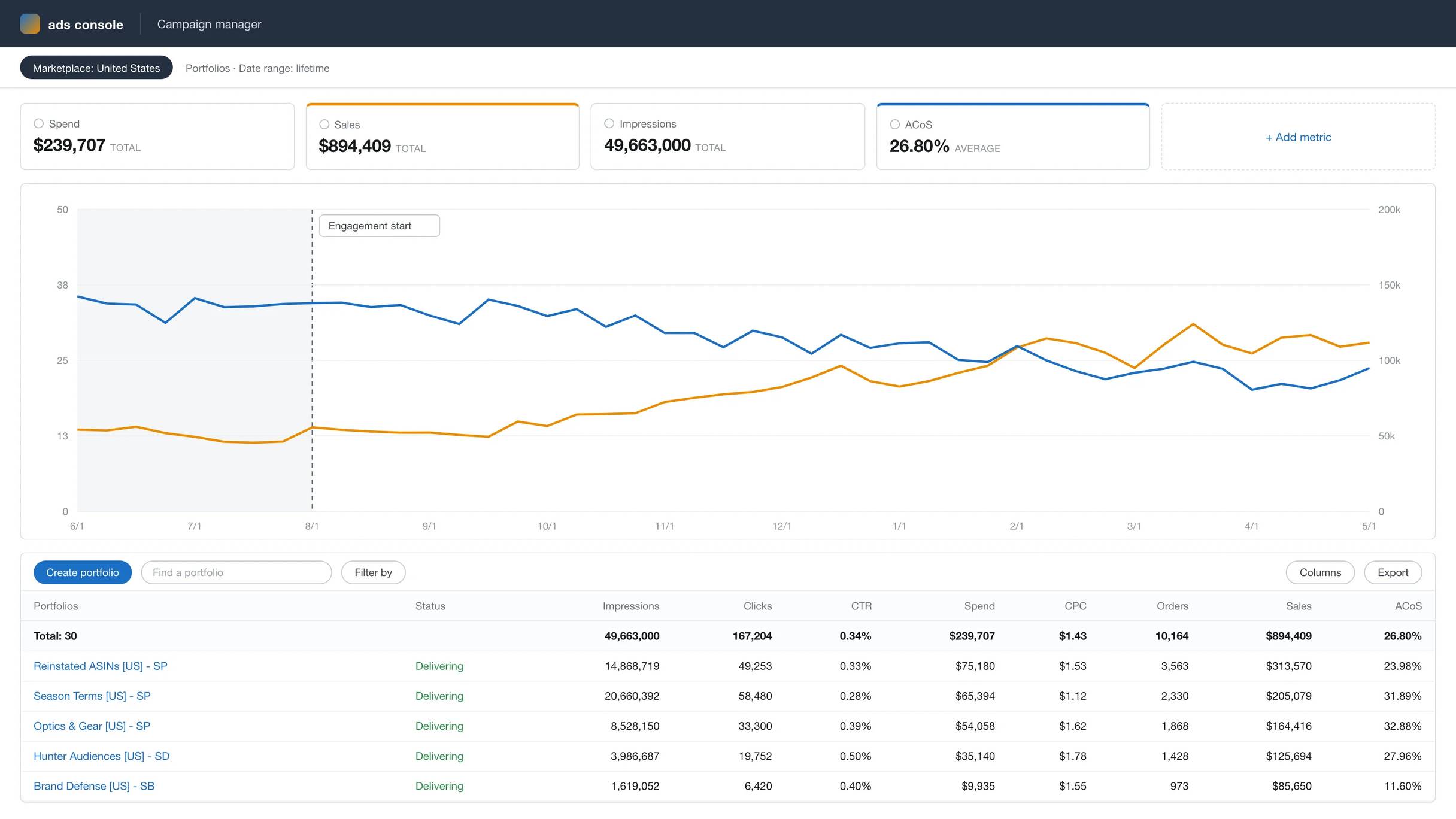
Anonymized account view, rebuilt from the figures reported above: ad sales growing from $53k to $113k a month while ACoS falls from 35% to 22% across the 9-month engagement.
The results
The searchable catalog went from 46% to 91%, and revenue more than doubled to $250k a month.
No new products were developed and no additional advertising budget was approved — the growth came entirely from products the brand already owned becoming findable again. The lasting change is procedural: suppressions now get resolved in about eleven days instead of accumulating into a belief that the category is hopeless.
“We'd decided the marketplace hated our category. It turned out we had three hundred unread notices.”
Services we delivered
Related case studies




Ready to scale your Amazon brand?
Talk to a senior strategist and leave with a growth plan for your store — no obligation.