
Owning a niche the category leaders ignore
#1 in a 310k-search segment
A deodorant brand was fighting for scraps of the main category. It had a formula genuinely suited to sensitive and reactive skin — a segment with real volume and no serious competitor.

At a glance
- Category
- Personal Care
- Marketplaces
- US
- Revenue at start
- $39k / month
- Context
- Category dominated by three multinationals
- Engagement
- Listing SEO + PPC
- Timeframe
- 6 months
Results
The challenge
The main deodorant category is owned by three companies with advertising budgets larger than this brand's annual revenue. Competing there meant a 42% ACoS for a position on page three — the brand was buying the privilege of being nearly invisible.
What it had not noticed was that its formula — no aluminum, no baking soda, no fragrance — is precisely what a specific, vocal and underserved group searches for. That segment carries around three hundred and ten thousand monthly searches and, at the time, no brand that had built its listings around it.
Our approach
We stopped competing in the category and started owning a segment of it.
- Segment head term identified and targeted — the sensitive-and-reactive cluster, with its own vocabulary of irritation, baking-soda-free and fragrance-free terms.
- Listing rebuilt as a segment product, leading with what is absent from the formula, which is what this shopper screens for.
- Budget withdrawn from the main category entirely for four months, concentrating everything on the narrower fight.
- Reviews mined for segment language and fed back into copy, since this audience describes its problem in consistent, specific words.
Inside the ad account
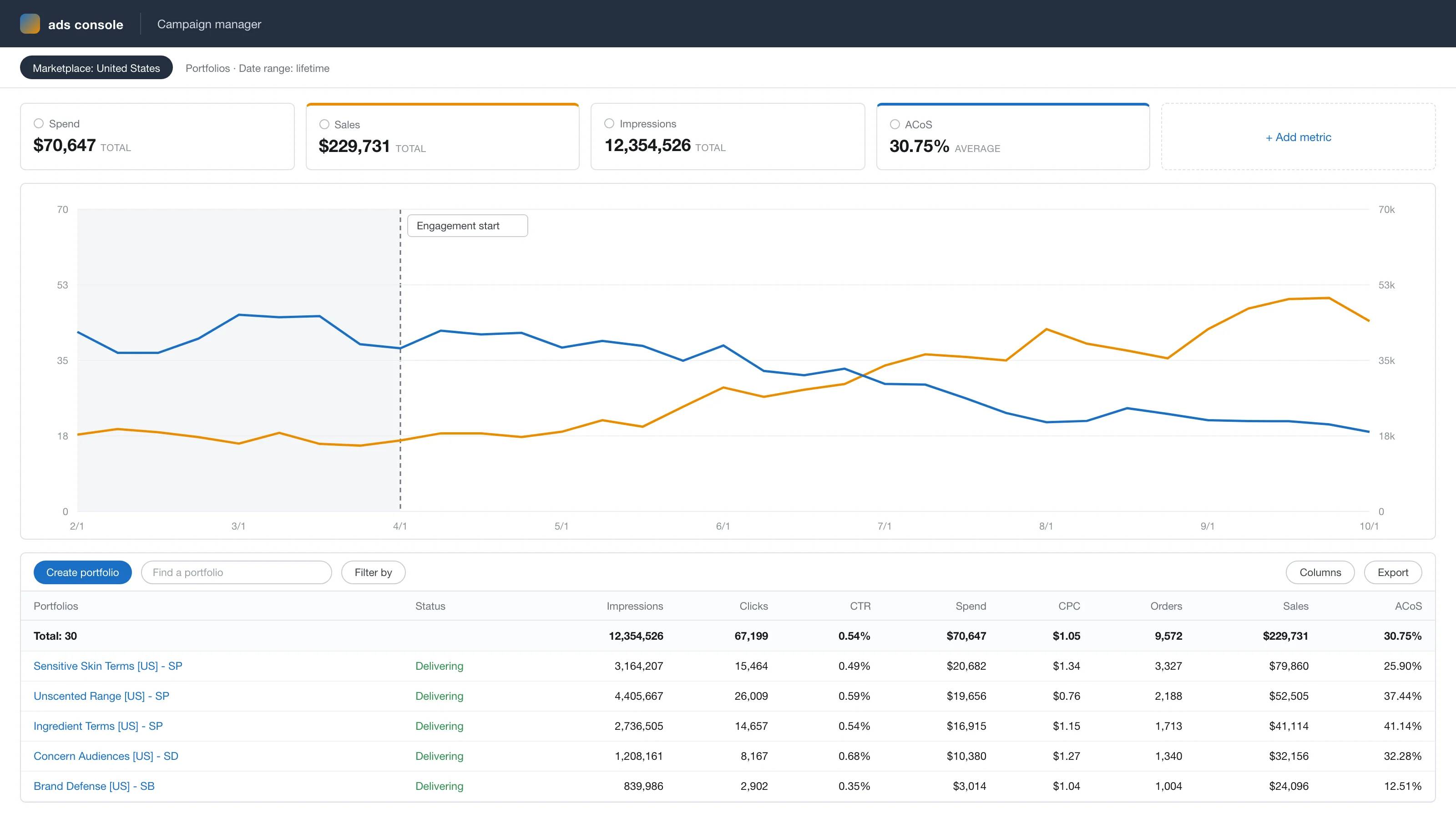
Anonymized account view, rebuilt from the figures reported above: ad sales growing from $18k to $44k a month while ACoS falls from 42% to 19% across the 6-month engagement.
The results
The brand reached #1 on the segment's head term and took 27% of that segment, up from 4%.
Revenue grew 149% on a smaller advertising budget, and ACoS fell from 42% to 19% — the arithmetic of fighting where you can win. The brand still sells to the wider category; it simply no longer pays to be page three in it.
“Being nobody's first choice in a huge category was worse than being the obvious choice in a small one.”
Services we delivered
Related case studies




Ready to scale your Amazon brand?
Talk to a senior strategist and leave with a growth plan for your store — no obligation.