
A pack-size ladder that turned a $9 impulse buy into a $26 habit
Revenue per customer +134%
A beauty tools brand sold consumable accessories one at a time at a price too low to advertise profitably. Restructuring the pack sizes fixed the unit economics before any campaign was touched.

At a glance
- Category
- Beauty Tools & Accessories
- Marketplaces
- US
- Revenue at start
- $58k / month
- Problem
- $9 unit price against a $0.98 cost per click
- Engagement
- Full account management + PPC
- Timeframe
- 7 months
Results
The challenge
The product is a consumable accessory people replace every few weeks, sold as a single unit at $9. A click costs about a dollar and conversion sits near 18%, so every order bought through advertising carried roughly $5.40 of ad cost against $11.40 of revenue — forty-eight cents of every dollar the product earned went straight back into the clicks that produced it, before a single other cost.
Every proposed fix aimed at the campaigns — better targeting, tighter negatives, dayparting. None of them could solve an arithmetic problem that starts on the price tag.
Our approach
We changed what is being sold before touching how it is advertised.
- A three-step pack ladder — single, four-pack and twelve-pack, priced so the per-unit saving grows visibly with each step.
- The four-pack as the advertised hero, which is the smallest size at which a paid click pays for itself.
- Replenishment framing — the pack sizes described in weeks of use, matching how the product is actually consumed.
- Campaigns rebuilt around the hero pack, with the single unit left to organic traffic as an entry price.
Inside the ad account
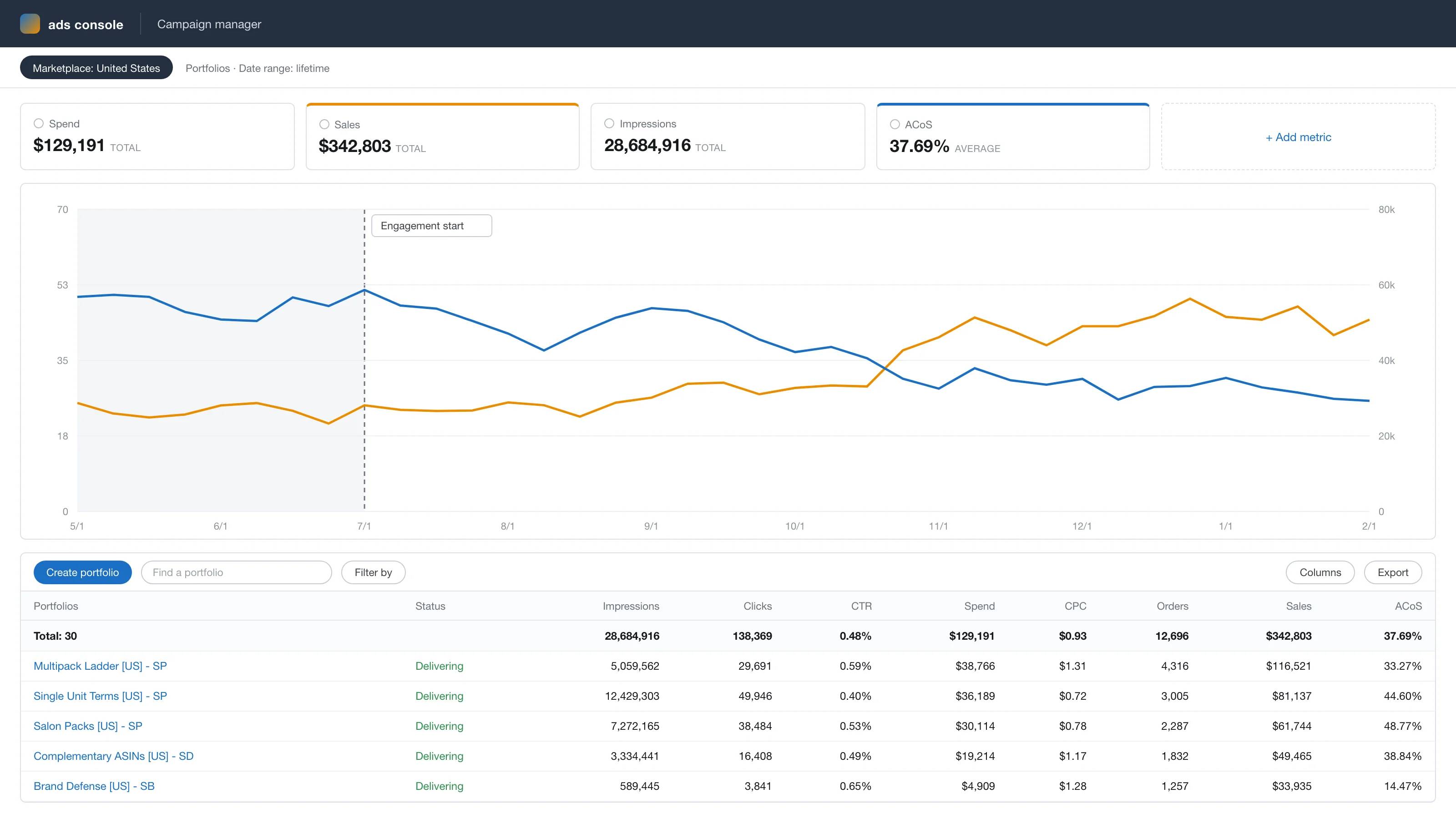
Anonymized account view, rebuilt from the figures reported above: ad sales growing from $26k to $51k a month while ACoS falls from 48% to 26% across the 7-month engagement.
The results
Revenue per customer rose from $11.40 to $26.70 and total revenue nearly doubled.
ACoS fell twenty-two points — not through better bidding, but because the average order that a click now produces is more than twice as large. Fifty-eight percent of orders are multipacks, which also lengthens the gap before the customer needs to reconsider the brand at all.
“We'd been optimizing campaigns for a year to fix something that was wrong with the price tag.”
Services we delivered
Related case studies

Ready to scale your Amazon brand?
Talk to a senior strategist and leave with a growth plan for your store — no obligation.