
Organizing a baby catalog the way parents count months
+68% sessions
A baby brand sold nineteen products to “parents”. Parents do not shop that way — they shop for a twelve-week-old or a crawling nine-month-old, and the catalog said nothing about either.

At a glance
- Category
- Baby Products
- Marketplaces
- US, CA
- Revenue at start
- $264k / month
- Catalog
- 19 ASINs, no stage structure
- Engagement
- Listing SEO + PPC
- Timeframe
- 10 months
Results
The challenge
A new parent does not search for a product category. They search for a moment: “newborn 0-3 months”, “6 month sitting up”, “12 lb baby”, “once they start rolling”. The vocabulary is age, weight and milestone, and it changes roughly every eight weeks for the first two years.
The brand's nineteen listings were written around materials and features, with age mentioned — if at all — in a compatibility line near the bottom of the bullets. It ranked for generic category terms against far bigger brands, and it was invisible for the stage searches that carry actual intent. Worse, the catalog gave a returning customer no reason to come back: a parent who bought the newborn item had no idea the brand made the version for the next stage.
Our approach
We reorganized the catalog around the timeline a parent is living in.
- Stage map first — every product assigned the age and weight window it genuinely serves, checked against the reviews of parents who described their child's age.
- Stage language in the title and first bullet, including weight ranges, since a parent who knows their baby's weight uses it as the filter.
- Campaign structure by stage, so bids follow the intent and the newborn cluster is not diluted by toddler traffic.
- Next-stage cross-references in A+ — each listing points to what the same brand makes for the following three months.
Timeline
Map
- Every ASIN audited against real usage windows
- Review text mined for the ages parents actually quote
- Stage keyword set built per window
Rewrite
- Titles and bullets rebuilt around stage and weight
- Campaigns split by stage cluster
- Stage terms indexed and tracked weekly
Connect
- Next-stage modules added to A+ across the catalog
- Repeat purchase measured per stage transition
- Budget reweighted toward the newborn entry window
Inside the ad account
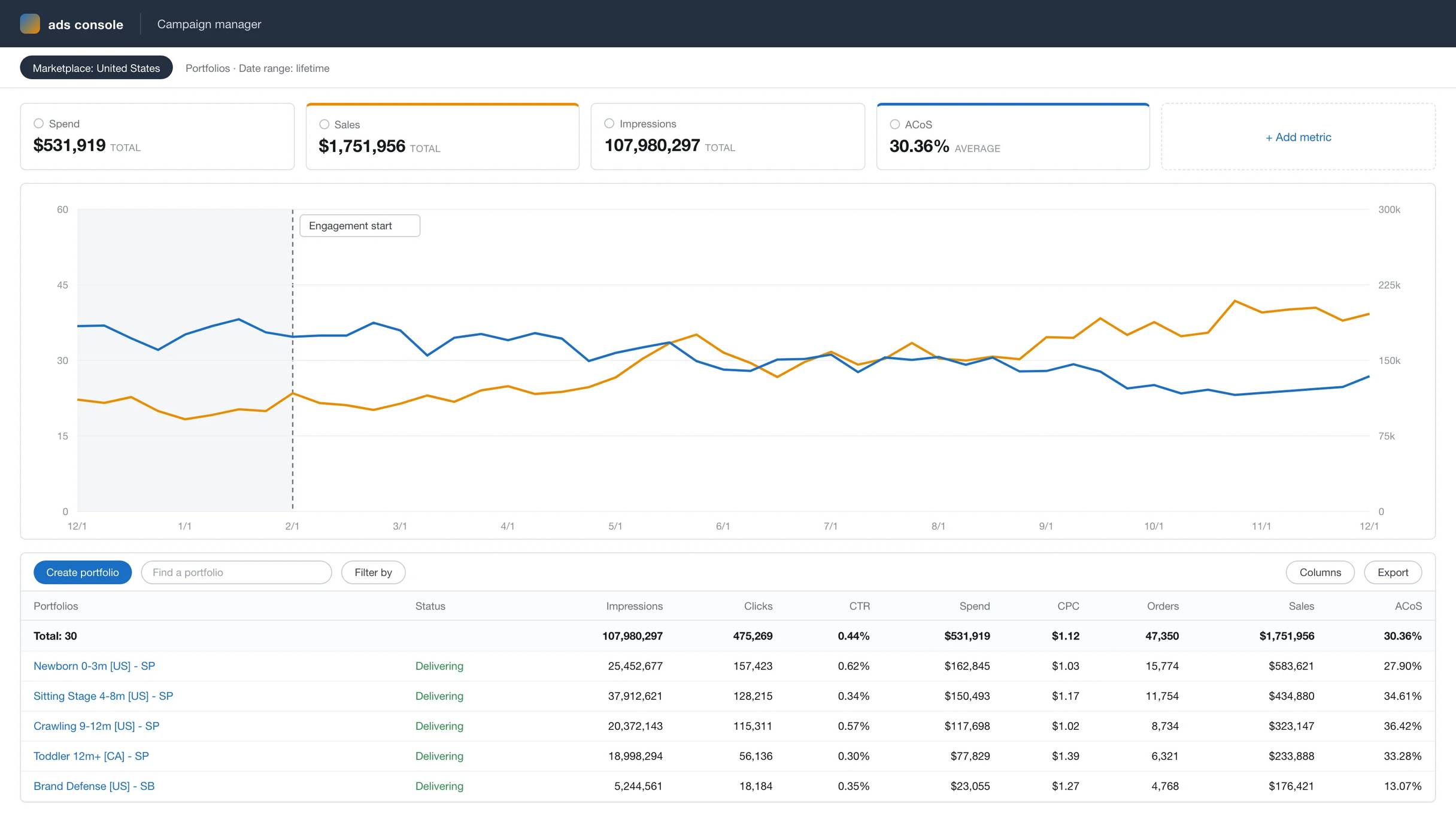
Anonymized account view, rebuilt from the figures reported above: ad sales roughly doubling across the ten-month catalog rebuild.
The results
Sessions grew from 88k to 148k a month and revenue doubled, with the same nineteen products and no new SKUs.
The mechanism is simply that the listings now contain the words parents use. Nine hundred stage-modified keywords now rank where seventy-four did, and because each of those searches carries a specific need, conversion rose 19% on top of the extra traffic. The next-stage modules changed the shape of the business as well: a first purchase now routinely leads to a second one four months later, which no listing had previously made possible.
“Our packaging had said “0-3 months” for years. It took us far too long to notice that our Amazon titles didn't.”
Services we delivered
Related case studies




Ready to scale your Amazon brand?
Talk to a senior strategist and leave with a growth plan for your store — no obligation.