
Getting onto the registry, six weeks before the baby arrives
Registry-intent clicks 1.1k → 14.7k / mo
A baby brand competed for the moment a parent needs a product. The bigger opportunity sits months earlier, when an expectant parent builds a list and someone else pays for it.
At a glance
- Category
- Baby Products
- Marketplaces
- US
- Revenue at start
- $187k / month
- Registry-intent clicks at start
- 1.1k / month, unmanaged
- Engagement
- Full account management + creative
- Timeframe
- 11 months
Results
The challenge
Every other brand in the category was bidding on the same purchase moment: the week a parent realizes they need a bottle steriliser. That auction is crowded and expensive, and it arrives late — by then the parent has usually already been given most of their gear.
The decision that mattered happened earlier. An expectant parent assembles a registry somewhere around the second trimester, adds thirty to sixty items in a handful of sessions, and those items get bought by other people over the following months. The brand had no presence in that process at all: it was not appearing in registry-oriented searches, its listings answered none of the questions someone building a list asks, and nothing in its merchandising acknowledged that the decision and the purchase would be three months apart.
Our approach
We treated the registry as a distinct channel with its own shopper.
- Registry-intent keyword work — the checklist and “must have” vocabulary of the planning phase, which is a different search set from the purchase phase.
- Listings that answer a planner's questions — what it replaces, what it works with, at what age it gets used, so an item can be justified to whoever will pay for it.
- Catalog spread across the checklist — an item in every slot a registry checklist prompts for, because a planner fills categories rather than compares brands.
- Imagery that survives a list view — a registry is browsed as a grid of thumbnails at speed, so the first frame has to identify what the product is for without being opened.
How we worked
- 1
Understand the timing
Order data mapped backwards: registry adds cluster around weeks 20-28, purchases arrive weeks 30-42 and in the two weeks after birth.
- 2
Rebuild for the planner
Listings rewritten to answer “do I need this and which one” rather than “buy this now”, with usage windows and compatibility made explicit.
- 3
Ladder the price points
The catalog spread deliberately across gift-sized tiers so the brand appears at every budget on a shared list.
- 4
Earn the add
Advertising pointed at the planning-phase terms, where cost per click was roughly half that of the purchase-phase head terms.
- 5
Follow the list
Inventory planned against the lag between an add and its purchase, so the brand is in stock when someone else finally pays.
Inside the ad account
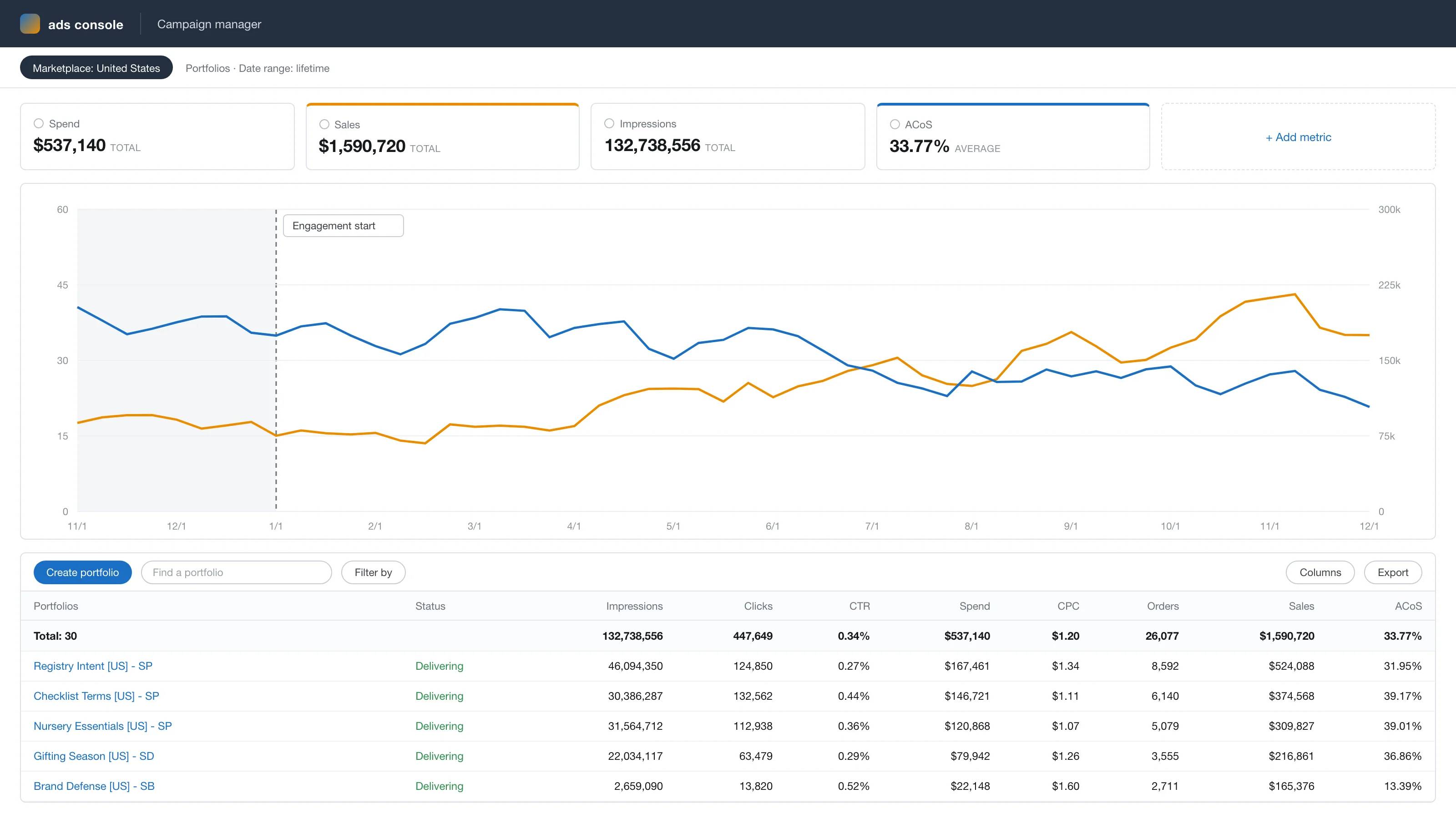
Anonymized account view, rebuilt from the figures reported above: ad sales more than doubling as registry-phase demand came online.
The results
Monthly clicks from registry-intent search terms went from 1.1k to 14.7k, and revenue more than doubled to $402k a month.
The less obvious win is the shape of the year. The brand had been heavily dependent on Q4, which fell from 38% of annual revenue to 27% — not because Q4 shrank, but because registry demand arrives continuously: babies are born every month, and the list that gets built in March is bought in June. Acquisition also got cheaper, since the planning-phase keywords are contested by a fraction of the brands fighting over the purchase moment.
“The registry was written three months before anyone bought anything. Our brand only ever showed up at the checkout.”
Services we delivered
Related case studies


Ready to scale your Amazon brand?
Talk to a senior strategist and leave with a growth plan for your store — no obligation.