
Amazon SEO: How Ranking Works and How to Actually Move Up
Indexation, relevance and performance are three separate gates — and most listing work fails at the wrong one. A practitioner's model of how Amazon ranking really behaves.


Amazon SEO is the work of getting a product indexed for the queries buyers actually type, then giving Amazon enough evidence that your listing is the one worth showing for them. It is not a content game the way Google SEO is — the marketplace ranks on purchase probability, so the same text that wins a keyword can lose it three weeks later if the listing stops converting. This guide separates what Amazon documents from what practitioners infer, and puts the levers in the order they actually pay.
What Amazon documents, and what everyone else infers
Start here, because most Amazon SEO advice presents inference as fact. Amazon publishes very little about how its search ranks products, and the gap gets filled with confident-sounding algorithm names.
What Amazon itself says, in its seller-facing guidance: it recommends keyword research, product titles that lead with product type and brand (most categories cap at 200 characters and Amazon suggests staying far shorter), informative descriptions, bullet points for key details, back-end search terms for keywords that did not fit elsewhere, high-quality images on white backgrounds, and competitive pricing. It also notes that listing quality and account health can contribute to search rankings, and that sales performance drives the Best Sellers list. That is roughly the whole official surface.
What is not documented: any weighting, any threshold, any confirmation that "A9" or "A10" is the current ranking system, or a published number for how much advertising lifts organic position. Amazon Science has published on COSMO, a commonsense knowledge graph presented at SIGMOD in 2024 and described as deployed in Amazon search applications — but the paper describes an added layer of intent understanding, not a replacement for conversion-based ranking. The "A9 is dead, COSMO replaced it" framing comes from agency blogs, not from Amazon.
| Claim | Status |
|---|---|
| Titles, bullets, backend search terms and images matter | Documented by Amazon |
| Price competitiveness affects sales and therefore visibility | Documented by Amazon |
| Backend Search Terms field is around 250 bytes and can be ignored entirely if exceeded | Stated in Amazon help/forum guidance; the public help page is vague on the exact number |
| Sales velocity and conversion rate drive rank | Practitioner consensus, consistent with Amazon's own framing but never quantified |
| Ad spend has an indirect halo on organic rank | Practitioner consensus; Amazon publishes no formula |
| Paying Amazon for ads directly buys organic position | Myth |
| A specific "A10 algorithm" with known weights | Myth — no Amazon source |
Treat the second group as a working model that survives contact with reality, and the third as noise. Anyone selling you a weighted ranking-factor pie chart is selling you a guess.
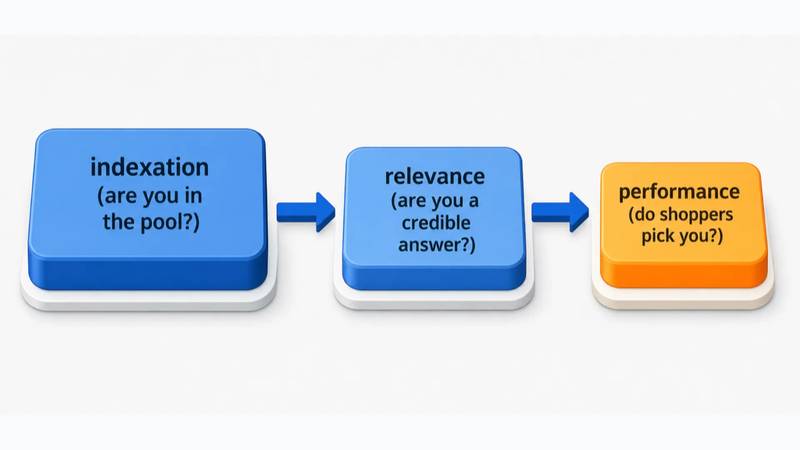
The three gates: indexation, relevance, performance
A keyword's position is decided in three stages, and they fail in order. Diagnosing rank without knowing which gate you are stuck at is the single most common waste of effort.
Gate 1 — indexation: can you appear at all?
If Amazon has not associated your ASIN with a phrase, no amount of conversion will rank you for it. Indexation is binary and it is cheap to check: search the exact phrase plus your ASIN in the Amazon search bar. If the product returns, you are indexed; if not, the phrase lives nowhere in your title, bullets, description, backend Search Terms or structured attributes.
Two things sellers get wrong here. First, Amazon indexes words, not strings — it splits on spaces and recombines, so you rarely need the full phrase written out verbatim. Second, the Search Terms field is bounded by bytes, and Amazon's guidance warns that exceeding the limit can cause the field to be ignored rather than truncated. A single byte over and you can silently lose every backend term at once. Fill it with words that appear nowhere else in the listing, in lowercase, separated by spaces, with no commas.
Gate 2 — relevance: are you a credible answer?
Being indexed gets you into the candidate pool. Relevance decides whether Amazon considers you a plausible answer for that query at all, and it is driven by more than text: structured attributes, category and browse node, variation family, and how the listing's language matches the query's intent. A supplement listed under the wrong browse node can be indexed for a term and still never surface for it.
This is also where COSMO-style intent modelling shows up in practice. Queries like "gift for someone who camps" or "shampoo that will not strip color" are not keyword matches — they are contexts. Listings that spell out use case, audience and situation in plain sentences tend to be reachable by those queries; listings written as keyword strings do not.
Gate 3 — performance: do shoppers pick you?
Once you are a credible candidate, position is decided by behavior. The consensus model — consistent with everything Amazon says publicly, though never quantified by Amazon — is that the marketplace ranks by expected revenue per impression: click-through rate on the search result, conversion rate on the detail page, and the recency-weighted volume of sales that came through that specific query.
The practical consequence is that ranking is not a state you reach, it is a rate you sustain. Go out of stock, raise price past the point where the offer stops making sense, lose the Featured Offer, or take a wave of one-star reviews, and the position decays on its own.
Sales velocity and conversion rate: the inputs you cannot see directly
Neither "sales velocity" nor "conversion rate for keyword X" appears as a ranking column anywhere in Seller Central. You infer both.
The closest first-party instrument is the Search Query Performance report in Brand Analytics (Brands → Brand Analytics, Brand Registry required), introduced in late 2022. It gives you, per query, the full funnel — impressions, clicks, cart adds and purchases — as a total for the whole marketplace and as your brand's share of each. That share structure is what makes it useful for SEO rather than just reporting:
| Pattern in Search Query Performance | What it usually means | Where to fix it |
|---|---|---|
| No impression share on a relevant query | Indexation or relevance problem | Listing text, attributes, browse node |
| Impression share healthy, click share far lower | The search result is not competitive | Main image, title, price, rating, review count |
| Click share healthy, purchase share far lower | The detail page loses the sale | A+ content, secondary images, price, offer, reviews |
| All three shares rising together | The keyword is compounding | Protect stock and price; do not touch it |
Two caveats worth knowing before you build decisions on it. The report combines organic and sponsored activity without separating them, so a strong impression share can be paid. And purchase attribution runs in a 24-hour window, which suppresses raw counts for considered purchases — read the percentages, not the absolute numbers.
Conversion rate is the highest-leverage of the three inputs, because it is the only one that improves every keyword at once. A title rewrite affects the queries it touches; a main image that lifts click-through lifts every query the listing appears on. If you want a structured pass over the whole page, the Amazon listing optimization checklist covers the fields in order.
How ads feed organic rank — and how they don't
The honest version: Amazon has never published a mechanism by which advertising raises organic position, and there is no console column for it. What is well supported is the indirect path.
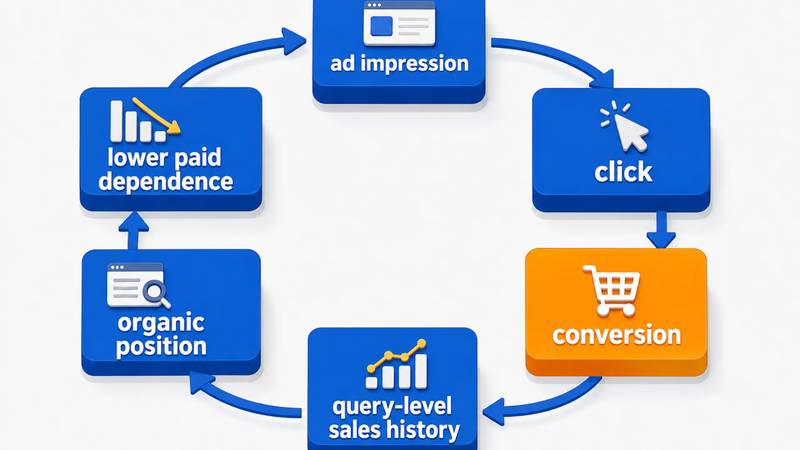
An ad puts your product in front of a query. Some of those clicks convert. Those sales are real sales attached to that query, and they enter the same behavioral history that ranks you organically. Nothing about the payment is a signal — the outcome is. Which is why the sequence matters more than the budget:
- Ads on a listing that does not convert make things worse, not better. You are buying traffic that generates non-purchase events on the exact query you are trying to win. Fix the page first, then buy the traffic.
- Ad spend is a way to buy data, not just sales. Search term reports tell you which phrases convert before you commit them to a title. That is the cheapest keyword validation available.
- Organic rank earned through ads is not permanent. It holds only as long as the underlying conversion rate holds. Brands that pull spend abruptly and watch rank slide usually had rank that was still being subsidized.
Published third-party estimates of the size of this halo range so widely — one agency figure spans a 5% to 60% lift depending on catalog, spend and ad types — that it is not usable as a planning number. Plan the mechanism, measure your own result. The metric that actually captures the paid/organic relationship over time is TACoS, which we cover in TACoS on Amazon: if TACoS falls while revenue grows, organic is picking up work the ads used to do.
What actually moves a keyword, in the order to work
Most listings are worked in the wrong sequence: keywords first, images last. Reverse it. Here is the order that respects the three gates.
- Fix conversion before visibility. Main image, price position against the visible competitive set, rating and review count, and the top of the detail page. Nothing below this line pays back until the page converts at category norm.
- Get the keyword set right. Not a 3,000-row export — the 20 to 50 queries that describe what the product is and who it is for, prioritized by relevance and revenue potential, not volume. Our keyword research workflow walks through sourcing and prioritizing them.
- Place them by field, once. Highest-value phrase in the title, secondary intent in bullets, use-case and long-tail language in A+ and description, everything left over in backend Search Terms. Verify indexation for every priority phrase afterwards; do not assume it.
- Send qualified traffic. Exact-match campaigns on the priority terms, at bids you would pay if organic never improved. Anything else is a hope, not a plan.
- Protect the offer. Stock cover, Featured Offer ownership, price stability. This is where most ranking gains are actually lost — not to competitors' SEO, but to a two-week stockout.
- Test one variable at a time. For brands with enough traffic, Manage Your Experiments splits traffic 50/50 and declares a winner at 95% significance on titles, main images, bullets, descriptions and A+ content. It requires a Professional account and Brand Registry, and it only qualifies ASINs with enough weekly orders to reach significance. Amazon has described the potential upside as up to a 25% sales increase — that is the ceiling from observed experiments, not an expected value.
Working in this order is what produced the result in our pet supplements listing SEO case: organic sales up 187%, driven by conversion and structured listing work rather than by adding keywords to a page that was not converting.
Where AI-assisted shopping changes the picture
A growing share of discovery no longer ends at a ranked list. Amazon's AI shopping assistant — launched as Rufus and folded into Alexa for Shopping in May 2026 — answers questions in natural language, using listing content, Q&A and reviews as source material. Amazon has said Rufus reached over 300 million shoppers before the transition.
For SEO purposes, this does not replace the three gates; it adds a fourth surface fed by the same content. The listings that get quoted are the ones that answer questions explicitly — dimensions, materials, compatibility, who it is and is not for — in plain sentences rather than keyword stacks. That is also, usefully, what converts human readers. What Amazon Rufus is and how it sources answers covers the mechanics in detail.
Common ways Amazon SEO goes wrong
- Optimizing for volume instead of relevance. A head term you convert at 2% is worth less than a mid-tail term you convert at 20%, and chasing it teaches the algorithm you are a weak answer.
- Rewriting the listing every three weeks. Ranking responds to sustained behavior over weeks. Constant edits mean you never have a clean read on what worked.
- Treating backend Search Terms as a dumping ground. Repeating title words wastes the byte budget; overflowing it can void the field entirely.
- Ignoring the offer layer. Suppressed buy box, thin stock and price drift undo listing work silently, and none of it shows up in a keyword tool.
- Reading rank instead of share. Daily rank trackers are noisy and personalized. Weekly click and purchase share in Search Query Performance is the more stable signal.
FAQ
How long does it take to rank on Amazon?
Expect four to eight weeks before a listing change shows a stable read, and a full quarter for a competitive keyword to settle. Ranking is driven by accumulated purchase behavior, so it moves at the pace of your sales volume — high-velocity products respond in days, slow movers in months.
Do Amazon ads improve organic ranking?
Indirectly, yes. Amazon publishes no mechanism by which spending money raises organic position, but ad-driven sales enter the same query-level purchase history that ranking uses. The lift comes from conversions, not from spend, so ads on a poorly converting listing can make organic performance worse rather than better.
Why did my Amazon keyword ranking drop overnight?
Check the offer layer before the listing. The usual causes are a stockout, losing the Featured Offer, a price increase that broke your position against the visible competitive set, a wave of negative reviews, or a suppressed listing. Genuine relevance loss is slower and rarely happens in a single day.
Is it bad to repeat keywords in the title and backend search terms?
It wastes space rather than causing harm. Amazon indexes a word once regardless of how many fields contain it, so repeating title words in the roughly 250-byte Search Terms field spends budget you could give to synonyms, misspellings and use-case phrases that appear nowhere else in the listing.
How many keywords should one Amazon listing target?
Twenty to fifty genuinely relevant queries per ASIN is a realistic working set. Beyond that you dilute the fields that matter and start targeting terms you cannot convert. Rank is won by being the best answer to a defined set of queries, not by appearing weakly across thousands of them.
Does the product description affect Amazon SEO?
It contributes, but less than the title and bullets. The description is indexed and it is a useful place for long-tail and use-case language, especially for AI-assisted shopping surfaces. Where A+ content replaces the description visually, keep the description populated anyway — the text still carries relevance weight.
Where to start
Pick your five highest-revenue ASINs and run one pass, in this order: verify indexation for each priority keyword by searching the phrase plus the ASIN, pull Search Query Performance for the last full month and find where the funnel breaks (impression, click or purchase share), then fix that one thing and leave the listing alone for four weeks. If you would rather have the gaps mapped for you before you commit the time, an Amazon growth plan covers the same ground across the catalog, and listing SEO is where we do this work end to end.