
What Is Amazon Rufus? How Amazon's AI Changes Product Discovery
Amazon's AI shopping assistant now lives in the search bar, reads your listing as a source document and carries ads. How it works, and what it changes for brands.


Amazon Rufus is Amazon's generative AI shopping assistant: it answers a shopper's question in natural language and recommends specific products from Amazon's catalog, using the listing text, reviews and community Q&A as its evidence. It launched in beta in February 2024, and on 13 May 2026 Amazon renamed it Alexa for Shopping — most sellers, tools and search queries still call it Rufus. For a brand, the practical change is that a second layer now sits between a shopper's question and your product page, and it reads your listing as a document rather than as a bag of keywords.
Rufus, Alexa for Shopping, and why the name still matters
Amazon's original announcement page for Rufus now carries a banner stating that on 13 May 2026 Rufus was renamed Alexa for Shopping. Amazon folded the standalone Rufus chat panel into a single assistant that lives in the main search bar and merges the shopping assistant with Alexa's assistant layer. The rebrand shipped in the US first; other marketplaces have been slower, and it is normal in mid-2026 to see the Rufus name still in the interface outside the US.
I keep using "Rufus" in client conversations for a simple reason: it is what the ecosystem indexes on. Seller Central documentation, third-party tools, agency reporting and the searches your team runs are all still built around the Rufus name. Underneath, the thing you optimize for did not change on 13 May — the retrieval engine, the data sources and the listing signals are continuous across the rename.
What did change is scope. The assistant is no longer a side panel you have to open on purpose; it answers inside the search bar, generates overviews above conventional results, and runs side-by-side product comparisons. Amazon has also pushed it toward agentic behavior — scheduled repeat purchases, price tracking, and buying on the shopper's behalf. The direction of travel is that fewer shopping journeys pass through a plain ten-blue-links results page.
How big it actually is
Amazon disclosed in its Q4 2025 earnings materials (published February 2026) that the assistant drove roughly $12 billion in incremental annualized sales, ahead of the $10 billion pace Andy Jassy described on the October 2025 call, and that more than 300 million customers used it during 2025. Amazon also states that shoppers who use the assistant during their journey convert at rates more than 60% higher than those who don't.
Treat that last number as Amazon's framing, not a causal law. Shoppers who ask an assistant three questions about a product are further down the funnel than shoppers who don't — correlation is doing some of that work. The honest read is not "Rufus lifts conversion 60%" but "a large and growing share of high-intent shoppers now pass through an AI layer before they reach your detail page."
How Rufus answers a shopper
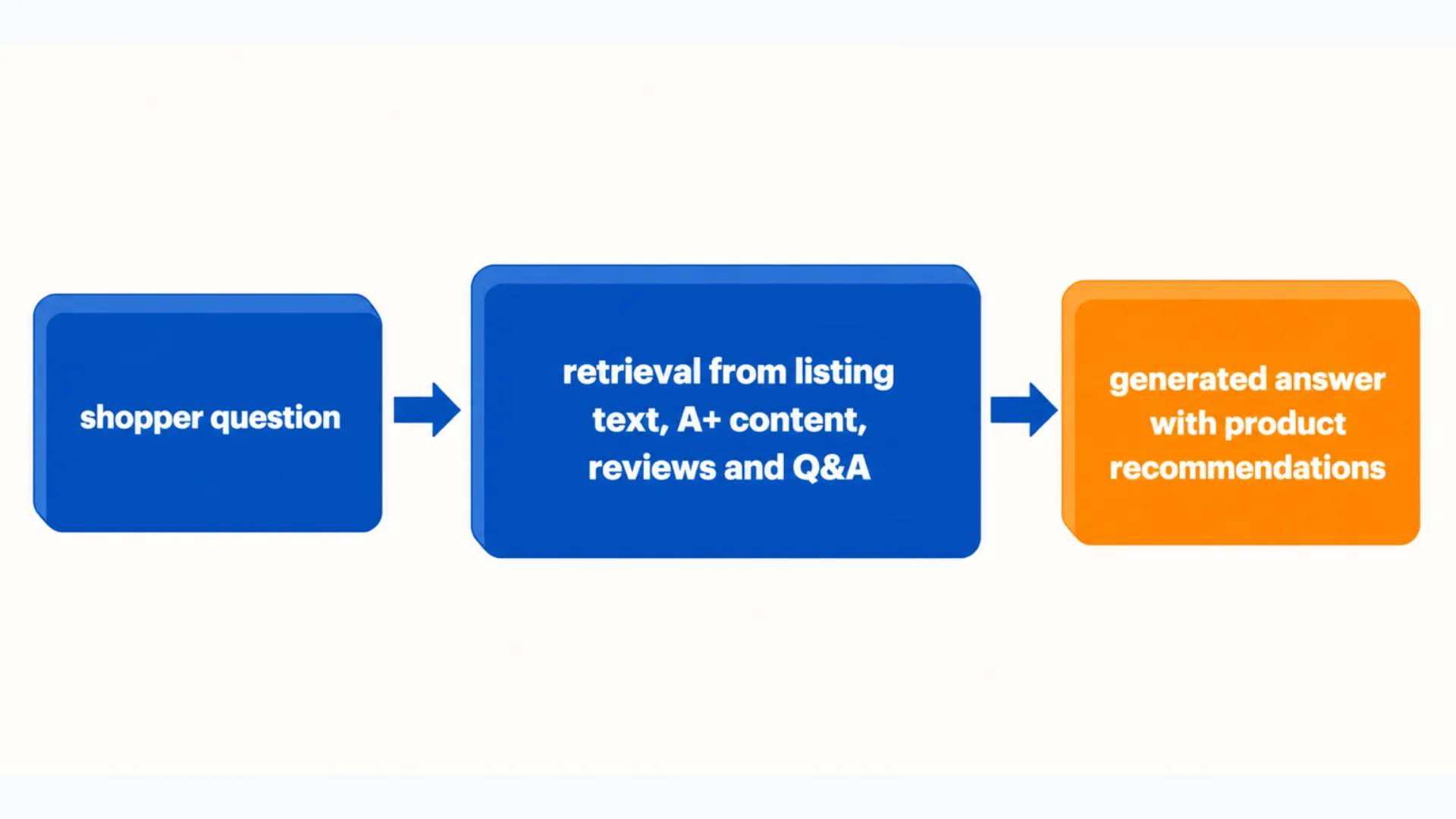
Amazon Science has published the architecture, so this part doesn't need guesswork. Rufus is built on a custom large language model trained on shopping-specific data — the Amazon catalog, reviews and community Q&A — combined with retrieval-augmented generation (RAG): before it writes an answer, it retrieves information it considers reliable and answers from that, rather than from model memory alone. Amazon names the retrieval sources explicitly: customer reviews, the product catalog, community questions and answers, and calls to relevant Stores APIs.
That mechanic has three consequences that matter more than any tactic:
- The answer is assembled at query time. If your listing text changes, the evidence available to the assistant changes with the next index pass — this is not a model that has to be retrained to notice your new bullet points.
- Missing information is a hard failure, not a soft one. If a shopper asks whether a product is safe for a specific use and nothing in your listing, A+ modules, Q&A or reviews addresses it, the assistant cannot invent a yes. A competitor who answered that question in a bullet gets recommended instead.
- The unit of relevance is the question, not the keyword. The retrieval step is semantic. "Which of these is quiet enough for a nursery" and "low decibel humidifier baby" land on the same evidence, and the listing that reads like an answer wins both.
Amazon also runs a semantic layer known as COSMO, a commonsense knowledge system that maps queries to intents and product attributes. Amazon has published research on it, but it has never documented COSMO as a ranking control sellers can act on, and most of what circulates about "optimizing for COSMO" is inference. The practical advice that survives the uncertainty is the same either way: describe use cases, contexts and compatibility explicitly instead of assuming the algorithm infers them.
Where Rufus pulls its data from
This is the part brands consistently get wrong — they optimize the title and treat everything else as decoration. The table below separates what Amazon has confirmed as a retrieval source from what is well-supported practitioner observation.
| Source | Status | What it does for you |
|---|---|---|
| Product catalog: title, bullets, description | Confirmed by Amazon | The primary evidence for what the product is, who it's for, and what it does |
| Customer reviews | Confirmed by Amazon | Third-party corroboration; the assistant quotes and summarizes them |
| Community Q&A | Confirmed by Amazon | Direct question-to-answer pairs, the closest match to how shoppers ask |
| Stores APIs (price, availability, delivery, variants) | Confirmed by Amazon | Filters your product in or out of "available now" style answers |
| A+ Content and Brand Story | Widely observed, not formally documented | Structured detail — materials, sizing, compatibility, comparison tables |
| Structured attributes in the backend | Widely observed | Fills the fields the assistant filters on; empty fields are silent nos |
| Images and on-image text | Observed | Read via vision/OCR; overlaid claims become retrievable text |
| External web content | Confirmed as part of training / stated in Amazon's launch material | Context for fresh or technical questions the catalog can't answer |
Two implications are worth spelling out.
Your listing is a source document. Whether a section is "SEO copy" or "brand copy" is a distinction that exists only inside your team. The assistant reads all of it as evidence. A comparison table inside an A+ module is more useful to it than a fifth keyword-stuffed bullet.
You do not control all of the evidence. Reviews and Q&A are retrieved with the same standing as your own copy, and where they contradict your claims, the shopper-generated version is what the assistant has to reconcile. That makes review quality and answered questions a discoverability asset, not just a conversion asset. The lever you hold is making sure your copy is specific and verifiable enough not to be contradicted.
If you want the tactical version of this — bullets phrased as answers, attributes to fill, what to put in A+ — that's the 12-point checklist for optimizing a listing for Rufus. It's the companion piece to this one.
Ads inside the assistant: Sponsored Products and Sponsored Brands prompts
This is the most concrete change of 2026 and the one most brands are paying for without knowing it.
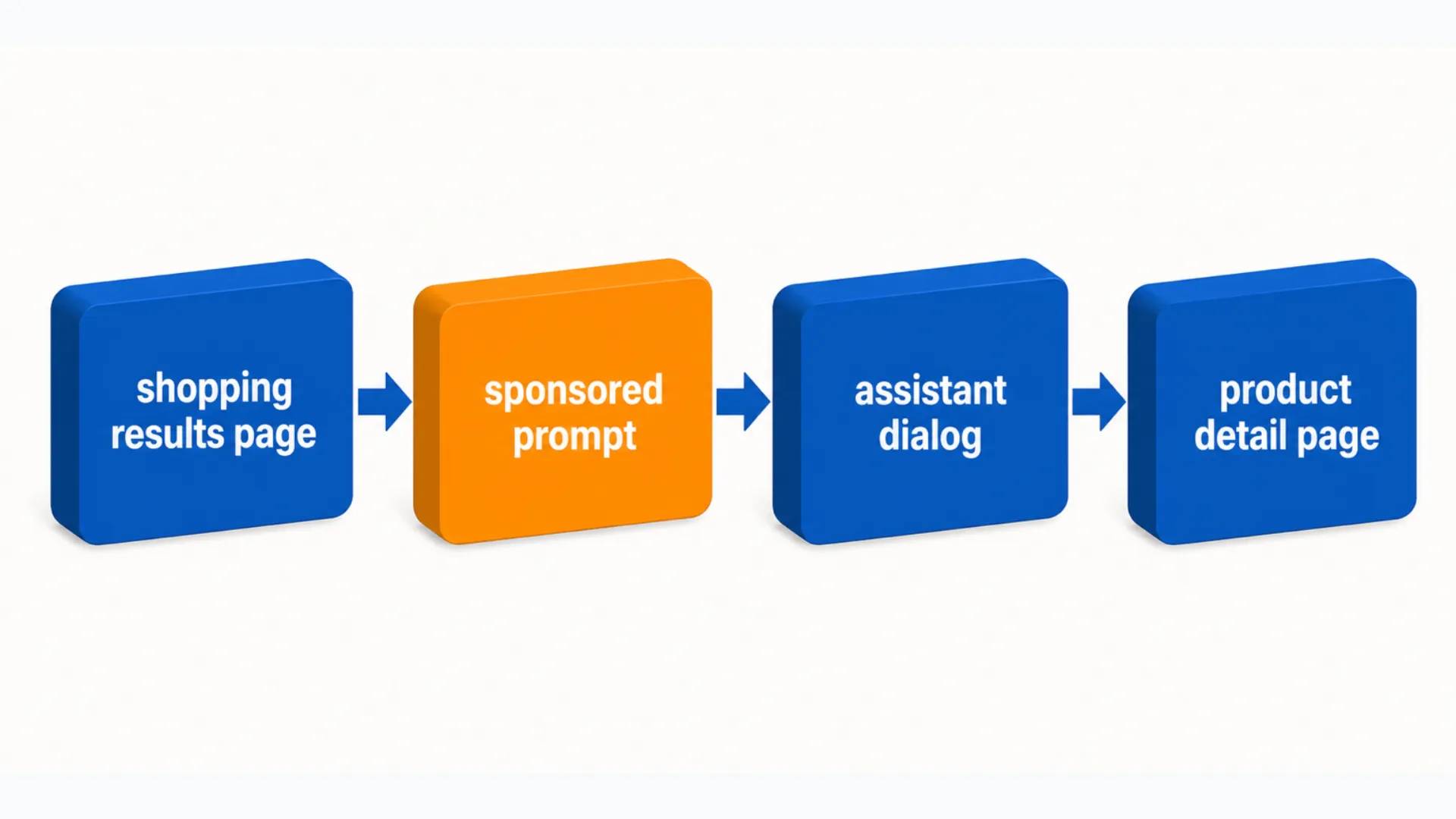
Amazon Ads launched Sponsored Products prompts and Sponsored Brands prompts into general availability on 25 March 2026, US only. Prompts are AI-generated suggested questions that appear in shopping results and on product detail pages; clicking one either opens a dialog in the assistant or answers the shopper directly on the page, drawing on Amazon's first-party signals from your detail page, Brand Store and campaign data.
Three properties of the format define how you should think about it:
- Enrollment is automatic. Existing Sponsored Products and Sponsored Brands campaigns were enrolled using their current parameters, with no setup step. If you were running ads in the US in spring 2026, you have been serving prompts.
- Amazon writes the creative. The prompt copy is generated from your listing and campaign signals. You do not author it, and the quality of it is downstream of the quality of your detail page — another reason listing content is now an advertising input, not just an organic one.
- It bills as CPC. From general availability, Amazon charges for prompt clicks under the same CPC bidding and billing parameters as the parent campaign. The free-pilot period some coverage describes was the beta phase, not the current state.
On the Q1 2026 earnings call Amazon said that nearly 20% of shoppers who interact with a brand's prompt continue the conversation about that brand — which is the strategic point of the format from Amazon's side, and a reasonable reason to leave it running rather than fight it.
How to measure it in the console
As of Q3 2026, prompt performance has its own reporting. Amazon exposes a Prompts report through the Ads Console and the Advertising API, containing the prompt text, the associated ad, impressions, clicks, click-through rate, cost per click, spend, sales, ACOS, ROAS, and 7-day orders and units. In Seller Central the same data is reachable under Advertising → Reports, and there is a Prompts view inside the campaign structure alongside the other placement reports.
What you can and can't do with it:
| You can | You can't |
|---|---|
| See spend, clicks and attributed sales by prompt | Bid separately on prompt placements |
| Read the exact prompt text Amazon generated | Write or edit the prompt copy |
| Compare prompt ACoS against your other placements | Target specific prompts or questions |
| Disable prompts on a campaign | Get organic (unpaid) assistant impressions as a reported metric |
That last row is the honest limitation. There is no "Rufus traffic" line in Seller Central for organic assistant answers the way there is for a sponsored placement. If your product is recommended inside an answer and the shopper clicks through, it appears as ordinary detail-page traffic. Anyone selling you a precise organic Rufus attribution number is selling you a model, not a measurement.
What you can watch instead, on a monthly cadence: the share of your converting search terms that read like questions or long descriptive phrases rather than head keywords; unit-session percentage on the ASINs whose listings you rewrote for question coverage; and prompt-level ACoS versus the rest of the campaign. Treat prompts like any other placement — if the ACoS is materially worse and there is no incremental order volume behind it, turning them off on that campaign is the only lever you have.
What Rufus does not change
Because the topic attracts a lot of noise, it's worth being explicit about the parts that are unchanged.
Conventional ranking still runs the results page. The assistant is a layer on top of Amazon search, not a replacement for it. Sales velocity, conversion rate, relevance, price competitiveness, availability and review profile still determine where you appear when a shopper types a keyword and scrolls, which is still the majority of sessions. If you're rebuilding fundamentals, start with how Amazon ranking actually works — Rufus optimization sits on top of that, not instead of it.
There is no separate "Rufus algorithm" to game. The assistant retrieves from the same catalog everyone else can see. There is no submission process, no schema to add, no hidden field. Listings that get recommended are listings that answer questions completely and are corroborated by reviews.
Bad unit economics don't become good. An AI layer that surfaces your product more often to better-qualified shoppers amplifies whatever your detail page already does. If the page converts poorly or the margin doesn't survive the ad cost, more qualified traffic just moves the problem faster.
The work itself is unglamorous: fill the attributes, answer the questions shoppers actually ask, make A+ carry information rather than mood, and keep the Q&A section alive. In our listing SEO work with a pet supplements brand, that combination — question-led listing rewrites plus Rufus-oriented content — moved organic sales +187%. It's the same discipline as classic Amazon listing SEO, applied with the assumption that a machine reads the page before a human does.
FAQ
Is Amazon Rufus still called Rufus?
Not in the US. Amazon renamed Rufus to Alexa for Shopping on 13 May 2026 and folded the standalone chat panel into the main search bar. Outside the US the rollout has been staged and the Rufus name may still appear in the interface. The underlying assistant, data sources and optimization work are the same.
Does Amazon Rufus affect search rankings?
Not directly. Rufus doesn't rank the conventional results page — Amazon's search algorithm still does that, driven by relevance, sales velocity, conversion rate and availability. Rufus is a retrieval layer that recommends products inside answers. The indirect effect is real: listings written to answer questions tend to convert better, which feeds ranking.
Can you opt out of Amazon Rufus ads?
Partly. Sponsored Products and Sponsored Brands prompts auto-enrolled existing US campaigns when they reached general availability in March 2026, and they bill under your normal CPC parameters. You can disable prompts at the campaign level, but you cannot bid on them separately, target specific prompts, or edit the copy Amazon generates.
Which countries is Amazon Rufus available in?
Rufus launched in the US in 2024 and has since expanded to major European marketplaces, Canada and India, with further markets rolling out. Feature parity lags outside the US — new capabilities usually appear in the US mobile app first. The 2026 rename to Alexa for Shopping also shipped in the US ahead of other locales.
How do I know if Rufus is sending me traffic?
For paid placements, use the Prompts report in the Ads Console or Advertising API: it shows prompt text, impressions, clicks, CPC, spend, sales, ACOS and ROAS. For organic assistant recommendations there is no separate metric — those clicks land as ordinary detail-page sessions. Watch question-shaped converting search terms and unit-session percentage as proxies.
Does Rufus read A+ content?
In practice, yes. Amazon confirms retrieval from the product catalog, reviews and community Q&A; A+ modules are widely observed to be used as a structured knowledge source, and Amazon's own comparison features draw on A+ content. Treat A+ as information architecture — specs, sizing, compatibility, comparison tables — rather than as brand mood imagery.
Where to start
Pick your top five ASINs by revenue and, for each one, write down the ten questions a shopper actually asks before buying — then check whether the listing, A+ modules and Q&A answer all ten in plain text. Most brands find three or four unanswered, and those gaps are exactly where an assistant recommends someone else. Then open the Prompts report for your US campaigns and see what Amazon has been writing on your behalf; if you'd rather have someone look at the whole account first, the Amazon growth plan covers listing coverage and ad placements together.