
Growing organic Amazon sales 187% with listing SEO and Rufus optimization
+187% organic sales
A US pet supplements brand rebuilt its listings around how shoppers — and Amazon's Rufus AI assistant — actually search, growing organic sales from $58k to $166k a month on flat ad spend.
At a glance
- Category
- Pet Supplies
- Marketplaces
- Amazon US
- Revenue at start
- $96k / month
- Organic share at start
- 60%
- Catalog
- 16 ASINs
- Engagement
- Listing SEO + creative
- Timeframe
- 9 months
- Team
- Account lead, SEO copywriter, designer
Results
The challenge
The brand sold a small, well-reviewed range of pet supplements and had reached roughly $96k a month — but almost every incremental sale had to be bought. Advertising carried the account while organic rank sat outside the top 10 for the category terms that mattered, so growth was capped by ad budget rather than by demand.
The listings explained why. Copy had been written years earlier in the brand's own vocabulary — supplement names, ingredient tables, dosage charts — while shoppers were searching in plain language for outcomes: joint support for older dogs, calming chews for travel, skin and coat relief for allergies. Backend keywords were duplicated across ASINs, variations competed with one another for the same terms, and nothing on the page answered the conversational, question-shaped queries that Amazon's Rufus assistant increasingly summarizes for shoppers. The catalog was, in effect, invisible to the way people now search.
Our approach
We rebuilt the catalog's content around how people actually search — including how an AI assistant reads a listing.
- Keyword and intent research — mapped the real demand landscape by pet, life stage and problem, then assigned each ASIN a primary term it could realistically own instead of letting the catalog fight over the same head keywords.
- Listing SEO — rewrote titles, bullets and backend keywords in shopper language, front-loading the outcome and moving ingredient detail to where it supports the decision rather than blocking it.
- Rufus optimization — structured the content to answer questions directly (who it's for, when to use it, what to expect and when), because conversational assistants surface listings that answer rather than listings that list.
- Creative content — rebuilt main images and A+ modules so the new positioning was visible before a single word was read, protecting conversion as traffic broadened.
- Catalog hygiene — consolidated variations, removed duplicate backend terms and fixed the internal cannibalization that had been splitting ranking signals.
How we worked
- 1
Demand and intent mapping
We rebuilt the keyword universe around pet type, life stage and the problem being solved, then assigned every ASIN one primary term it could win.
- 2
Cannibalization cleanup
Duplicate backend keywords and overlapping variations were consolidated so ranking signals stopped being split between the brand's own listings.
- 3
Listing rewrite in shopper language
Titles and bullets were rewritten to lead with the outcome a pet owner is searching for, with ingredient and dosage detail repositioned as supporting evidence.
- 4
Answer-shaped content for Rufus
Each listing was structured to answer the questions shoppers ask out loud — suitability, timing, expected results — so AI-generated answers had something concrete to draw on.
- 5
Creative aligned to the new positioning
Main images and A+ modules were rebuilt around the same outcome-led message, so the broader traffic the rewrite attracted still converted.
Timeline
Research
- Full keyword and intent map by pet, life stage and problem
- Cannibalization audit across ASINs and variations
- One primary term assigned per ASIN
Rewrite
- Titles, bullets and backend keywords rebuilt
- Answer-shaped content added for conversational queries
- Variations consolidated and duplicates removed
Index and climb
- Indexation tracked term by term
- Creative and A+ rebuilt to protect conversion
- Ad spend held flat while organic rank moved
Compound
- Top-10 keyword count growing month over month
- Organic sales overtaking paid as the growth driver
- Winning patterns rolled out across the catalog
Inside the ad account
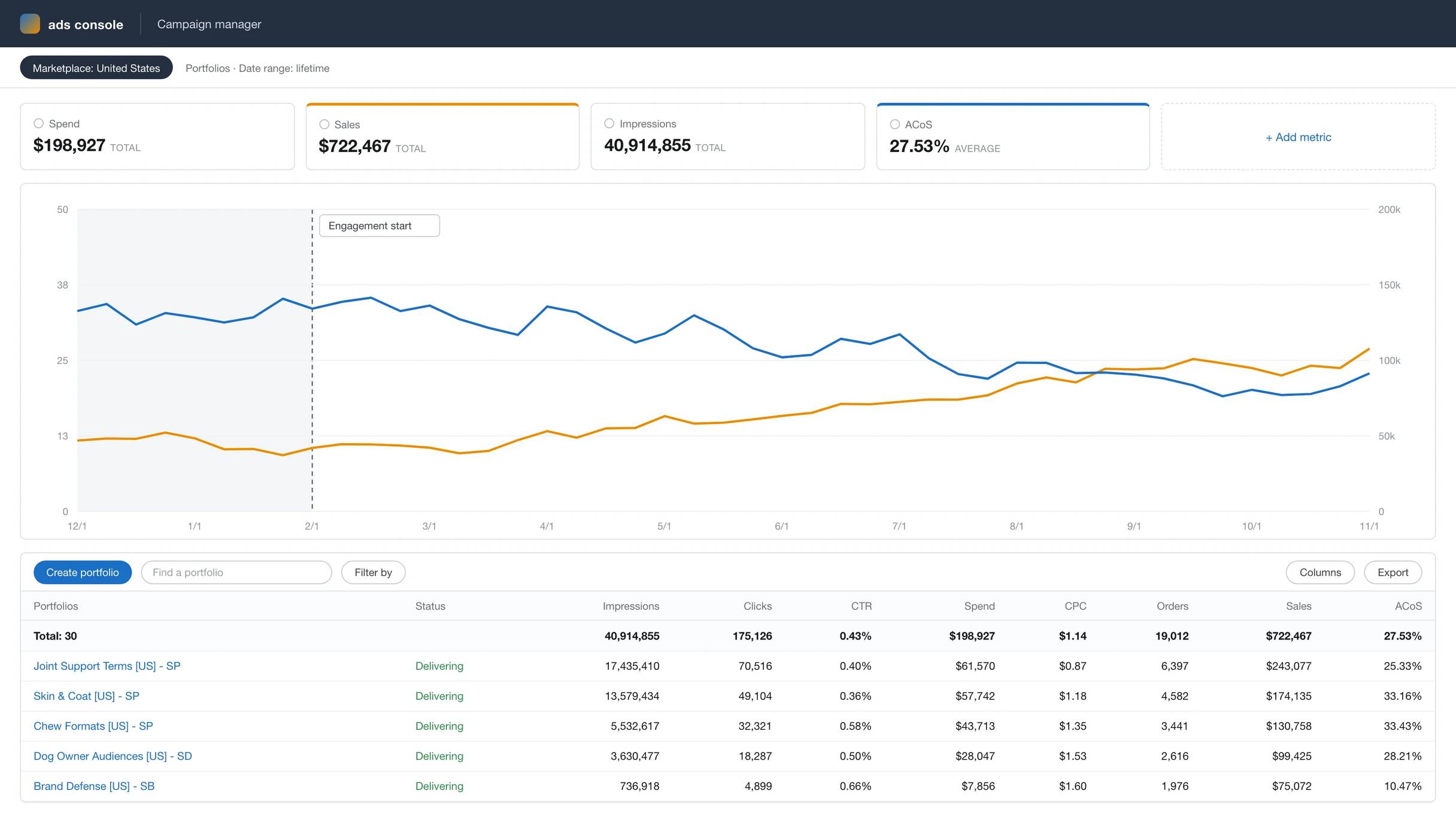
Anonymized account view, rebuilt from the figures reported above: ad sales growing from $44k to $97k a month while ACoS falls from 34% to 22% across the 9-month engagement.
The results
Organic sales grew from $58k to $166k a month — a 187% increase — while total revenue rose from $96k to $214k. The number of keywords ranking in the organic top 10 went from 43 to 191, and conversion rate improved from 11.4% to 16.8% as the rewritten pages matched what shoppers were actually looking for.
Crucially, ad spend was held essentially flat across the nine months. The extra revenue came from demand the brand was already generating but failing to capture — which means the gains keep paying out every month without a matching increase in budget.
“We had been writing for ourselves for years. Once the listings spoke the way our customers do, the rankings followed.”
“Our ad budget hasn't moved, and we're doing more than double the revenue. That's the part our board cares about.”
Services we delivered
Related case studies


Ready to scale your Amazon brand?
Talk to a senior strategist and leave with a growth plan for your store — no obligation.