
Keeping the customer when the puppy stops being a puppy
Stage-to-stage retention 12% → 44%
A pet nutrition brand acquired customers at the puppy stage and lost almost all of them at month twelve, when the animal outgrew the product. The transition was a marketing moment nobody was covering.

At a glance
- Category
- Pet Supplies
- Marketplaces
- US, CA
- Revenue at start
- $412k / month
- Catalog
- Life-stage nutrition: puppy, adult, senior
- Engagement
- Full account management + DSP
- Timeframe
- 11 months
Results
The challenge
The brand was very good at winning the first purchase. A new puppy owner is an easy customer to reach: the search intent is unmistakable, the emotional moment is high, and the brand's puppy formula converted well. Then, around the twelfth month of ownership, the customer simply stopped appearing. Only twelve percent of them ever bought the adult formula.
The reason was structural rather than competitive. The puppy bag runs out, the owner realizes the dog has outgrown it, and at that moment the brand has nothing in front of them — so they search the category fresh and buy whichever adult formula ranks. The brand was paying full acquisition cost to hand a customer to a competitor on a predictable schedule, and every retention idea on the table treated the loss as generic churn instead of a dated event.
Our approach
We built the account around the animal's calendar rather than the customer's.
- Transition timing modeled from first purchase in Amazon Marketing Cloud, the only place a per-customer order history exists — the breed-size and bag-size signals on the first order predict within a few weeks when the dog moves to adult food.
- DSP audience keyed to that date, so the adult formula appears to the owner in the window when they are about to make the decision, not six months earlier.
- The transition made explicit on the listing — the puppy detail page now states at what age and weight to switch, and to what.
- A transition bundle pairing the last puppy bag with a first adult bag, which converts the switch into a single unremarkable reorder.
How we worked
- 1
Cohort reconstruction
Two years of orders traced by customer to find when purchases stop; the drop-off clustered tightly between months 10 and 14.
- 2
Transition model
First-order bag size and stated breed size turned into a predicted switch date, accurate to roughly three weeks.
- 3
Listing honesty
The puppy listing began telling owners when to stop buying it — which felt counterintuitive and became the highest-converting content on the page.
- 4
DSP windowing
Audiences built to reach each owner in the four weeks around their predicted switch, and nowhere else.
- 5
Transition bundle
A puppy-plus-adult pairing launched for the final reorder, removing the decision entirely.
Inside the ad account
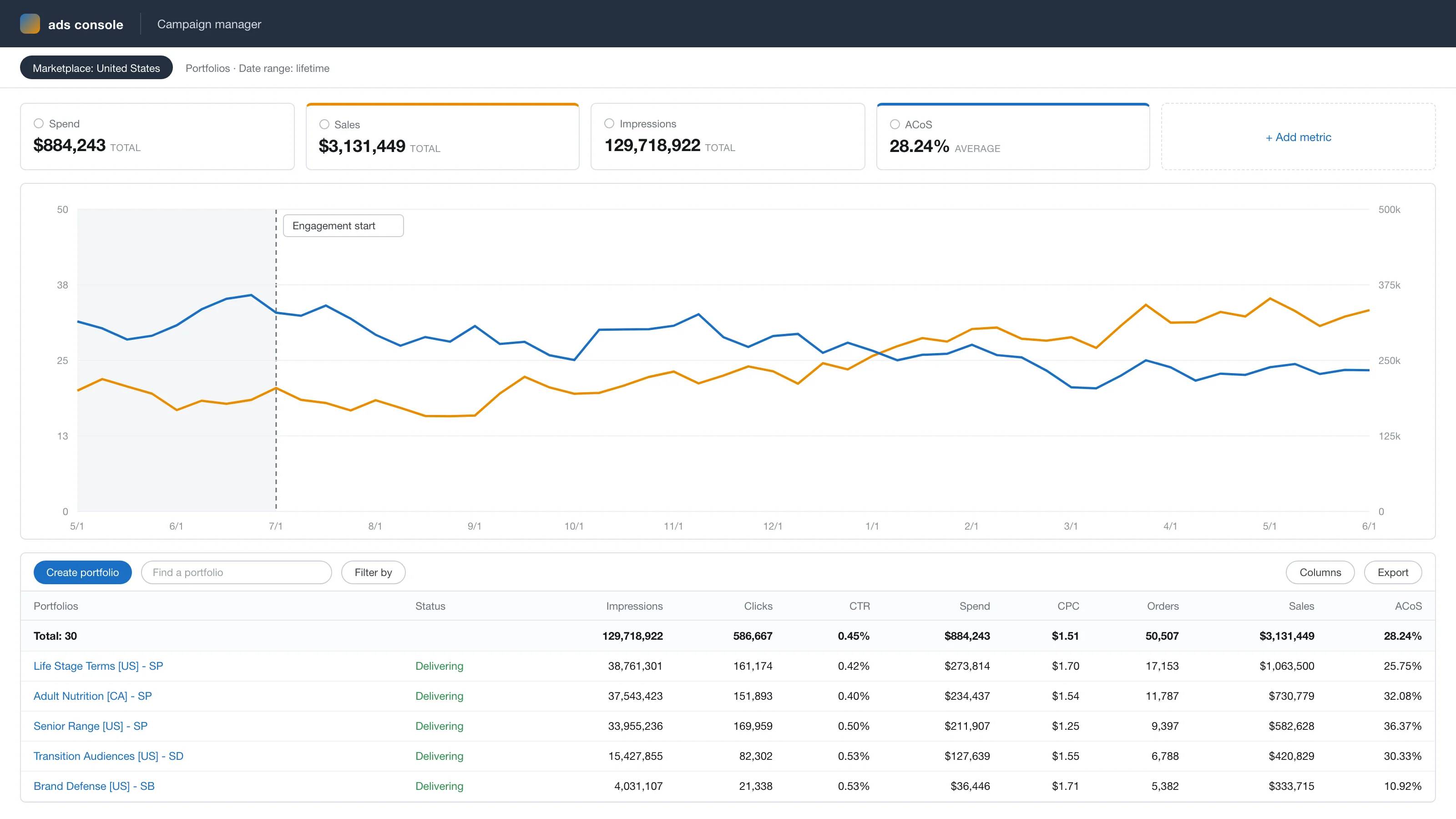
Anonymized account view, rebuilt from the figures reported above: ad sales growing from $185k to $310k a month while ACoS falls from 32% to 22% across the 11-month engagement.
The results
Stage-to-stage retention went from 12% to 44%, and modeled twenty-four-month customer value rose to $390.
The mechanism is unglamorous: the brand now shows up on a date it can predict, with the product the owner is about to need. Acquisition cost barely moved — the growth came entirely from keeping customers the brand had already paid for, through a transition that had been treated as inevitable attrition rather than as a scheduled marketing event.
“We knew exactly when every customer would leave us. It never occurred to us that this made it a date we could put in a calendar.”
Services we delivered
Related case studies




Ready to scale your Amazon brand?
Talk to a senior strategist and leave with a growth plan for your store — no obligation.