
Selling a clinic-priced product to shoppers who had already seen the clinic price
Conversion 4.6% → 9.9%
A brand distributed through veterinary practices moved onto Amazon and found its price being compared with mass-market shelf products rather than with the channel it came from.

At a glance
- Category
- Pet Supplies
- Marketplaces
- US
- Revenue at start
- $96k / month
- Position
- $54 product beside $19 mass-market alternatives
- Channel history
- 12 years of veterinary practice distribution
- Engagement
- Full account management + listing SEO
- Timeframe
- 12 months
Results
The challenge
For twelve years the product had been handed to owners by a veterinarian, which does most of the selling. On Amazon there is no veterinarian, and the listing appeared in a results page next to supermarket-tier products at a third of the price. Shoppers arriving from broad category searches saw a number they could not justify and left, and the ones who did buy included a meaningful share who had misunderstood what they were buying — hence a fourteen percent return rate.
The brand's instinct was to discount, which would have damaged its clinic relationships without fixing anything: the problem was not that $54 was too much, it was that the page gave shoppers nothing to compare it against except the cheapest thing on screen.$
Our approach
We moved the brand out of the comparison it loses and into the one it wins.
- Keyword strategy shifted to specialist intent — formulation, ingredient and feeding-plan language, where the shopper arrives already expecting clinic pricing.
- Broad category terms abandoned as paid targets, since a shopper who typed the generic term is not the customer.
- The formulation described precisely — the ingredient profile and inclusion rates that separate it from the shelf product, stated without a health claim or a veterinary recommendation, neither of which this category permits.
- Directions for use given the space they deserve, because most returns came from owners who used it like a shelf product and concluded it did not work.
Timeline
Diagnose
- Traffic segmented by search intent; broad terms found to convert at under 2%
- Return reasons coded — most were misuse, not dissatisfaction
- Specialist keyword universe mapped
Reposition
- Listing rewritten around the veterinary channel and the formulation
- Paid spend withdrawn from broad category terms
- Usage guidance built into the image stack and A+
Compound
- Organic rank earned on specialist terms as conversion signals accumulated
- Return rate stabilized at 5%
- Price held at $54 throughout
Inside the ad account
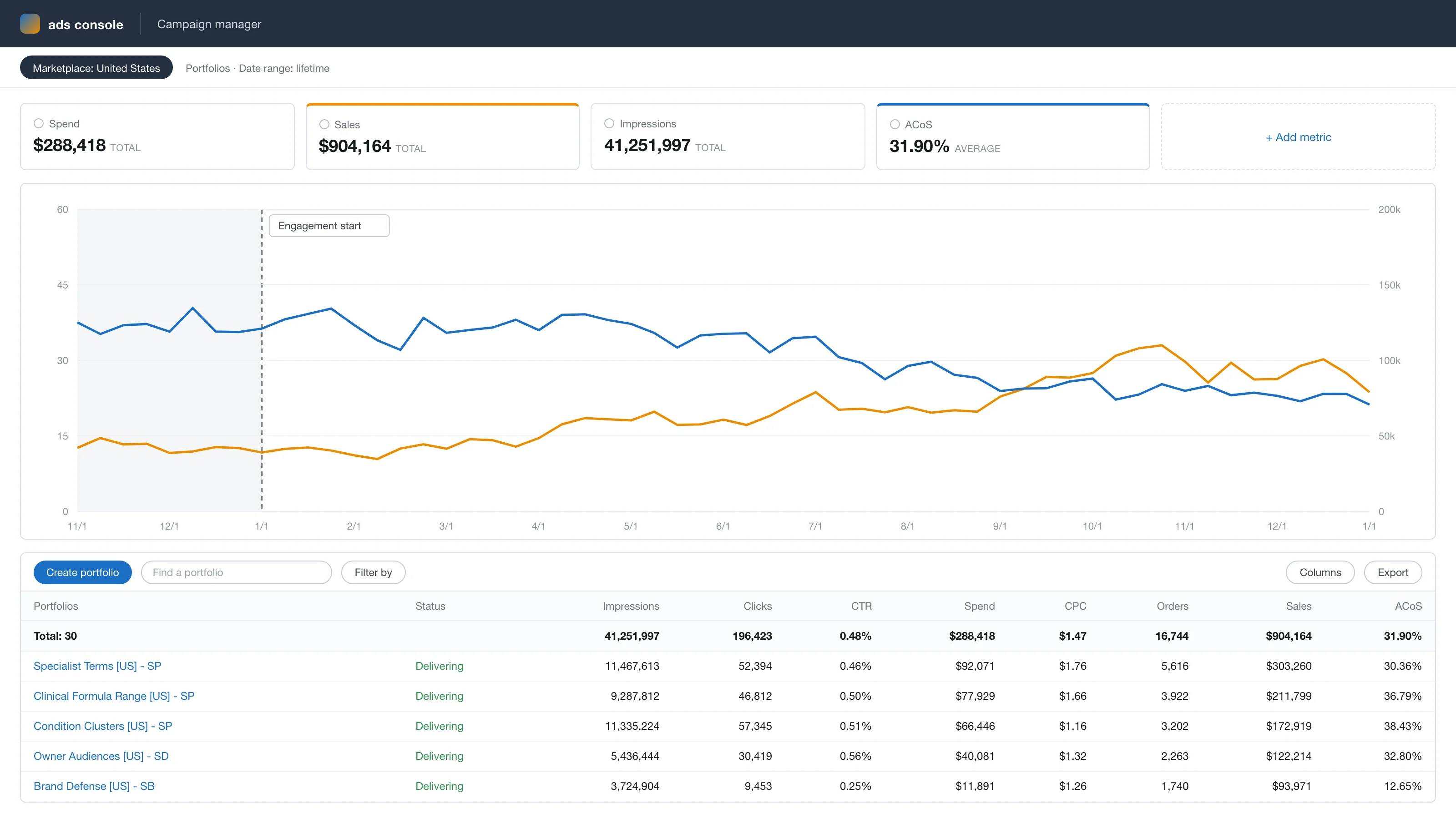
Anonymized account view, rebuilt from the figures reported above: ad sales growing from $43k to $96k a month while ACoS falls from 38% to 22% across the 12-month engagement.
The results
Conversion more than doubled to 9.9% and revenue grew 122%, with the price unchanged — which was the condition the brand had to meet to keep its clinic distribution intact.
Almost all of the gain is composition: nearly six in ten visitors now arrive from searches that imply a specialist product, instead of one in ten. The return rate fell nine points for the same reason, plus clearer usage instructions — a customer who understands what they bought is far less likely to send it back and far more likely to buy it again.
“We were being priced against dog food from a supermarket. The moment the page said where the product actually comes from, the argument changed.”
Services we delivered
Related case studies




Ready to scale your Amazon brand?
Talk to a senior strategist and leave with a growth plan for your store — no obligation.