Amazon Marketing Cloud: What Brands Actually Get From It
AMC is a database, not a dashboard — it answers the questions you know how to ask. What brands actually get from the clean room, and what it can never tell you.
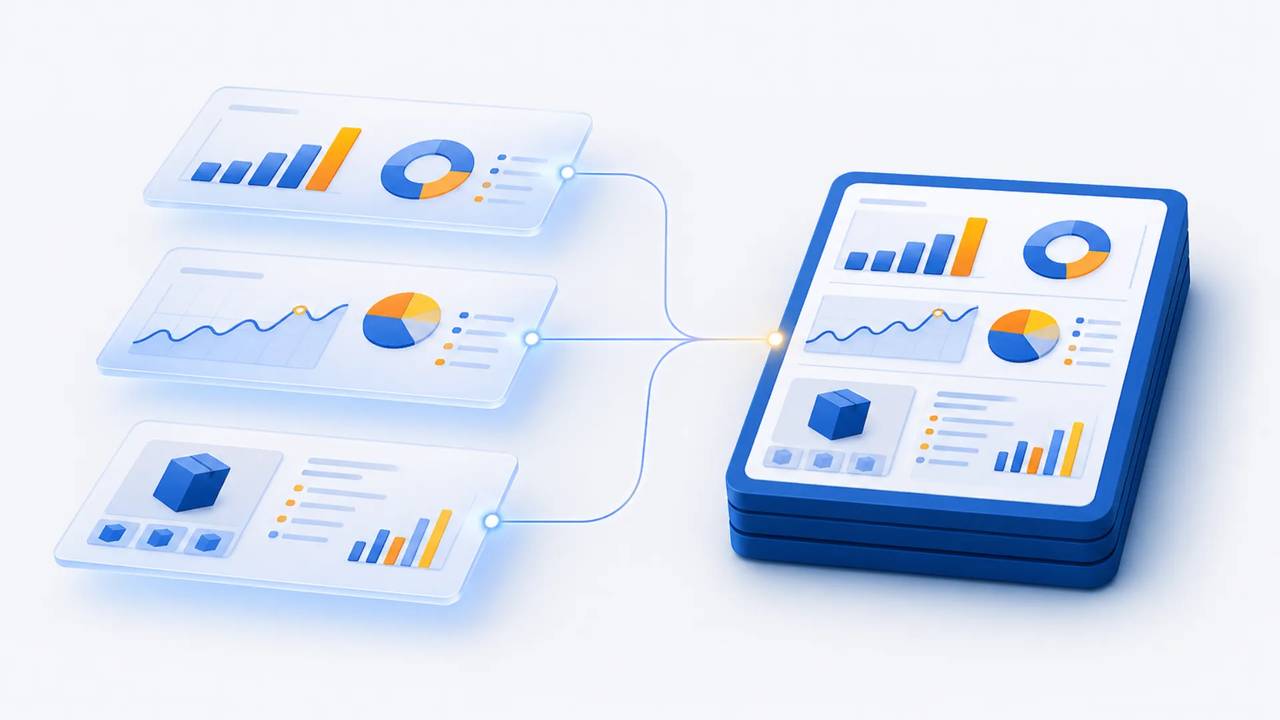

Amazon Marketing Cloud (AMC) is a clean room: a secure environment where a brand can query event-level records of its own Amazon ad exposures and conversions, and get back aggregated answers. Amazon describes it as a "secure, privacy-safe, and cloud-based clean room solution" and offers it at no cost to eligible advertisers. What it is not is a dashboard that tells you what to do — it is a database that answers the questions you know how to ask.
What AMC actually holds
The useful mental model is a private copy of your own advertising events, one row per event, in a query environment you cannot export raw. Impressions, clicks and conversions from Sponsored Products, Sponsored Brands, Sponsored Display and Amazon DSP land in the same instance, keyed to a pseudonymous user identifier. That single fact is the whole point: standard reporting shows each ad type in its own silo, and AMC is the only place where they sit on one table.
Two privacy rules shape everything you can do with it. Output is aggregated only — Amazon requires a minimum audience size (commonly documented as at least 100 users) before a row is returned, and rows below the threshold are dropped silently rather than flagged as an error. And the user identifier can be used to join, group and filter, but never selected into the output.
Amazon has also stretched the history available: at unBoxed 2025 the ad traffic lookback window went from 13 to 25 months, which is what makes year-over-year comparison possible inside AMC rather than in a spreadsheet of exports.
The questions AMC can answer
These are the four that justify the effort for most brands in the $50k–$1M/month range. All of them are questions the Ads console structurally cannot answer.
How did the ad types combine before a purchase?
Path-to-conversion analysis groups converting users by the sequence of ad types they were exposed to. You find out how many purchases followed a display impression and a Sponsored Products click, versus Sponsored Products alone. In last-touch reporting the display impression is invisible; here it has a measurable presence in the paths. This is the analysis that most often changes a budget decision, because it puts a number on the "DSP assists search" argument instead of leaving it as a theory. If DSP itself is still new to you, start with Amazon DSP explained.
How much do DSP and Sponsored Ads overlap?
Overlap queries count users reached by one channel, the other, and both, and compare conversion rates across the three groups. Two brands with identical spend splits can have completely different overlap profiles: one is paying twice to reach the same buyer, the other is genuinely extending reach. Which of those you are doing is invisible in campaign reports and obvious in AMC.
What is actually bringing in new customers?
Amazon reports new-to-brand at the campaign level, but AMC lets you attribute it across the mix — which combination of exposures preceded a first purchase, and how the mix differs for repeat buyers. Amazon has also extended retail purchase history well beyond the ad-traffic window for measurement use cases, which raises the fidelity of anything customer-lifetime-shaped. Practically, this is where an Amazon DSP program stops being defended by impressions and starts being defended by acquisition.
Where does frequency stop paying?
Frequency queries bucket users by number of impressions and show conversion rate per bucket. The curve nearly always flattens, and often turns down. Finding the bucket where the return goes flat gives you a defensible frequency cap instead of an inherited default. This pairs directly with how you build the audiences in the first place — see DSP audiences and targeting.
| Question | Where standard reporting lands | What AMC adds |
|---|---|---|
| Path to conversion | Last touch per ad type | Ordered combinations of exposures |
| Channel overlap | Not available | Reached-by-both vs either alone |
| New-to-brand | Per campaign | Across the whole mix, per user |
| Frequency | Average frequency | Conversion rate per impression bucket |
The questions AMC cannot answer
Being clear about the ceiling saves a lot of disappointment.
- Anything about a named person. No lists, no exports of individuals, no matching back to an order. The clean room exists precisely to prevent this.
- Anything below the aggregation threshold. A small brand, a narrow segment or a heavily filtered query returns nothing rather than a small number. Below roughly 100 attributed users per row you get empty results, not insight.
- Competitor data. AMC contains your advertising and your retail signals, not the category's.
- Causality. Path and overlap analyses are observational. Someone exposed to three ad types is different from someone exposed to one before any advertising happened. AMC can tell you what co-occurred; it cannot tell you what caused what unless you deliberately design a holdout.
- Organic performance. It is an advertising clean room. Ranking, search-term visibility and the organic half of a TACoS picture live elsewhere.
Getting access: the threshold moved
This is the part that most articles have wrong, because it changed twice.
AMC used to require an Amazon DSP relationship. At unBoxed 2024 Amazon adjusted the eligibility criteria so that DSP usage is no longer mandatory: DSP direct advertisers and Amazon Ads Partner Network partners serving clients with or without DSP can register. In September 2025 Amazon went further and opened direct self-service access to sponsored ads advertisers inside the advertising console, with pre-built templates rather than a blank SQL editor.
As of 2026, Amazon's own product page states the two routes plainly: advertisers registered with Amazon DSP request access through their Ad Tech Account Executive, and advertisers registered with sponsored ads can access AMC via self-service. Availability still varies by marketplace.
On price: the instance is free. Some signal sets are paid features — and Amazon has made its own first-party paid features free to query through the end of 2026, while third-party data subscriptions (Experian and similar) still cost money. Treat the free window as a reason to start now, not as a permanent state.
The real cost is the analyst, not the licence
AMC is free the way a database is free. The cost is the person who can specify a business question, express it as SQL against the right tables and attribution windows, and then read the output without over-claiming.
The no-code templates and the SQL-generating assistant Amazon has added genuinely lower the floor — a brand can run a path-to-conversion template in an afternoon. What they do not do is interpretation. The common failure mode we see is a beautifully executed query whose result is read as proof that a channel "drives" sales, when the query only established co-occurrence. The second failure mode is quieter: a query that returned fewer rows than expected because segments fell under the aggregation threshold, and nobody noticed the missing rows.
Budget for AMC as a few hours a month of a competent analyst, not as a tool purchase. If nobody on the team owns that time, the instance sits idle — which is exactly what has happened at most brands that requested access in the first wave.
FAQ
Do you need Amazon DSP to use AMC?
No. Amazon removed the DSP requirement — the eligibility criteria were adjusted at unBoxed 2024, and since September 2025 advertisers registered with sponsored ads can access AMC through self-service in the advertising console. DSP advertisers still request access through their Ad Tech Account Executive. Availability depends on your marketplace.
How much does Amazon Marketing Cloud cost?
The AMC instance itself is free. Amazon states AMC is available at no cost to eligible advertisers via the web UI and API. Certain paid feature signal sets exist; Amazon's own first-party paid features are free to query through the end of 2026, while third-party data providers still charge subscription fees. Analyst time is the real expense.
Do you need to know SQL to use AMC?
Not to start. Amazon now ships curated templates and an AI assistant that generates queries from plain-language questions, so a non-technical marketer can run standard analyses. SQL still matters for anything custom, and interpretation matters more than either — reading an AMC result correctly is a harder skill than writing the query.
Is AMC worth it for a smaller Amazon brand?
Often not yet. AMC suppresses any result covering fewer than about 100 users, so brands with low attributed order volume get empty rows instead of answers. The value scales with spend across multiple ad types — if everything runs through Sponsored Products alone, standard reports already tell you most of it.
Where to start
Request the instance now while access is open and the first-party signals are free to query, but do not treat that as the project. Pick one decision you are currently making on instinct — a frequency cap, a DSP budget defence, a channel split — and run the single template that speaks to it. If the answer changes what you do, staff the analyst time. If you want an outside read on whether your account has the spend spread and order volume to make AMC worthwhile at all, an Amazon growth plan is the faster first step.