Amazon DSP Explained: What It Is and When a Brand Is Ready for It
Amazon DSP buys audiences, not keywords — across Prime Video, Fire TV, Twitch and the open web. Here is what it actually does, what it costs, and when it is too early.
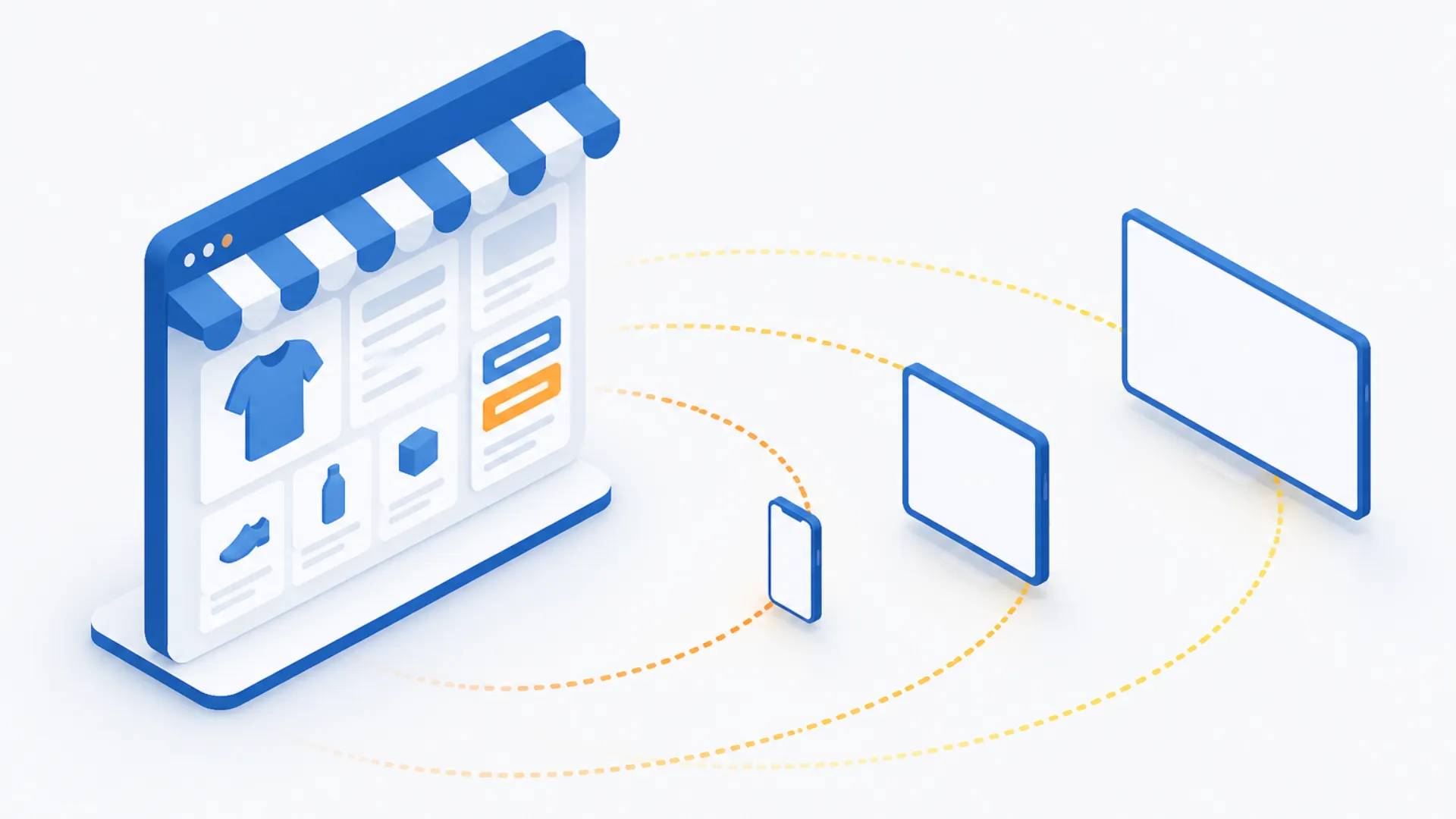

Amazon DSP is Amazon's demand-side platform: a programmatic buying tool that lets you serve display, video and audio ads to Amazon's shopping audiences, both on Amazon properties and across the open web. Unlike Sponsored Products or Sponsored Brands, it does not bid on keywords — it bids on audiences, using Amazon's purchase and browsing signals to decide who sees the ad. It is available as a self-service platform you run yourself and as a managed service run by an Amazon Ads team. This guide covers what it buys, what it costs, how it is measured, and the cases where it is simply too early.
What Amazon DSP actually is
A demand-side platform is software that buys ad impressions through real-time auctions across many publishers at once. The "demand side" is you, the advertiser; the supply side is the inventory owners. Every DSP does roughly the same mechanical job — the difference between them is the data they bid with and the inventory they can reach.
Amazon's version is interesting for one reason: the bidding data is retail data. Amazon knows what a shopper searched for, which product detail pages they viewed, what they added to cart and abandoned, what they bought last quarter, and what they bought from your competitor instead of you. That signal is what you are actually renting when you buy Amazon DSP. The ad formats — display banners, online video, streaming TV, audio — are commodities.
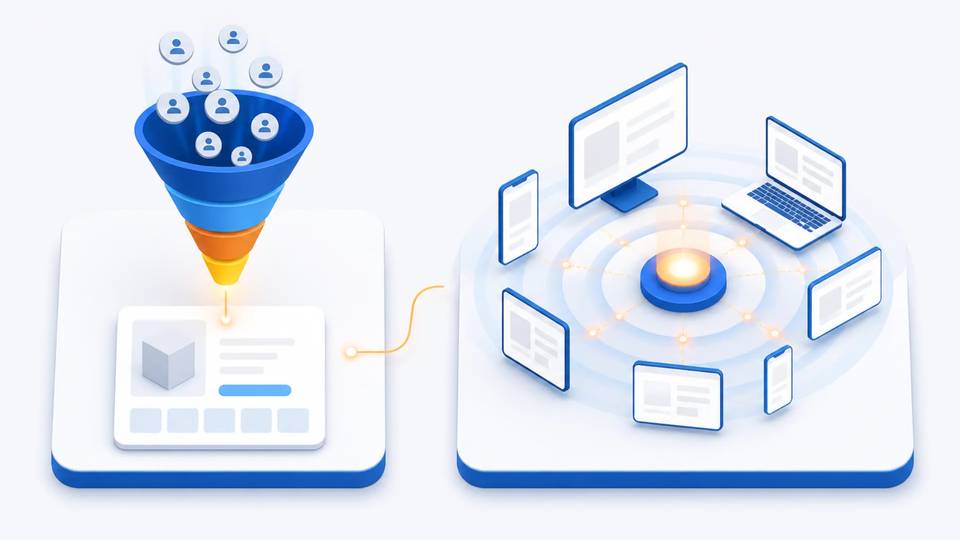
The second thing to understand is that Amazon DSP is not confined to Amazon. It buys inventory on Amazon-owned properties and beyond them, which means it can reach an Amazon shopper while they are reading a news site or watching a streaming show, then measure whether that exposure produced a purchase on Amazon. Very few platforms can close that loop.
Amazon DSP vs Sponsored ads
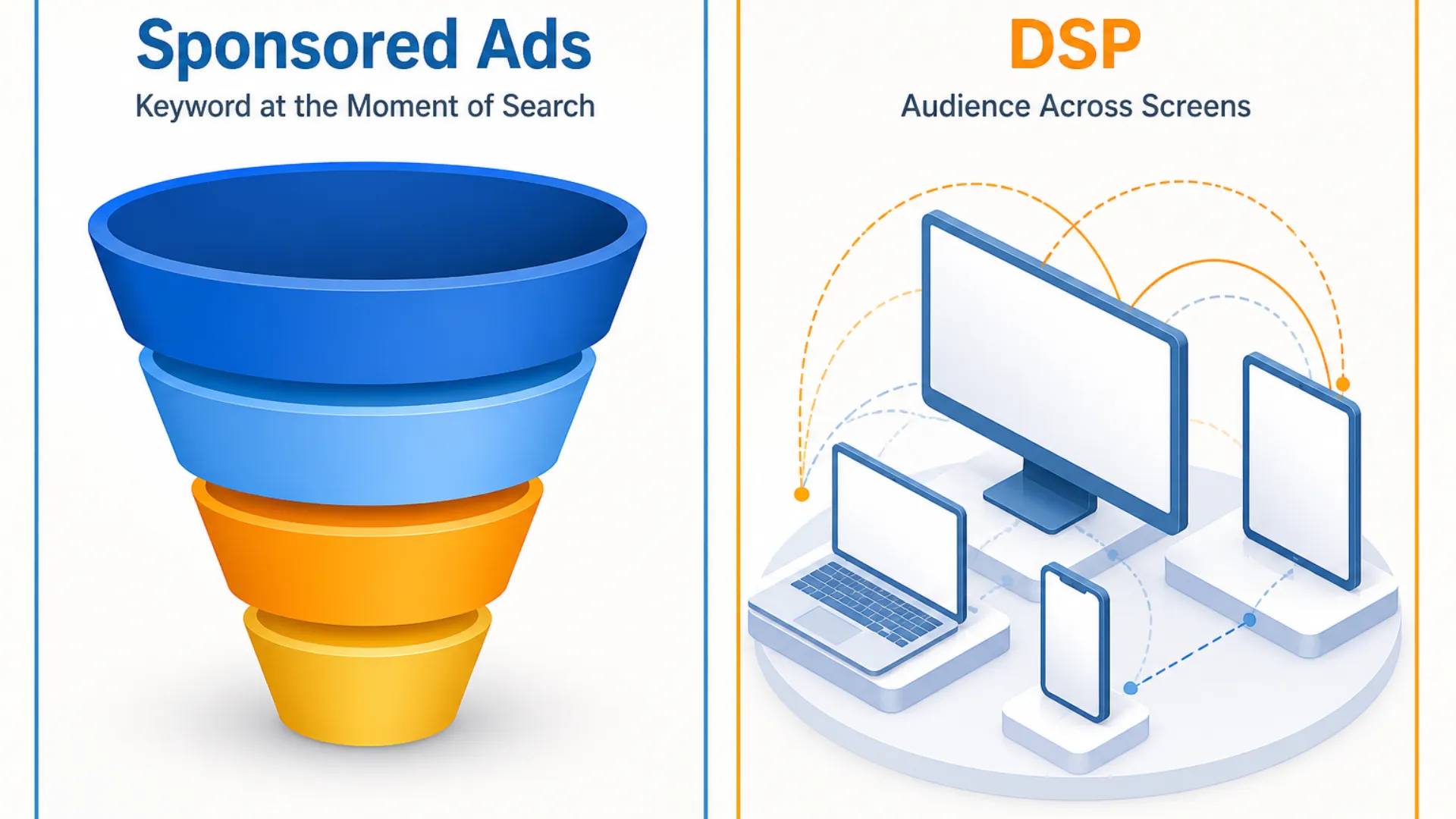
If you already run Amazon PPC, the cleanest way to place DSP is by what triggers the ad and where it appears.
| Sponsored Products / Brands | Amazon DSP | |
|---|---|---|
| Buying unit | Keyword or product target | Audience segment |
| Pricing model | Cost per click | Cost per thousand impressions (CPM) |
| Where ads run | Amazon search and detail pages | Amazon properties, Amazon devices, third-party sites and apps |
| Formats | Text, image, some video | Display, video, streaming TV, audio |
| Demand it serves | Existing, expressed demand | Demand you create or re-engage |
| Access | Any seller in Seller Central | Advertising console / DSP, brand-registered |
The practical distinction: Sponsored ads harvest people who are already searching for something like your product. DSP puts your product in front of people who are not searching right now but whose behavior suggests they will, or who already looked at you and left. That is a genuinely different job, and it is why DSP results almost never look like PPC results on the same dashboard. We go deeper on the trade-offs in Amazon DSP vs Sponsored Ads.
The inventory Amazon DSP buys
Amazon Ads describes DSP supply in three broad tiers, and it is worth knowing which is which, because they behave very differently.
Amazon first-party supply. Amazon's own product page lists Amazon Originals on Prime Video, livestreams on Twitch, live sports including Thursday Night Football, and Amazon.com itself. On-Amazon placements — the detail page, the search results rail, the cart and checkout pages — are the highest-intent inventory in the system and usually the first thing a performance-minded brand buys.
Amazon devices and physical surfaces. Fire TV, Kindle and Alexa are named as connected-device inventory, alongside Amazon Fresh kiosks. Streaming TV on Fire TV is the format that draws the most attention, and it is also the one most often bought for the wrong reason — a brand doing a few hundred thousand a month in revenue rarely needs a TV campaign.
Third-party inventory. Amazon reaches "thousands of premium third-party sites and apps" through Amazon Publisher Direct and leading third-party exchanges. This is the off-Amazon reach layer: same audiences, same measurement back to Amazon purchases, much cheaper CPMs and much weaker intent.
A common and expensive mistake is treating these as one pool. On-Amazon retargeting and open-exchange prospecting are two different businesses with two different acceptable CPMs and two different reporting expectations. Media plans that blend them into a single ROAS number tend to hide a strong retargeting line item propping up a weak prospecting one.
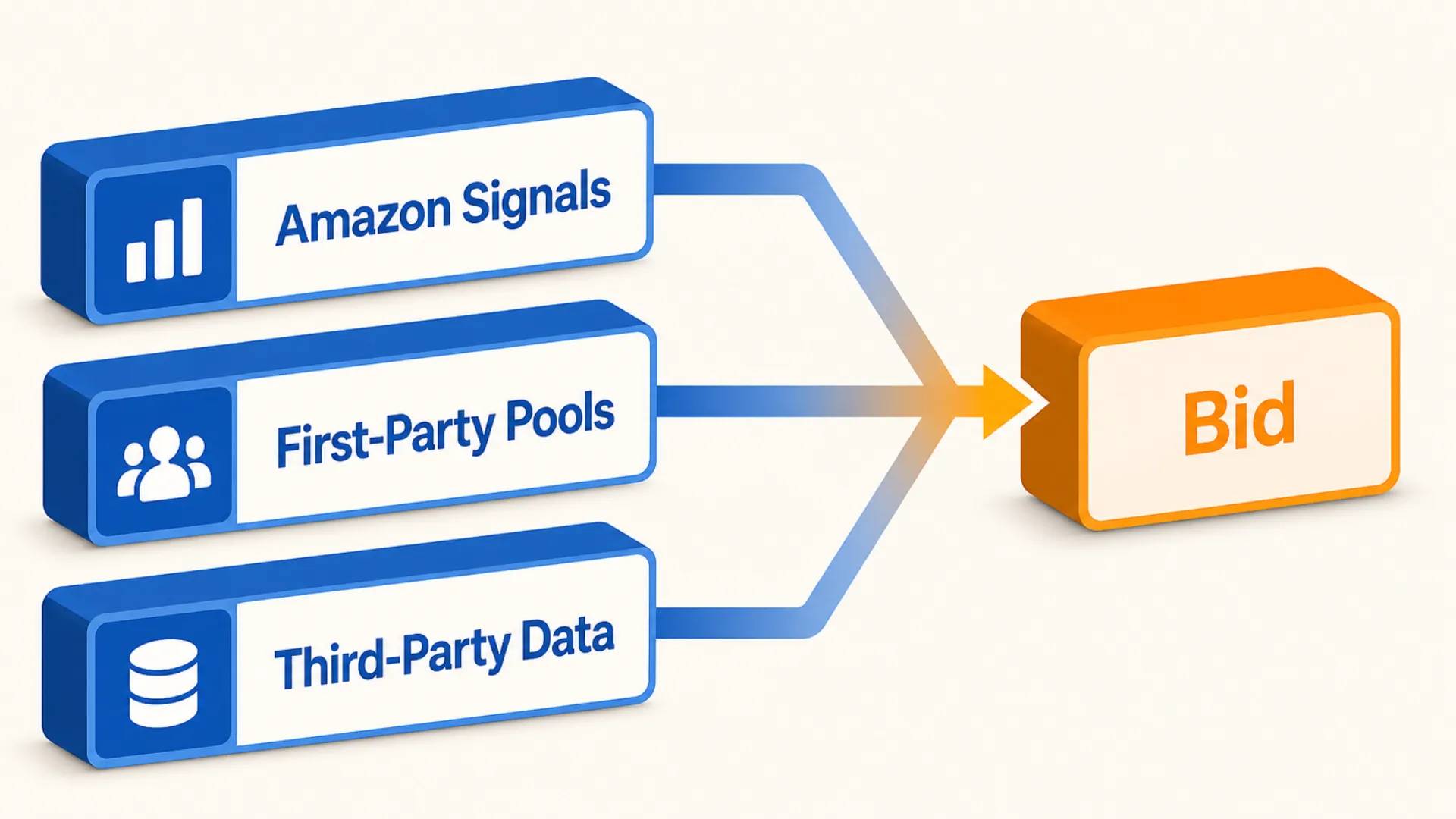
Audience data is the product
The reason to use Amazon DSP rather than a general-purpose DSP is the audience taxonomy. Amazon Ads groups targeting into three families.
Amazon audiences are built from Amazon's own shopping and streaming signals: in-market segments (shoppers actively browsing a category), lifestyle segments, and behavioral segments derived from purchase history. These are the segments no other platform can rebuild from scratch.
Advertiser audiences are yours: pixel-based site visitors, hashed customer lists you upload, and — most importantly for a seller — Amazon-side remarketing pools such as people who viewed your detail page in the last 30 days, people who viewed a competitor's, and past purchasers due for a repeat order.
Third-party audiences come from external data providers and describe behavior outside Amazon. They are the least differentiated layer and generally the first place a budget leaks.
In practice the audience strategy is the campaign strategy — creative and bid tuning matter far less on DSP than on PPC, because a badly chosen audience cannot be rescued by a better banner. The full segmentation map is in Amazon DSP audiences and targeting.
How Amazon DSP is bought: self-service vs managed
There are two routes into the platform, and the difference is who operates the account.
Managed service means an Amazon Ads team plans and runs the campaigns for you. Amazon's own DSP page states a minimum spend of $50,000 USD for managed service, and notes the minimum may vary by country. That is a published, official figure. Managed service also historically carried some inventory controls and guarantees that were not available self-serve in the US.
Self-service means you — or an agency operating your account — build, target, bid and optimize yourself. Amazon describes self-service customers as being "in full control of their campaigns." Amazon does not publish a self-service minimum spend on that page.
This is the part that changed recently and is still widely misreported. For years the practical route into DSP for a mid-size brand ran through an agency or reseller, because self-service access carried a substantial spend commitment. At its unBoxed conference in November 2025 Amazon rebuilt the DSP interface for a broader market and, according to trade coverage of the event, removed the self-serve minimum. The same conference introduced a consolidated Campaign Manager that puts DSP and Sponsored ads in a single interface, with reporting rolling out through 2026.
Two cautions. First, older figures — a $35,000 or $50,000 self-service commitment — are still repeated in guides published well after the change; treat any self-serve minimum you read as needing a date. Second, "no minimum" is an access rule, not a performance rule. Removing a floor does not make small budgets work.
What it costs in practice
DSP is bought on CPM, so the meaningful budget question is not "what is the minimum" but "how much conversion signal does the optimization model get."
The platform's targeting and bid models improve with observed conversions. Below a certain volume the model is essentially guessing, the campaign never leaves its learning phase, and the reported numbers swing wildly week to week. Agency and vendor guides put the practical self-service entry point somewhere in the region of $5,000–$15,000 per month of DSP spend — the range varies by source, and none of these are Amazon-published numbers. Treat them as a practitioner consensus about where the model starts to behave, not a rate card.
A more useful test than any single number: can you fund the campaign for a full quarter without needing it to pay back in week two? DSP retargeting can return quickly; prospecting and streaming TV usually do not. A budget that has to prove itself monthly will get switched off before it has produced the data it needs.
The brands where these conversations get serious are already doing real volume — the scale of an account like Levoit, which moved from $318k to $677k in monthly revenue. At that level a DSP line item is a percentage of a working media budget. At $30k a month in revenue it is the whole budget.
Measurement: view-through, new-to-brand and AMC
DSP reporting confuses people because it is doing something PPC reporting does not: crediting impressions that were seen but not clicked.
View-through attribution is the mechanism. If a shopper sees your ad, does not click it, and later buys on Amazon within the lookback window, DSP counts that as a view-through conversion. This is legitimate — display advertising has always worked this way — but it is also where inflated DSP reports come from, because a retargeting campaign chasing people who were already going to buy will show excellent view-through ROAS while adding almost nothing.
Amazon has tightened this. Effective 1 January 2026 Amazon replaced the flat 14-day view-through window for on-Amazon Store ads — including DSP, Sponsored Brands and Sponsored Display — with a machine-learning attribution model that filters out impressions unlikely to have influenced the purchase. Off-Amazon DSP delivery continues on the traditional 14-day click and 14-day view lookback. Amazon also kept an "all views" metric reflecting the previous methodology so advertisers can compare against history. If your DSP view-through numbers fell in early 2026 without anything changing in the account, this is why.
New-to-brand is the metric that makes DSP legible to a business. Amazon classifies a purchase as new-to-brand by checking the shopper's purchase history for the brand over the previous twelve months, using the brand in the product byline; it accounts for both ad-attributed and organic purchases. Since prospecting DSP exists to bring in buyers who have never bought from you, new-to-brand purchases and new-to-brand cost per acquisition are the honest scorecard for it — not blended ROAS.
Amazon Marketing Cloud is where the two above get reconciled. AMC is Amazon's clean room: event-level, pseudonymized ad and conversion signals you query with SQL, available to eligible advertisers at no cost, and now open far beyond DSP — Amazon has extended access to advertisers running sponsored ads campaigns. It is the only place to answer questions like "how many DSP-exposed shoppers converted through Sponsored Products" or "what does a DSP impression add on top of the search ad." We cover it separately in Amazon Marketing Cloud explained.
When Amazon DSP is premature
This is the section most DSP articles skip. A large share of brands that get sold DSP should not be buying it yet, and the tells are consistent.
Your Sponsored ads are not exhausted. If your Sponsored Products campaigns are still budget-capped on profitable search terms, or your top keywords are not holding a top-of-search position, DSP is buying colder traffic while cheaper warm traffic is left on the table. Fix the cheaper channel first.
Your detail pages do not convert. DSP sends traffic to the same product pages as everything else, at a higher effective cost per visit. A page converting below its category norm will convert no better because the visitor arrived from a Fire TV ad. Run a proper page review — our Amazon growth plan covers listing and account health — before you add a channel that magnifies the problem.
You need this month's revenue. DSP prospecting is a multi-week feedback loop measured in new-to-brand acquisition, not a demand tap. Brands managing week to week should not open it.
Your catalog is one or two ASINs with no repeat purchase. DSP economics improve sharply with repeat purchase and cross-sell, because the same acquired customer is worth several orders. A single-SKU, one-time-purchase catalog has to earn its acquisition cost back on the first order, which is a hard test at DSP CPMs.
Nobody will own the reporting. DSP requires someone to separate retargeting from prospecting, watch new-to-brand rather than blended ROAS, and defend a line item that looks worse than PPC on a spreadsheet. Without that, the campaign gets killed in month two regardless of merit.
The inverse case is straightforward: strong Sponsored ads performance that has plateaued, healthy detail-page conversion, a catalog with repeat or cross-sell behavior, and a budget that can run a quarter. That is when Amazon DSP advertising tends to earn its place.
FAQ
What is Amazon DSP in simple terms?
Amazon DSP is software for buying display, video and audio ads programmatically using Amazon's shopping data. Instead of bidding on keywords like Sponsored Products, you bid to reach defined audiences — past visitors, competitor shoppers, in-market segments — on Amazon sites, Amazon devices and third-party sites across the web.
Is there a minimum spend for Amazon DSP?
Amazon publishes a $50,000 USD minimum for its managed service, noting it varies by country. No self-service minimum is published; trade coverage of Amazon's unBoxed 2025 event reported the self-serve floor was removed. Practically, agencies suggest budgets in the region of $5,000–$15,000 monthly before optimization has enough conversion signal.
Can sellers use Amazon DSP without an agency?
Yes. Amazon offers a self-service option where advertisers control their own campaigns, and the 2025 interface rebuild made access considerably easier for mid-size brands. The constraint is operational rather than contractual: DSP needs someone who can build audience strategies, read view-through data honestly and hold a budget through a learning period.
Is Amazon DSP worth it for a small brand?
Usually not yet. DSP costs more per visitor than Sponsored ads and pays back over weeks, so it fits brands whose Sponsored campaigns are already maxed out on profitable terms and whose detail pages convert well. Below that, the same money spent on PPC and listing quality returns faster.
How is Amazon DSP performance measured?
Through click-through and view-through conversions, with new-to-brand metrics separating genuinely new customers from existing ones using a twelve-month purchase-history lookback. Since January 2026 on-Amazon view-through attribution uses a machine-learning model rather than a flat window. Amazon Marketing Cloud handles cross-channel questions PPC reports cannot answer.
Where to start
If you are evaluating Amazon DSP, do it in this order rather than opening the platform first.
- Confirm your Sponsored ads are genuinely capped — profitable campaigns hitting budget, top terms holding top-of-search — so DSP is adding reach rather than substituting for cheaper clicks.
- Check detail-page conversion against your category and fix it before you buy colder traffic at higher CPMs.
- Decide upfront what the campaign is for — retargeting recovery or new-customer acquisition — and which metric will judge it, then commit a budget for a full quarter rather than a month.