
A music microphone found a second, larger audience off the stage
44% of revenue from non-music buyers
The brand sold studio microphones to musicians. The same products were being bought by podcasters, streamers and people on video calls all day — searching with words the listings never used.

At a glance
- Category
- Recording & Studio
- Marketplaces
- US, UK
- Revenue at start
- $158k / month
- Positioning at start
- Home recording and music production only
- Engagement
- Listing SEO + creative
- Timeframe
- 10 months
Results
The challenge
Every listing in the catalog was written for someone recording a vocal take. The copy talked about cardioid patterns, self-noise and preamp headroom, and the imagery was a darkened room with a pop filter.
But the reviews had been saying something else for two years: people were buying these microphones for podcasts, for streaming, for meetings they spend six hours a day in. Those buyers search for completely different things — a use case rather than a specification — and the brand ranked for none of it. It was serving a second market by accident, at whatever volume leaked through, while competitors with technically weaker products owned the searches because they had simply named the use case in a title.
Our approach
Same microphones, three audiences, three vocabularies.
- Use-case keyword universes mapped separately — recording, podcasting and streaming or calls, with almost no overlap in phrasing.
- Product-to-use-case assignment — each microphone matched to the one or two contexts it is genuinely best in, rather than all three claiming everything.
- Imagery per context — a desk, a stream setup and a booth, so the first frame confirms the shopper is in the right place.
- Setup content for non-musicians — what it plugs into and what else is needed, which is the question a musician never asks and a podcaster always does.
Timeline
Map
- Two years of reviews mined for non-music use language
- Three keyword universes built and sized
- One product chosen for the first repositioning test
Expand
- Podcast and streaming copy and imagery rolled out across four products
- Setup and compatibility content added for non-technical buyers
- Indexed keywords past 5,000
Balance
- Music listings restored to full spec depth after over-simplification in month 5
- Budgets split by use case with separate targets
- Non-music revenue settled at 44% of the total
Inside the ad account
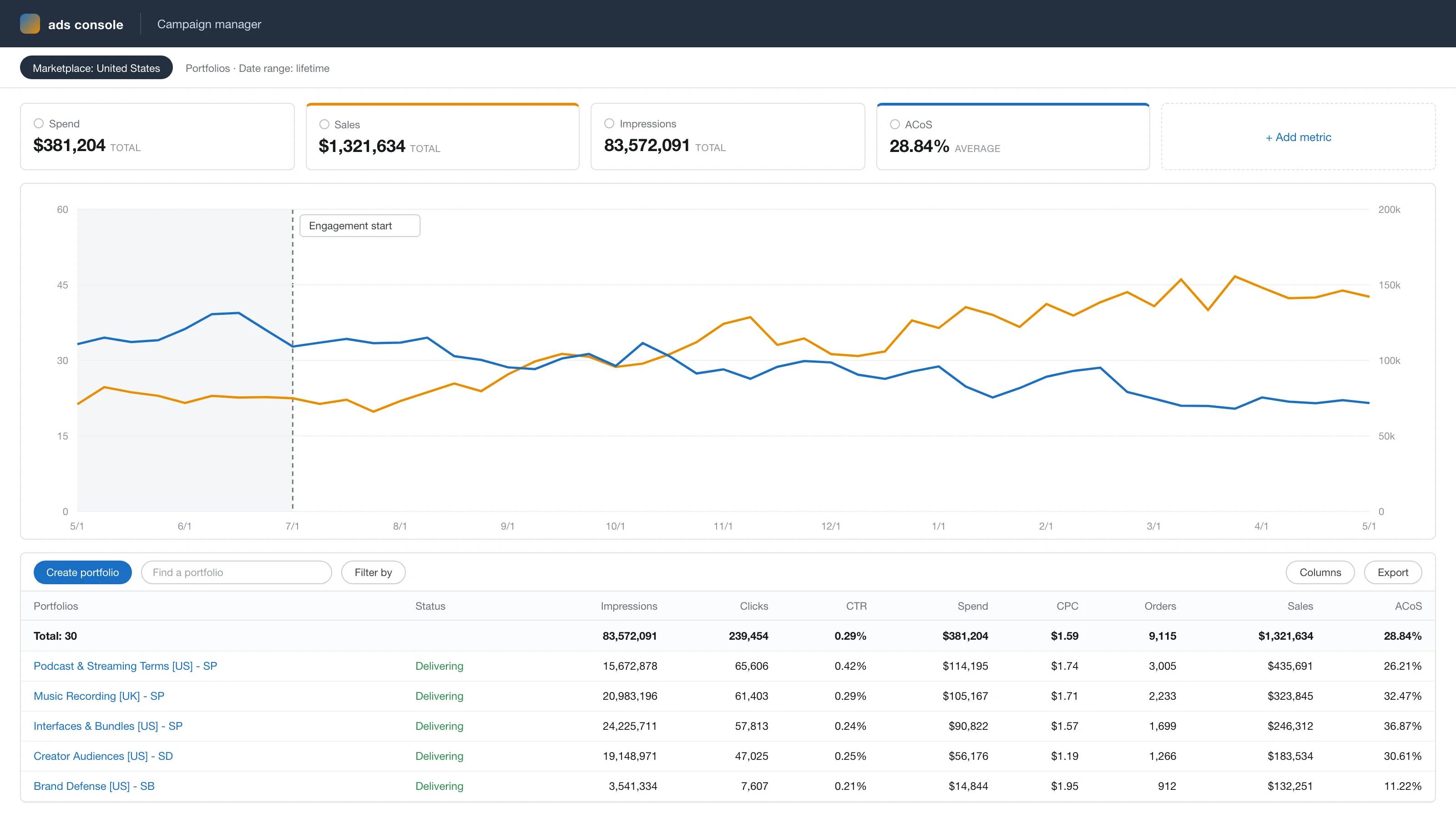
Anonymized account view, rebuilt from the figures reported above: ad sales growing from $71k to $153k a month while ACoS falls from 34% to 22% across the 10-month engagement.
The results
Revenue grew 116% to $341k a month, with 44% of it coming from buyers who are not making music at all.
The indexed keyword count almost quadrupled. Nothing was reformulated: the set of searches they could appear in did. One correction along the way mattered — the first pass simplified the music listings too far in pursuit of the new audience, and the spec depth had to go back, because the original buyer still converts on exactly those numbers.
“Our customers had been telling us in reviews for two years what they were using these for. We were still writing for the recording studio.”
Services we delivered
Related case studies

Ready to scale your Amazon brand?
Talk to a senior strategist and leave with a growth plan for your store — no obligation.