
Proving it was an instrument in a category flooded with toys
Conversion +79%, price up 28%
Shoppers could not tell a real ukulele from a painted toy at thumbnail size, so they defaulted to the cheapest. We made the difference visible in the first three seconds.

At a glance
- Category
- Ukuleles & Folk
- Marketplaces
- US
- Revenue at start
- $31k / month
- Context
- Search page dominated by $19 toy-grade listings
- Engagement
- Creative & content + listing SEO
- Timeframe
- 5 months
Results
The challenge
At thumbnail size a proper ukulele and a decorated toy look the same. Both are small, wooden-ish and photographed against white. The difference lives in things no photograph was showing: geared tuners that hold a tune, a fretboard that is level, a nut cut to the right width. A shopper who cannot see any of that quite reasonably picks the $19 one.
The brand's response had been to write “high quality” and “professional” in the title, which is precisely what the $19 listings also say. Its reviews carried a revealing pattern too — the occasional one-star came from someone who had bought it expecting a toy for a child and found it too serious, while the four- and five-star reviews all mentioned tuning stability. The page was attracting the wrong buyer and failing to prove itself to the right one.$
Our approach
We stopped claiming quality and started showing the parts that contain it.
- Close-ups of the hardware in frames two and three — the tuners, the nut, the fret ends — because those are where the difference physically is.
- Tuning stability demonstrated over time, the single thing owners praise and toy buyers complain about.
- Explicit disqualification — the copy states plainly that this is a playable instrument rather than a decorative gift, which loses a few sales and prevents the one-star ones.
- Search terms that exclude the toy market — playing, tuning and learning phrasing, with negatives on toy and novelty terms in the campaigns.
Inside the ad account
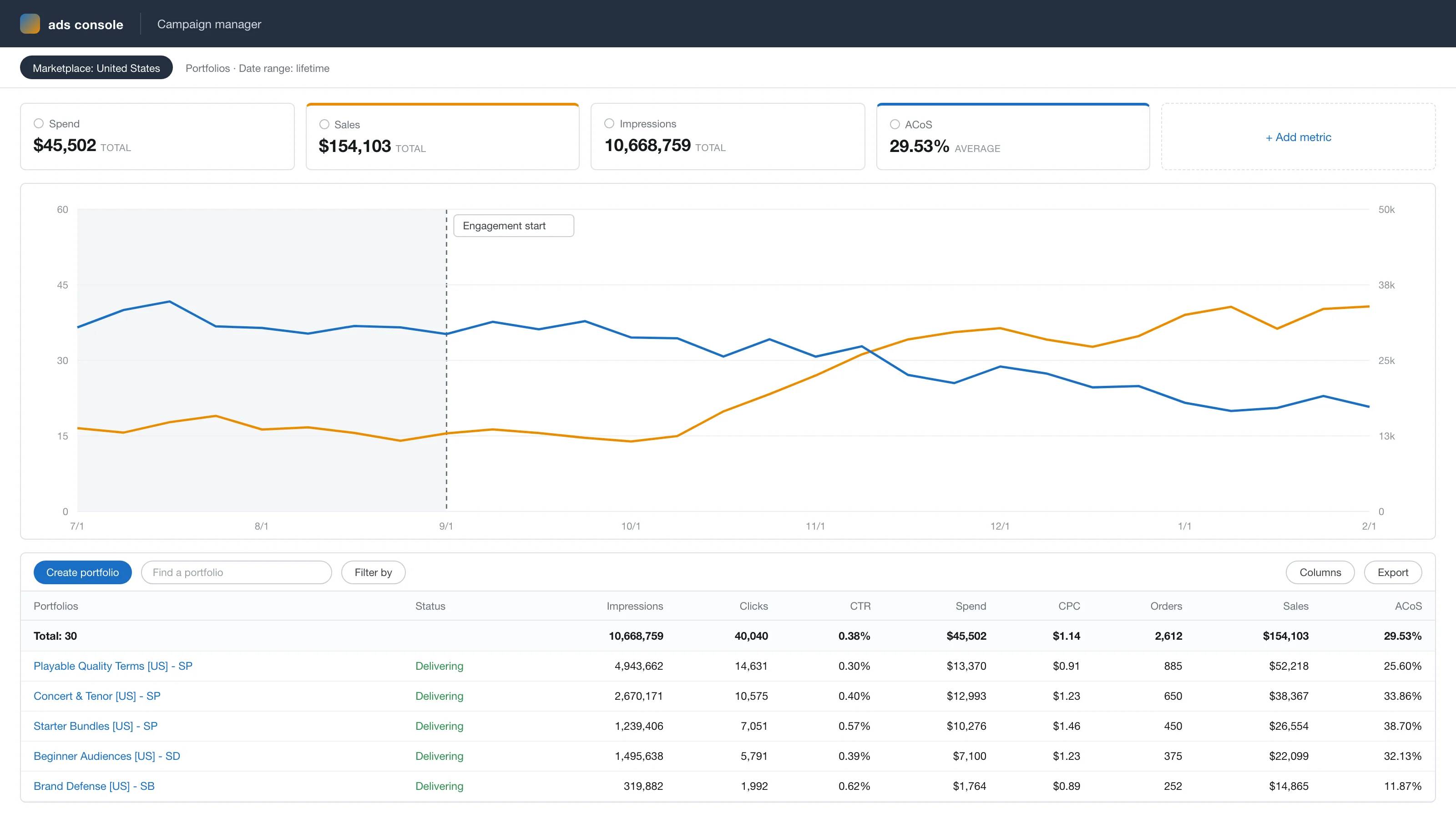
Anonymized account view, rebuilt from the figures reported above: ad sales growing from $14k to $33k a month while ACoS falls from 38% to 22% across the 5-month engagement.
The results
Conversion went from 5.8% to 10.4% and revenue more than doubled in five months, while the average selling price rose 28% — the brand moved buyers onto its better models rather than defending its cheapest.
One-star reviews fell from 9% to 3%, almost entirely by turning away a buyer who was never going to be happy. In a category where the cheapest listing usually wins, the way to beat it is to make the comparison visible rather than to argue about it in adjectives.
“Every listing on that page says “high quality”. The only way to say it credibly was to photograph the tuning pegs.”
Services we delivered
Related case studies



Ready to scale your Amazon brand?
Talk to a senior strategist and leave with a growth plan for your store — no obligation.