
The parent pays, but the band director decides
+138% revenue in student instruments
Parents would not buy a student instrument without someone qualified approving it. We rebuilt the listings so they could survive being forwarded to a band director.

At a glance
- Category
- Band & Orchestra
- Marketplaces
- US
- Revenue at start
- $76k / month
- Buying pattern
- Parent purchases, school program specifies
- Engagement
- Listing SEO + PPC
- Timeframe
- 14 months
Results
The challenge
A student instrument is bought by a parent who cannot evaluate it and will not risk being wrong. The actual decision sits with a third person who is never on the page: the band or orchestra director, who has a list of what the program requires and a strong opinion about which cheap instruments are not worth repairing.
So the purchase has an approval step built into it. A parent finds a candidate, screenshots it, and asks someone at the school whether it will do. The brand's listings were written to reassure the parent — warm photography, reassurance about beginners — and contained almost none of the information that the person doing the approving needs. Forwarded to a director, the page could not be evaluated, so the answer was usually “rent one from the shop instead”, and a chunk of the sales that did happen came back once the instrument reached a rehearsal.
Our approach
We wrote a page that survives being forwarded.
- Program-relevant specifications stated explicitly — key, bore, materials, included mouthpiece and case type, in the vocabulary a director uses.
- Serviceability made visible — standard parts, replaceable pads and springs, since “can it be repaired locally” is the question that kills cheap instruments.
- A comparison against rental-grade instruments, which is the real alternative the parent is weighing rather than another Amazon listing.
- Search terms covering the approval language — student model, program and grade phrasing that appears when a parent has been told what to look for.
How we worked
- 1
Interviewing the deciders
Conversations with directors and repair technicians on what disqualifies an instrument, then the disqualifiers checked against the brand's own products.
- 2
Spec disclosure
Every specification a director asks about published on the listing, including the two the brand had been vague about.
- 3
Serviceability content
Parts availability and repair standards documented and added to A+, with the repair technician as the implied reader.
- 4
Rental comparison
A like-for-like comparison against a season of rental, built as information rather than as a sales argument.
- 5
Return audit
Returns re-examined after six months: the remaining cases were size mismatches, which drove one further round of sizing guidance.
Inside the ad account
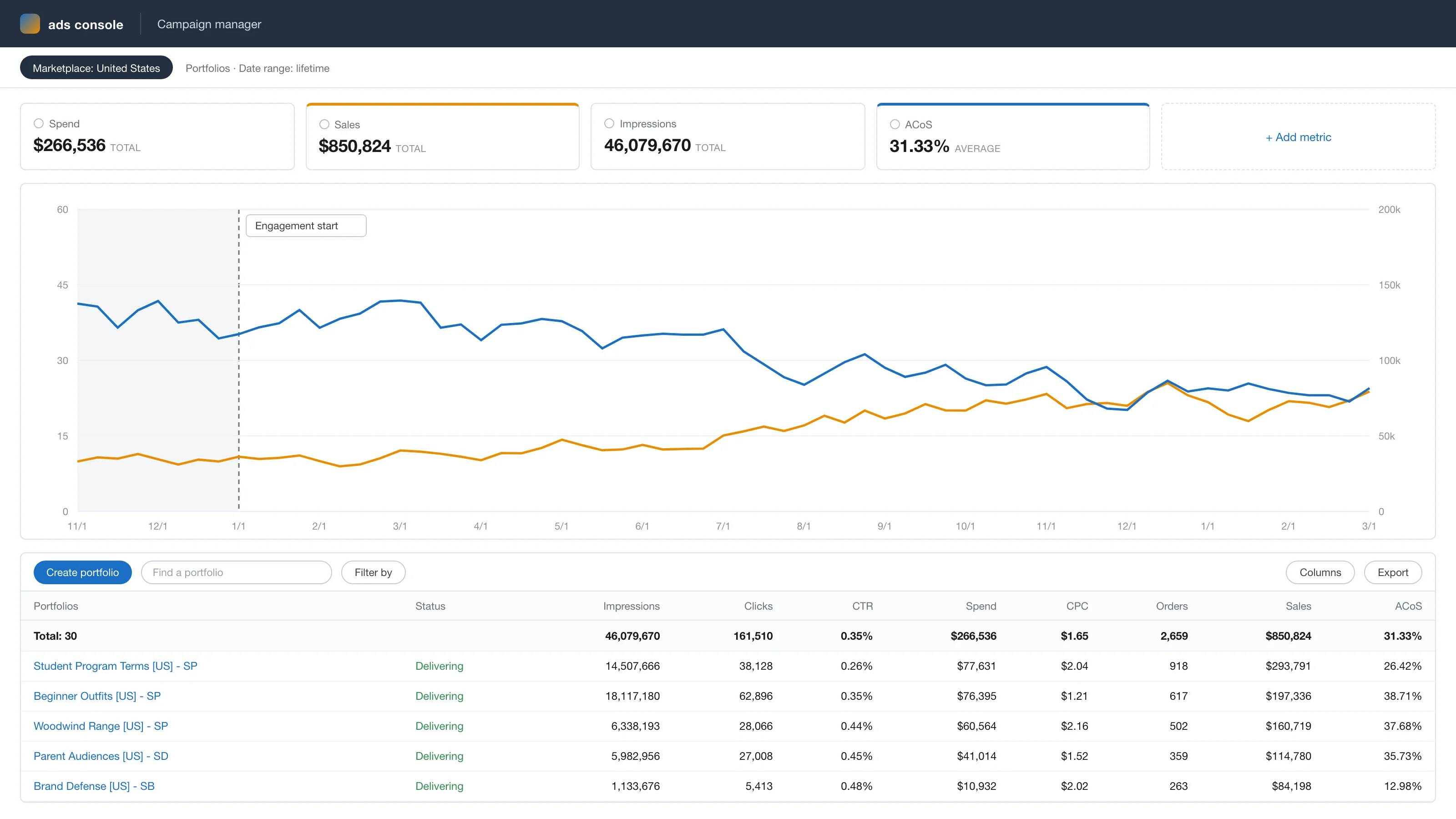
Anonymized account view, rebuilt from the figures reported above: ad sales growing from $34k to $81k a month while ACoS falls from 37% to 22% across the 14-month engagement.
The results
Revenue grew 138% to $181k a month over fourteen months — slow at first, because the approval loop means the market's opinion of a brand updates at the speed of a school year.
Returns fell from 17% to 7% once instruments stopped arriving at rehearsals and being judged unsuitable. The ranking footprint on student and program phrasing went from 85 keywords to 690, which is how the brand got in front of parents who had already been told what to look for.
“The parent was never our customer's decision-maker. We just kept writing to them because they were the one holding the card.”
Services we delivered
Related case studies


Ready to scale your Amazon brand?
Talk to a senior strategist and leave with a growth plan for your store — no obligation.