
When an operating system update breaks a product you shipped two years ago
Rating 3.6 → 4.1
Hardware that worked perfectly at launch started collecting one-star reviews after a major OS release. The product had not changed — the computers it plugged into had.

At a glance
- Category
- Computers & Accessories
- Marketplaces
- US, UK, DE
- Revenue at start
- $412k / month, declining
- Trigger
- Two major OS releases in 14 months
- Review base
- 2,400 reviews on the hero ASIN, ~190 new per month
- Engagement
- Full account management + creative
- Timeframe
- 11 months
Results
The challenge
The brand's devices had shipped for years with ratings in the mid-fours. Then a major desktop OS release changed how third-party drivers are signed, and within eight weeks a third of all new reviews were one star, describing a product that had stopped working after an update the customer did not connect to the device at all.
The engineering team had shipped a fix within a month. Nobody knew. The updated driver lived on a support page the customer would only find if they already suspected a driver was the problem — and a shopper who has just plugged in a new device and seen nothing happen does not suspect anything. They write a review and return the box. Meanwhile the listing, the images and the A+ all still showed a product from before the problem existed, so the page was silently arguing against the most recent thing every visitor read in the reviews.
Our approach
We treated post-purchase software support as a merchandising problem, not a support-desk one.
- Compatibility stated by OS version on the listing and in the image stack, updated within days of each OS release rather than annually.
- The first-run experience rebuilt in creative — the update step shown as part of setup, so it reads as normal rather than as a rescue.
- The Brand Registry critical-review contact tool on every OS-related complaint — public replies to reviews have not existed since 2020, so the message goes to the buyer with the specific fix and a two-line path to it.
- Insert card and packaging copy revised with the brand's engineering team, so the box itself sets the expectation the listing does.
How we worked
- 1
Review forensics
Nine months of one-star reviews coded by cause: 71% traced to two OS releases, not to hardware failure.
- 2
Compatibility matrix published
Every SKU mapped to the OS versions it supports with and without a driver update, stated on the page in plain language.
- 3
Setup content rebuilt
Image frames four and five turned into a three-step first-run sequence that includes the update, plus a short A+ module in place of a feature grid.
- 4
Response cadence
Every new OS-related one-star review contacted within 48 hours with the actual fix; the nine-month backlog worked through oldest-first over six weeks.
- 5
Standing release process
A checklist that fires on each OS beta, so the listing is updated before the release reaches customers, not after.
Inside the ad account
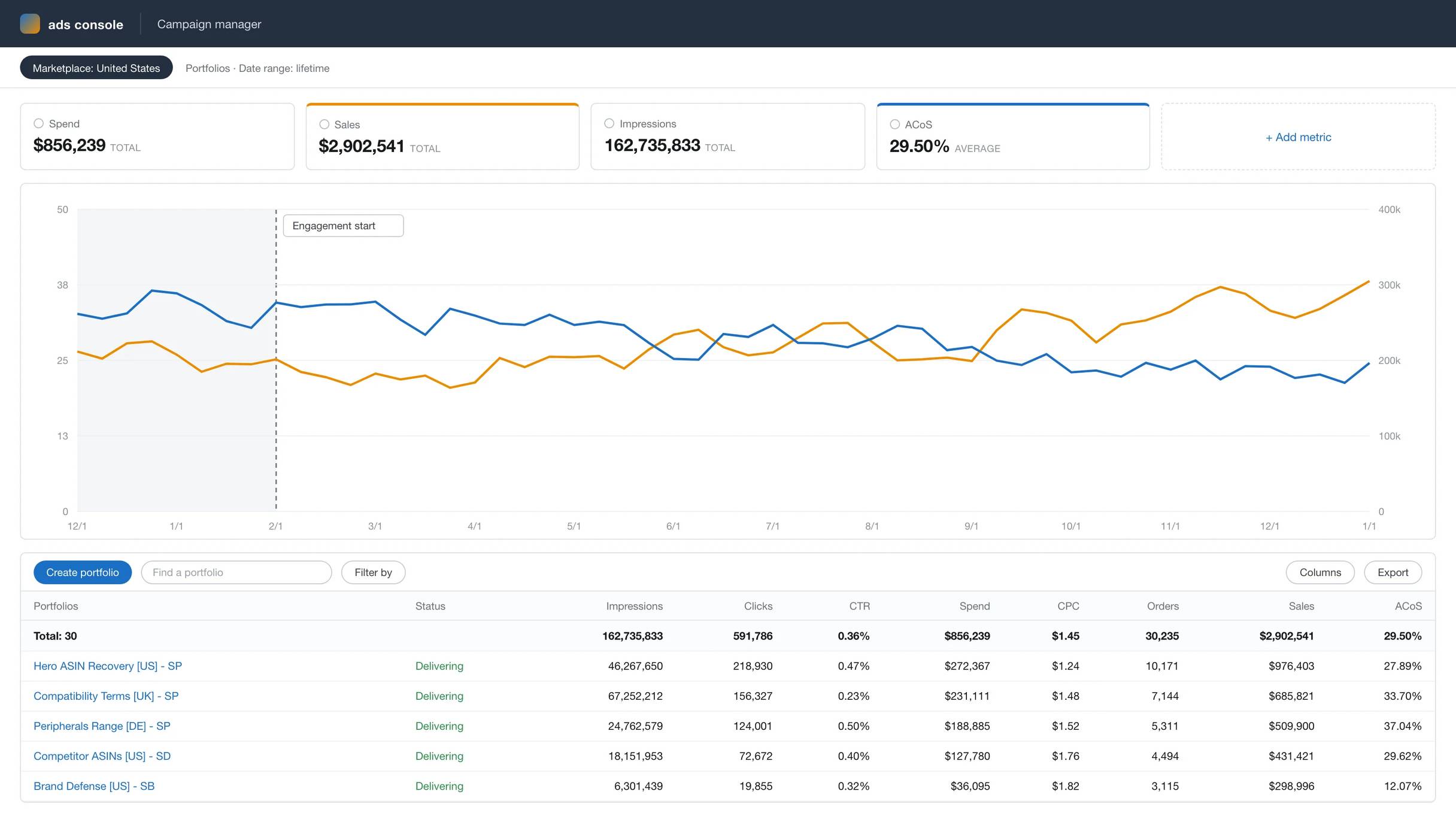
Anonymized account view, rebuilt from the figures reported above: ad sales growing from $185k to $264k a month while ACoS falls from 34% to 24% across the 11-month engagement.
The results
The hero ASIN recovered from 3.6 to 4.1 stars, and one-star reviews fell from 31% of new reviews to 6%.
Revenue grew 42% without a single change to the hardware line, because the rating had been suppressing both conversion and ad rank at the same time — a listing under four stars pays more per click and converts fewer of them. The durable part is the release checklist: the next OS update is now a scheduled content change rather than a quarter spent explaining a fix that already existed.
“Our engineers fixed it in three weeks. It took us another year to tell anyone, and the reviews were written in the gap.”
Services we delivered
Related case studies



Ready to scale your Amazon brand?
Talk to a senior strategist and leave with a growth plan for your store — no obligation.