
Cutting ACoS from 44% to 21% while growing an outdoor brand 68%
ACoS 44% → 21%
A seasonal outdoor gear brand was buying every sale at a 44% ACoS. A rebuilt campaign structure, strict search-term control and stronger creative more than halved it — while revenue still grew 68%.

At a glance
- Category
- Sports & Outdoors
- Marketplaces
- US + CA
- Revenue at start
- $187k / month
- Ad spend at start
- $35k / month
- Catalog
- 31 ASINs
- Engagement
- PPC + creative
- Timeframe
- 8 months
- Team
- Account lead, PPC specialist, designer
Results
The challenge
The brand made durable outdoor gear with strong reviews and a genuine seasonal peak between April and August. It was doing $187k a month — but at a 44% ACoS, and advertising was consuming almost a fifth of total revenue. Every growth plan the owner modelled ended the same way: more sales, less profit.
The account had been run almost entirely on automatic and broad-match campaigns. That had been a reasonable way to discover demand in year one, but nothing had ever been promoted into controlled, exact-match structures, so the brand kept paying discovery prices for keywords it had already proven. More than a quarter of spend was going to search terms that had never produced a sale. Seasonality made it worse: budgets were set once and left alone, so the account overspent in the shoulder months and ran out of budget exactly when demand peaked.
Our approach
The goal was not to spend less — it was to stop paying discovery prices for demand the brand had already proven.
- PPC restructure — moved proven search terms out of automatic and broad campaigns into controlled exact-match structures with their own budgets and bids, so known winners stopped competing with open-ended discovery.
- Search-term control — established a weekly harvest-and-negate routine that cut off the long tail of terms spending without converting, while keeping a small, capped discovery budget running.
- Seasonal budget planning — built a month-by-month plan tied to the category's demand curve, front-loading budget into the peak and pulling it back in the shoulder season.
- Creative content — rebuilt main images and A+ for the top-revenue ASINs, lifting conversion so the same bids returned more, which is what made the lower ACoS sustainable rather than a symptom of cutting spend.
How we worked
- 1
Search-term forensics
Twelve months of search-term reports were analysed to separate terms that had genuinely produced sales from the long tail that had only ever produced spend.
- 2
Promote the winners
Proven converting terms were promoted into dedicated exact-match campaigns with their own budgets, so they were no longer bidding against the brand's own discovery campaigns.
- 3
Cap and contain discovery
Automatic and broad campaigns were kept alive but capped, turning open-ended discovery from the main spend channel into a small, deliberate research line.
- 4
Creative rebuild on top ASINs
Main images and A+ were rebuilt for the products carrying most of the revenue, lifting conversion so lower bids still won profitable placements.
- 5
Seasonal budget calendar
Budgets were mapped to the category demand curve month by month, so spend concentrated in the peak instead of leaking through the off-season.
Timeline
Diagnose the waste
- 12 months of search-term data analysed
- Non-converting spend quantified per campaign
- Restructure and seasonal plan agreed with the owner
Restructure
- Winning terms promoted into exact-match campaigns
- Automatic and broad campaigns capped
- Weekly harvest-and-negate routine started
Lift conversion
- Main images and A+ rebuilt for top-revenue ASINs
- Bids re-set against the improved conversion rate
- ACoS falling while sales volume held
Scale into the peak
- Budget front-loaded into peak season
- Efficiency gains reinvested rather than banked
- Revenue growing on a materially lower ACoS
Inside the ad account
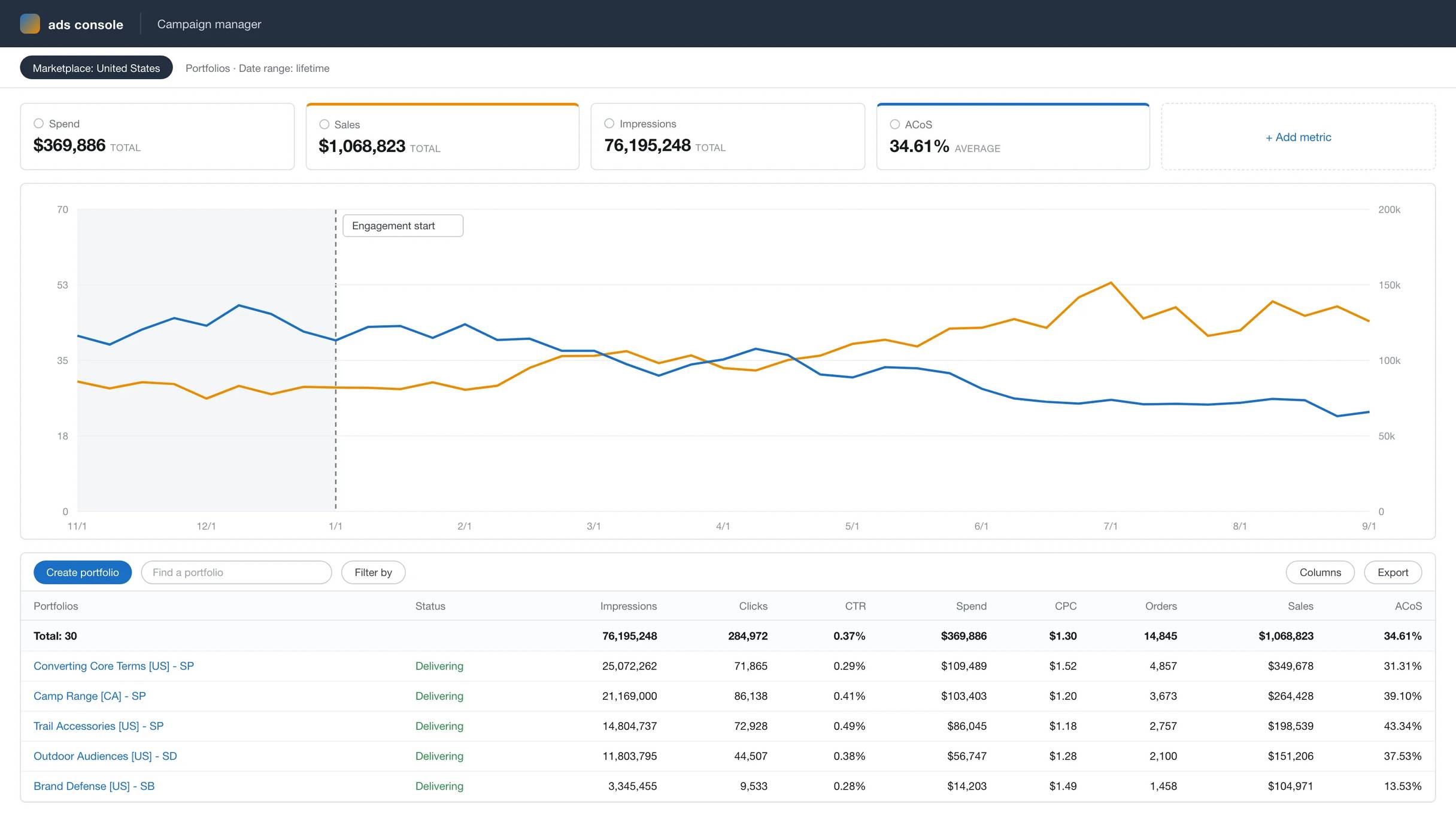
Anonymized account view, rebuilt from the figures reported above: ad sales growing from $84k to $141k a month while ACoS falls from 44% to 21% across the 8-month engagement.
The results
ACoS fell from 44% to 21% and TACoS from 19% to 9%, while monthly revenue still grew from $187k to $314k — a 68% increase. Spend on search terms that never converted dropped from 27% of the budget to 8%.
The important detail is that efficiency did not come from spending less. Ad spend rose in absolute terms across the peak season; it simply went to demand the brand had already proven it could convert, at prices that reflected that. With advertising taking half the share of revenue it used to, the owner could reinvest into inventory ahead of the next season instead of funding the previous season's discovery.
“We thought we had a bidding problem. We actually had a structure problem — we were paying full price to learn things we already knew.”
“Halving our ACoS in a growth year was the difference between reinvesting in inventory and just breaking even.”
Services we delivered
Related case studies




Ready to scale your Amazon brand?
Talk to a senior strategist and leave with a growth plan for your store — no obligation.