
Proving the cards are real before the buyer has to wonder
Counterfeit claims 14 → 0.6 per 1,000
Counterfeits in the category had made buyers suspicious of everyone, including the legitimate seller. Serialized authentication turned a category-wide fear into this brand's reason to be chosen.

At a glance
- Category
- Collectibles & Trading Cards
- Marketplaces
- US
- Revenue at start
- $390k / month
- Problem
- 14 counterfeit claims per 1,000 orders; rating 4.0
- Engagement
- Full account management + creative
- Timeframe
- 10 months
Results
The challenge
The category is full of fakes, and shoppers know it. A buyer opening a sealed pack has no way to distinguish a genuine one from a convincing counterfeit except by outcome, so a proportion of them assume the worst whenever a pull disappoints them — and the seller wears the claim, the refund and the one-star review.
Fourteen counterfeit claims per thousand orders is what that looks like at scale. Most of them were not fraud on either side; they were a shopper with no way to verify what they had bought. The rating sat at 4.0 as a result, in a category where the rating is the only trust signal a buyer has, and the fear was self-reinforcing: every “might be fake” review on the page made the next shopper more likely to file the same claim.
Our approach
We gave the buyer proof that does not rely on trusting the seller.
- Serialized authentication codes applied per unit through Amazon's Transparency program, so each item can be verified independently by the buyer.
- Verification shown as a step in the creative — the image stack demonstrates how to check the code, which is itself the trust signal.
- Sourcing stated plainly — the brand's own print-to-pack chain described in the A+ rather than implied.
- Claim-handling rewritten so a verified code resolves a dispute in one message instead of a refund and a review.
How we worked
- 1
Claim analysis
Ten months of counterfeit claims read individually; 80% involved no verification attempt of any kind, on either side.
- 2
Serialisation rollout
Unique codes applied at the packing stage, starting with the four highest-claim ASINs.
- 3
Proof content
Verification demonstrated in the image stack and in a short A+ module, so the code is visible before purchase, not only after.
- 4
Dispute playbook
A standard response that resolves a verified item in one exchange; unverifiable ones escalated properly.
- 5
Review recovery
Once claims dropped, the accumulated fresh reviews moved the hero product from 4.0 to 4.5 over two quarters.
Inside the ad account
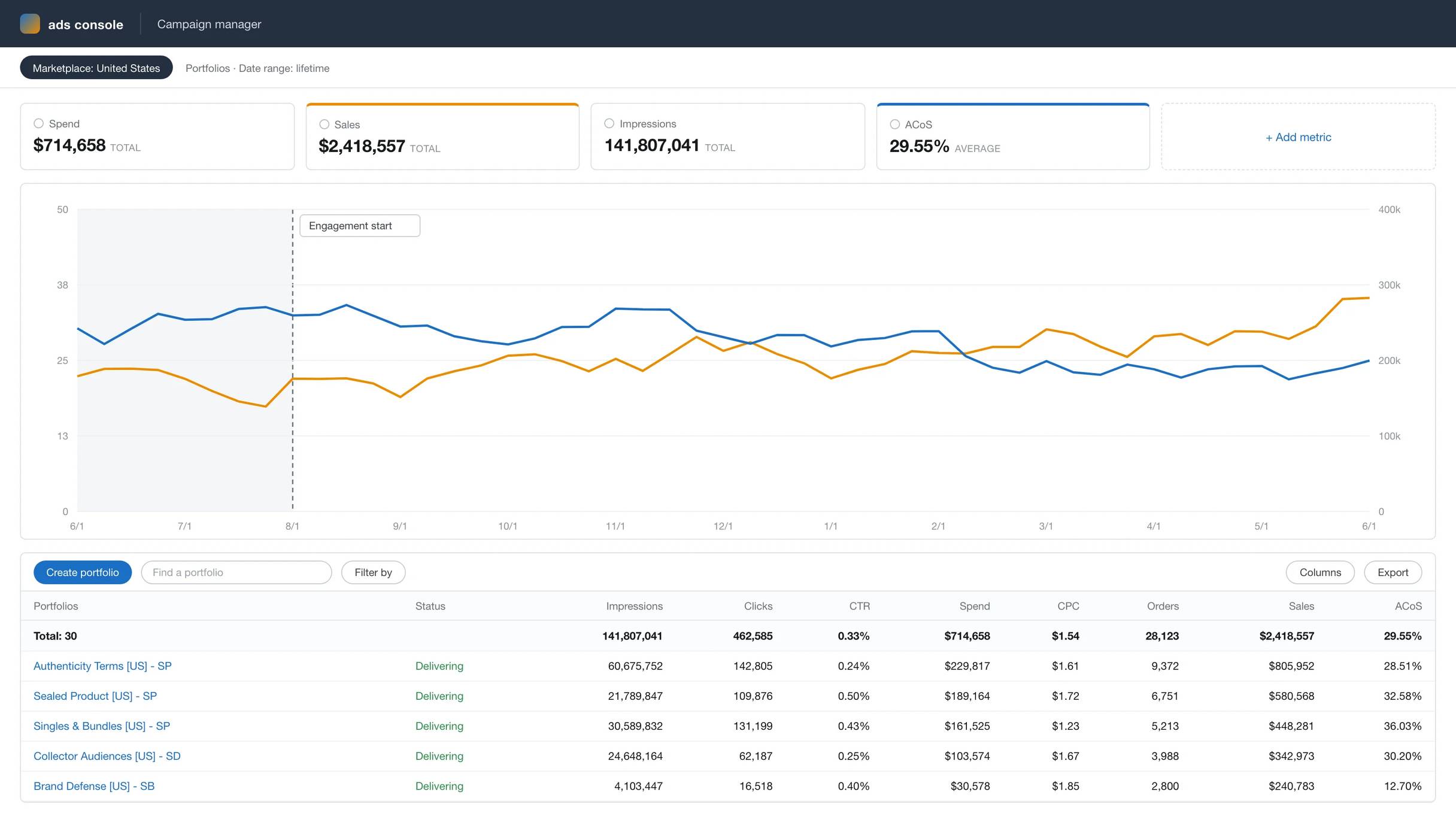
Anonymized account view, rebuilt from the figures reported above: ad sales growing from $176k to $252k a month while ACoS falls from 32% to 23% across the 10-month engagement.
The results
Counterfeit claims fell from 14 to 0.6 per thousand orders and A-to-z claims by 89%, while revenue grew 44%.
The growth is a consequence of the trust, not a separate initiative. In a category where every listing looks the same and the buyer's main fear is being cheated, the seller who can prove authenticity at the point of sale is the one that gets chosen — and the rating recovery from 4.0 to 4.5 compounds that, since rating is the first filter a collector applies.
“Half the reviews we were getting weren't about our product at all. They were about the category's reputation, and we were paying for it.”
Services we delivered
Related case studies




Ready to scale your Amazon brand?
Talk to a senior strategist and leave with a growth plan for your store — no obligation.