
A year's worth of reviews arriving in six weeks, then silence
Non-Q4 revenue share 22% → 47%
A kids' electronics brand sold almost everything in December, so its reviews arrived in one burst and its ranking decayed for the other eleven months. Building non-gift demand fixed the ranking, not just the revenue.
At a glance
- Category
- Kids' Electronics
- Marketplaces
- US, CA
- Revenue at start
- $246k / month average
- Pattern
- 78% of annual revenue in Q4
- Engagement
- PPC + creative
- Timeframe
- 14 months
Results
The challenge
Seventy-eight percent of the year's sales happened in the gifting quarter, and so did seventy-eight percent of the reviews. That concentration did more damage than the revenue numbers suggested.
Amazon's ranking weighs recent sales and recent reviews. A listing that sells enormously in December and quietly from February to September looks, by June, like a product losing relevance — its rank decays month by month until the next Christmas buys it back at full advertising price. The brand had been treating this as a fact of a gifting category. It was actually a self-inflicted loop: the listings only spoke about gifting, so nobody had a reason to buy one in June, so the rank fell, so the next December cost more to win.
Our approach
We gave the product reasons to be bought in the other nine months.
- Non-gift use cases built into the creative — travel and car journeys, screen-time alternatives, holiday-break activity — each with its own frame in the image stack.
- Occasion keywords beyond December — school holidays, road trips, rainy-day, summer break — targeted as their own clusters.
- Spend redistributed across the calendar, holding budget in the quiet months rather than concentrating it where competition is fiercest and most expensive.
- Review velocity tracked as a metric in its own right, with the Request a Review automation running on every order all year instead of only after the December wave.
Timeline
Diagnose
- Rank decay mapped month by month against review arrival
- Non-gift use cases identified from existing review language
- Budget held back from the December peak for the first time
Build the off-season
- Travel and school-holiday creative shipped
- Off-season keyword clusters launched with their own budgets
- Reviews per month in the quiet period up from 19 to 54
Compound
- Entered Q4 from rank #9 rather than #41
- Peak-season ACoS fell as less rank had to be repurchased
- Non-Q4 revenue share reached 47%
Inside the ad account
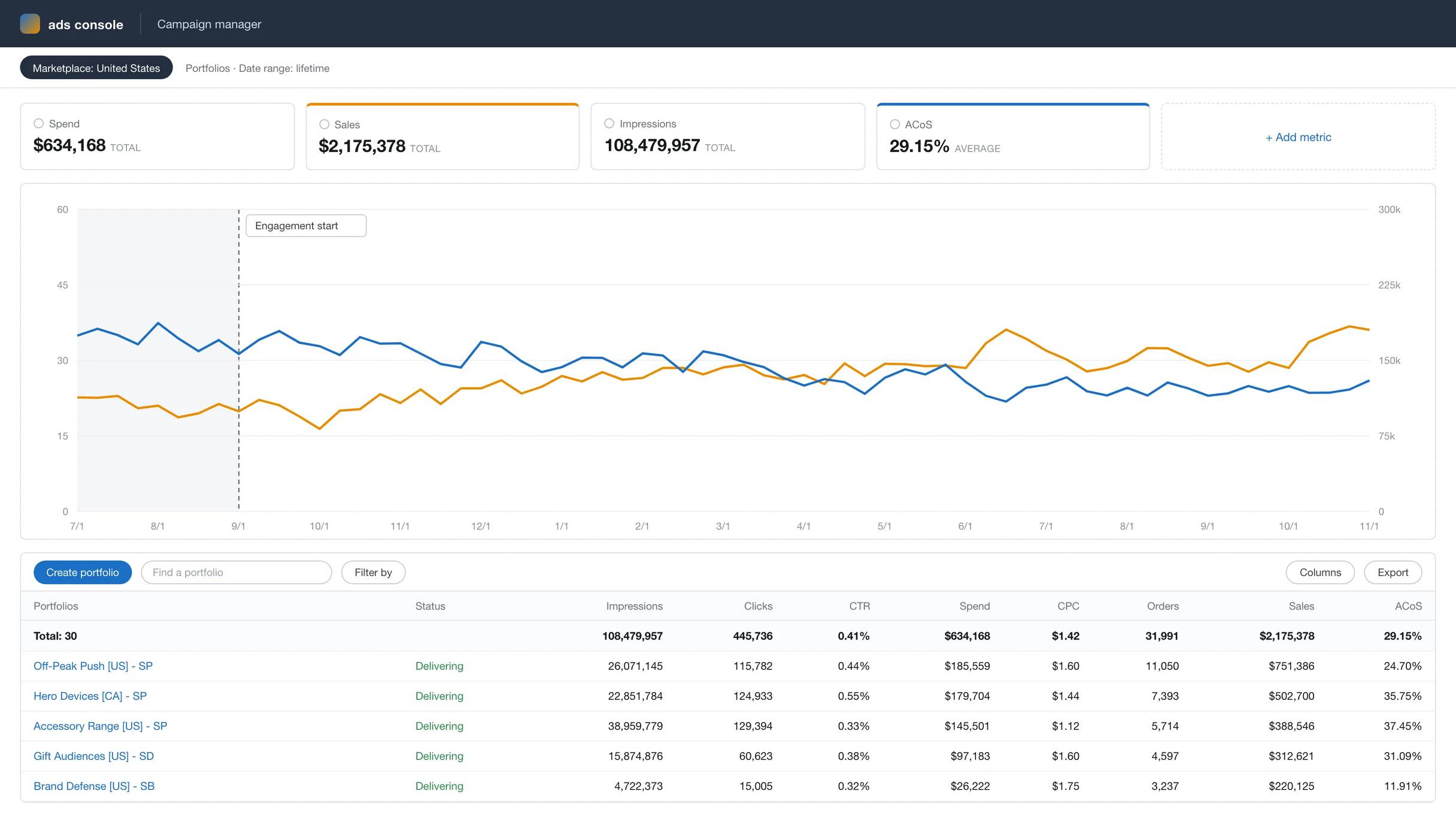
Anonymized account view, rebuilt from the figures reported above: ad sales growing from $111k to $167k a month while ACoS falls from 34% to 23% across the 14-month engagement.
The results
Revenue outside the gifting quarter went from 22% to 47% of the total, and the annual average rose 26%.
The ranking explains most of it. By holding sales and review velocity through the quiet months, the hero listing entered the following December at #9 instead of #41 — so the peak began from a position the brand had held all year rather than one it had to buy back. A flatter year is worth more than a taller December, because the December is cheaper when the rest of the year has already been paid for.
“Every year we spent the fall buying back a ranking we'd let go of in February. It took us a long time to see that as a choice.”
Services we delivered
Related case studies




Ready to scale your Amazon brand?
Talk to a senior strategist and leave with a growth plan for your store — no obligation.