
Ranking for the ingredient, not the product type
+50% sessions
Skincare shoppers search for molecules — niacinamide, azelaic acid, peptides — and the brand's listings were written around product categories. We rebuilt the catalog around what people actually type.

At a glance
- Category
- Skin Care
- Marketplaces
- US
- Revenue at start
- $167k / month
- Engagement
- Listing SEO + PPC
- Timeframe
- 8 months
Results
The challenge
The brand sold a serum, a moisturiser and a cleanser, and its listings said exactly that. Meanwhile the category's search behavior had shifted years earlier: shoppers who read skincare content search for the active ingredient and a concern — “niacinamide serum for pores”, “azelaic acid for redness” — because that is how the content they consume is written.
Competing on “face serum” meant bidding against every brand in the category at $2 a click for a shopper with no stated need. The ingredient terms were cheaper, more specific, converted better, and the brand was invisible on all of them because the words were in the product's ingredient list rather than in its title, bullets or backend.$
Our approach
We rewrote the catalog in the language of the category's own discourse.
- Ingredient-and-concern keyword map — every active in the formulas paired with the concerns it is searched alongside.
- One primary ingredient per listing — each product leads with the actual hero active rather than claiming all of them.
- Concern language in the bullets — pores, redness, texture, barrier, written the way shoppers describe them rather than in clinical terms.
- Campaigns following the map, with exact-match on ingredient-concern pairs where competition and cost per click are far lower.
Inside the ad account
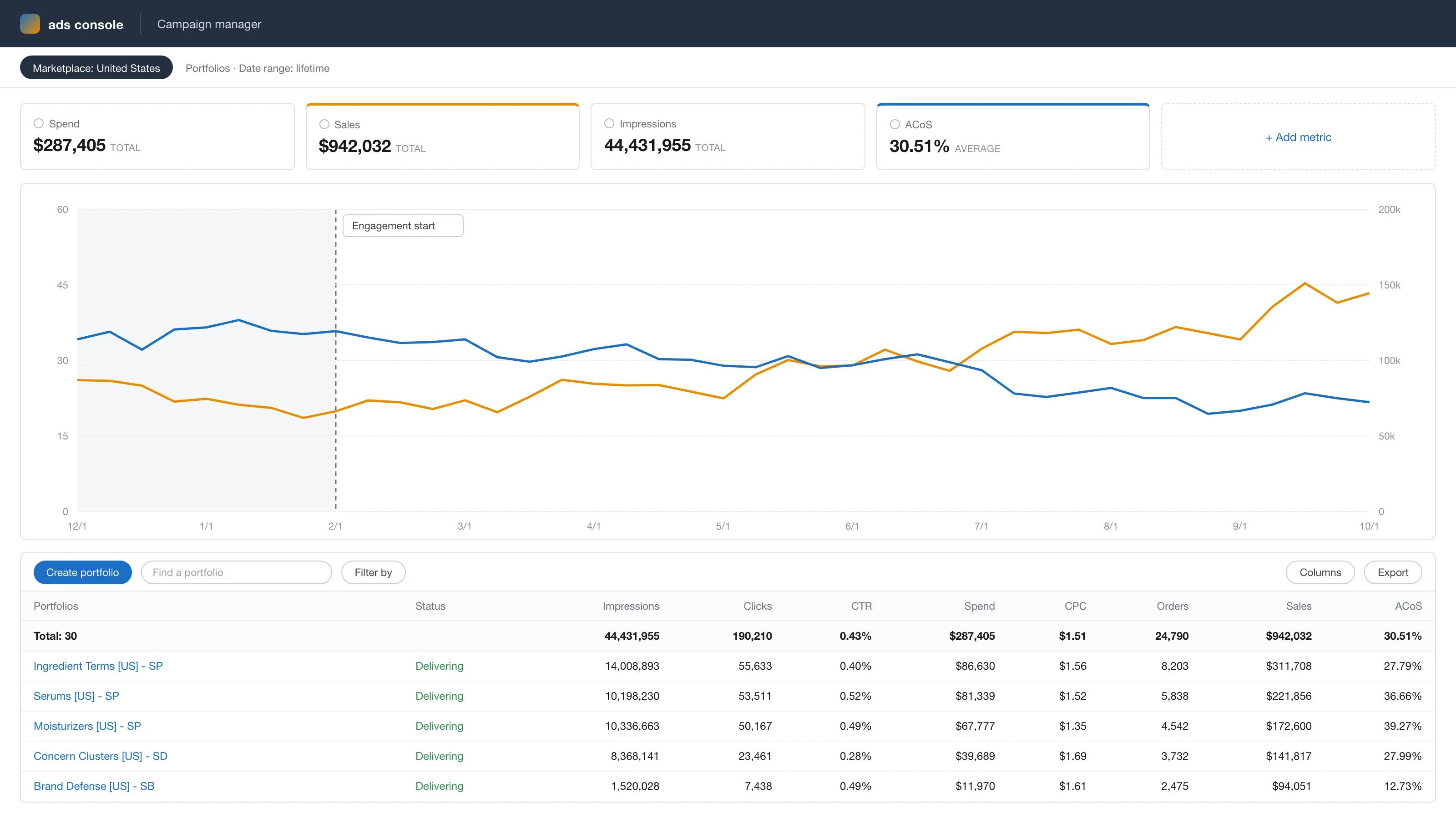
Anonymized account view, rebuilt from the figures reported above: ad sales growing from $75k to $130k a month while ACoS falls from 34% to 21% across the 8-month engagement.
The results
Sessions grew by half — 62k to 93k a month — and revenue grew 73%.
Almost half of revenue now comes through ingredient terms that the brand did not rank for at all a year ago, and blended cost per click fell 40% because that traffic is dramatically cheaper than the category head. The formulas did not change; only the words describing them did.
“Every ingredient we now rank for was already in the bottle. It just wasn't in the title.”
Services we delivered
Related case studies



Ready to scale your Amazon brand?
Talk to a senior strategist and leave with a growth plan for your store — no obligation.