
Cutting foundation returns from 19% to 6% with better shade guidance
Return rate 19% → 6%
A foundation range with thirty shades was being bought wrong once in five orders. The fix was not the shades — it was making it possible to choose one on a phone screen.

At a glance
- Category
- Makeup
- Marketplaces
- US
- Revenue at start
- $203k / month
- Problem
- 19% return rate, 78% of them shade mismatches
- Engagement
- Creative & content + account management
- Timeframe
- 7 months
Results
The challenge
Nineteen percent of foundation orders came back, and the return reasons were unambiguous: the shade was wrong. That is a brutal number in a category where the return also costs the review — a customer who ordered the wrong color usually blames the product.
The listing gave them no way to succeed. Shade names were poetic rather than descriptive, the swatch image was a row of circles photographed under warm studio light, and there was no undertone guidance anywhere. Choosing correctly required knowledge the shopper did not have and the page did not provide.
Our approach
We treated shade selection as the product's main usability problem.
- Swatches on real skin, photographed in consistent neutral light across the full range rather than as abstract dots.
- Undertone framework on the page — a simple, repeatable way to self-identify, applied identically to every shade.
- A depth-and-undertone scale — every shade given a number on one 1–30 depth ladder and a stated undertone, so the range can be calibrated against itself instead of against half-remembered shades from other brands.
- Shade names made descriptive, with the poetic name kept secondary.
How we worked
- 1
Return reason analysis
Eight months of returns coded: 78% were shade mismatches, concentrated in the six lightest and four deepest shades.
- 2
Re-shoot the range
All thirty shades swatched on skin under one lighting setup, so the range is internally comparable for the first time.
- 3
Undertone guidance
A three-question self-identification framework built into the image stack and repeated in A+.
- 4
Naming revision
Descriptive depth and undertone added to every shade name in the variation dropdown.
- 5
Post-change monitoring
Return rate tracked per shade for twelve weeks; two shades still over-returning were re-swatched.
Inside the ad account
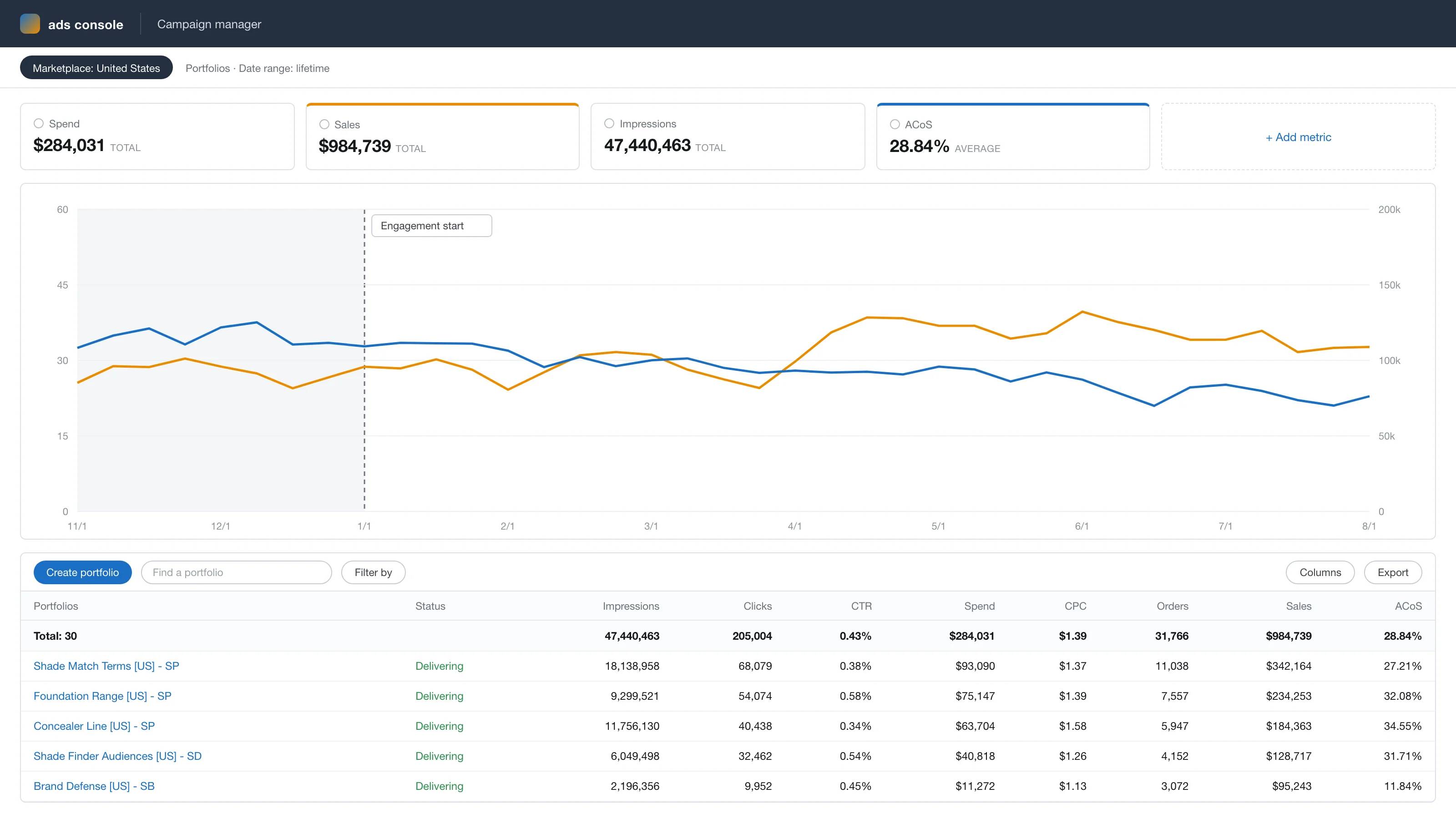
Anonymized account view, rebuilt from the figures reported above: ad sales growing from $91k to $133k a month while ACoS falls from 33% to 23% across the 7-month engagement.
The results
The return rate fell from 19% to 6% — a thirteen-point improvement that goes almost entirely to the bottom line, since returned cosmetics cannot be resold.
Net revenue rose 53% without a matching increase in gross orders. The rating recovered from 3.9 to 4.2, because the reviews that had been punishing the product for the customer's mis-selection largely stopped, and the repeat rate more than doubled: a customer who gets the right shade the first time comes back.
“We assumed a 19% return rate was the price of selling foundation online. It was the price of our swatch photo.”
Services we delivered
Related case studies


Ready to scale your Amazon brand?
Talk to a senior strategist and leave with a growth plan for your store — no obligation.