
The customer who orders too little fabric twice
Second-order rate 31% → 6%
A third of a sewing brand's support tickets were people who had run out mid-project. Telling shoppers how much they needed, before they bought, changed the order size and the reviews at once.

At a glance
- Category
- Sewing
- Marketplaces
- US
- Revenue at start
- $76k / month
- Product
- Fabric sold by the yard, 40+ substrates
- Engagement
- Creative & content + account management
- Timeframe
- 7 months
Results
The challenge
Fabric is sold by the yard and bought by the project, and the shopper has to do the conversion themselves. Most of them underestimate: they forget seam allowance, they forget that a directional print cannot be laid out efficiently, they forget that the width they ordered is narrower than the one the pattern assumed.
The consequence is a customer who runs out halfway through. They reorder — which looked, in the data, like a healthy repeat rate — but the second cut often comes from a different roll, and by then the project has stalled for a week. Nearly a third of orders were followed by one of these, and they generated most of the three-star reviews: not about the fabric, about the experience.
Our approach
We put the arithmetic on the page instead of leaving it to the shopper.
- A yardage table per substrate — how much this fabric, at this width, takes for the projects it is actually bought for.
- Directional and repeat prints flagged explicitly, with the extra allowance stated rather than implied.
- Project-sized cuts listed as their own options — 3, 5 and 8-yard children in the variation strip, because the quantity box always opens at one and nothing on the page can change that.
- Cut-continuity language — a plain statement that a single order ships as one continuous cut, which is the real reason under-ordering hurts.
How we worked
- 1
Ticket and reorder analysis
Six months of support tickets and same-customer repeat orders coded; 31% of orders were followed by a shortfall reorder within 14 days.
- 2
Yardage measurement
Requirements measured in-house across the substrates and the projects the reviews said people made, rather than copied from generic charts.
- 3
Content rebuild
Tables added to the image stack and A+ for all 40 substrates, with the print-repeat allowance called out.
- 4
Project-sized variations
Each substrate given 3-, 5- and 8-yard children sized to the most common project, instead of leaving the amount to the shopper.
- 5
Follow-up check
Reorder rate tracked per substrate for twelve weeks; three heavy-repeat prints needed a second revision.
Inside the ad account
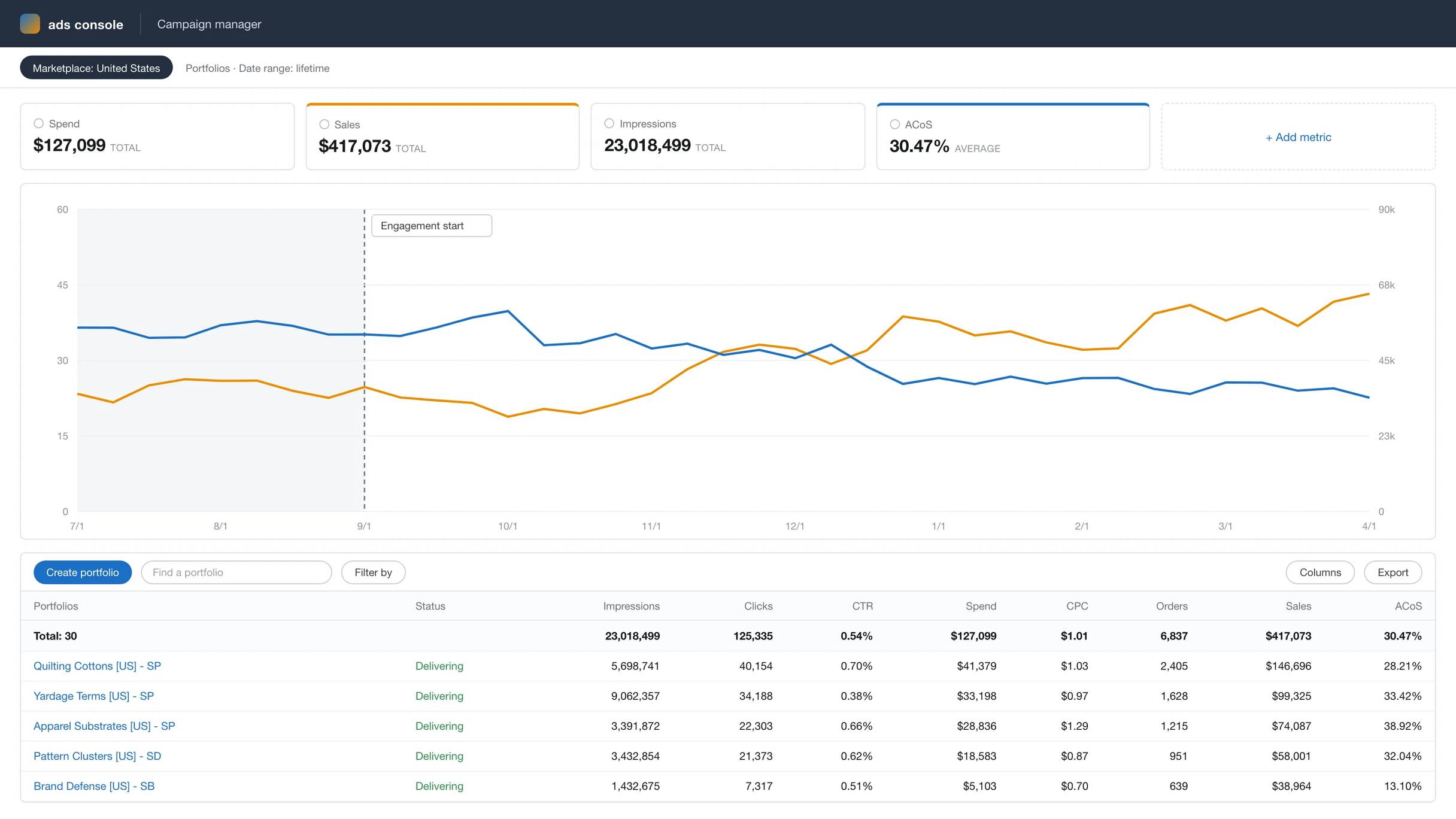
Anonymized account view, rebuilt from the figures reported above: ad sales growing from $34k to $63k a month while ACoS falls from 35% to 23% across the 7-month engagement.
The results
Shortfall reorders fell from 31% of orders to 6%, and average order value rose 79% — the same fabric, ordered once in the right amount instead of twice in the wrong one.
Revenue grew 43% even though the order count fell about a fifth — the corrective second order stopped happening. That surprised the team, who had assumed the reorders were incremental revenue they were about to lose. They weren't. Customers who ran out often abandoned the project or bought the remainder elsewhere, and either way left a mediocre review. The rating moved four tenths once that stopped.
“We thought a high reorder rate meant people loved the fabric. It meant we'd let them buy the wrong amount.”
Services we delivered
Related case studies




Ready to scale your Amazon brand?
Talk to a senior strategist and leave with a growth plan for your store — no obligation.