
A chemical product that could only be sold where it could be shipped
Deliverable footprint 61% → 96% of orders
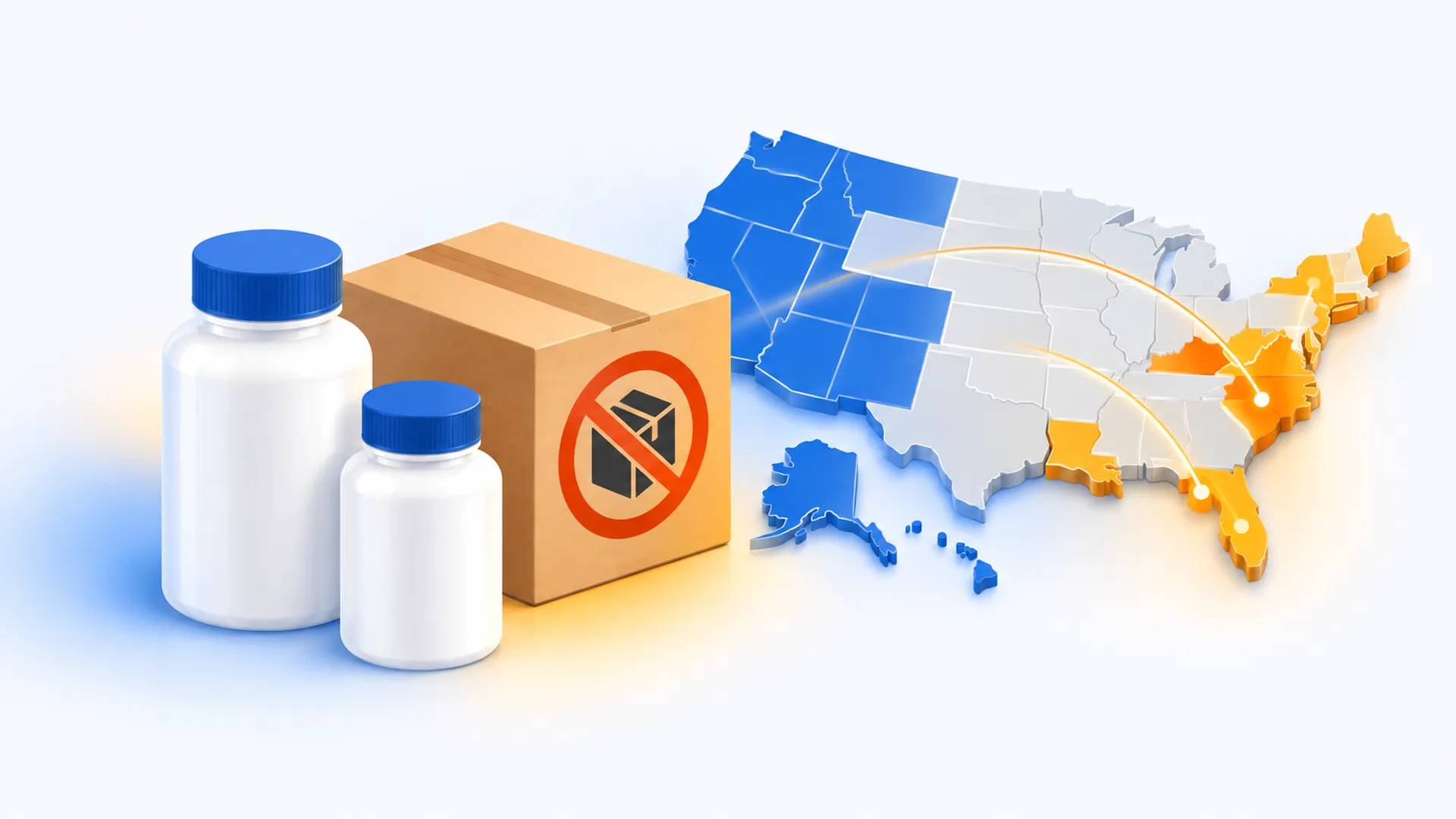
An epoxy brand's listings were suppressed, throttled and unshippable to whole regions because the product's hazmat classification had never been resolved properly. It was a paperwork problem costing a third of the addressable market.
At a glance
- Category
- Resin & Epoxy Crafts
- Marketplaces
- US
- Revenue at start
- $71k / month
- Constraint
- Hazmat review pending, FBA intake blocked
- Engagement
- Full account management + listing SEO
- Timeframe
- 8 months
Results
The challenge
Epoxy is a regulated chemical, and Amazon's hazmat process decides whether it can be stored in a fulfillment center, shipped by air, or shipped at all. The brand had submitted safety documentation once, been partially rejected, and worked around it: ten of fourteen products were merchant-fulfilled by ground, which meant slow delivery, no Prime badge, and refusal to ship to several states and every non-contiguous destination.
The cost was invisible in the sales data because rejected orders never become orders. Roughly two fifths of the demand the listings generated could not be converted into a shipment — and because delivery speed feeds both conversion and ranking, the products that could ship were also under-performing.
Our approach
We treated classification as the growth lever it actually was.
- Complete safety documentation resubmitted — correct sheets, correct flash points, correct UN classification per formulation rather than one generic submission.
- Formulation-by-formulation routing — the products that clear ground-only limits, the ones that clear air, and the ones that genuinely cannot go into FBA, separated instead of lumped together.
- Listings rebuilt for the resolved state, including the shipping and handling language shoppers in this category look for before ordering.
- Ranking re-established after eligibility, with advertising restarted on the newly Prime-eligible products first.
How we worked
- 1
Audit the rejections
Every prior hazmat decision retrieved and read; two of the four blocking issues were missing document fields rather than actual restrictions.
- 2
Resubmit per formulation
Fourteen products documented individually, since the range spans three different flash-point bands treated as one before.
- 3
Re-route fulfillment
Seven products moved into FBA as eligibility cleared, taking the FBA range to eleven of fourteen; the remaining three stayed merchant-fulfilled by ground with the restriction stated on the page.
- 4
Rebuild ranking
Advertising concentrated on the newly Prime-eligible hero products, whose conversion rate rose immediately on delivery speed alone.
- 5
Regional check
Order rejections monitored by destination for eight weeks to confirm the restricted footprint had actually closed.
The results
The share of generated demand the catalog could fulfil went from 61% to 96%, and revenue grew 162% to $186k a month.
Median delivery fell from 6.4 days to 2.1, which did as much work as the extra geography: in a category where a maker has a weekend project planned, a two-day arrival converts and a six-day one does not. Two of the four original blocking issues turned out to be incomplete form fields, which had cost the brand two years of restricted selling.
“We'd accepted for two years that most of our range just couldn't go into FBA. Most of it was a document nobody had filled in properly.”
Services we delivered
Related case studies




Ready to scale your Amazon brand?
Talk to a senior strategist and leave with a growth plan for your store — no obligation.