
Writing listings in the language of the classroom supply list
Revenue $96k → $212k
Parents do not shop for school supplies. They work down a printed list written by a teacher, in the teacher's words and quantities, and the brand's listings were written in none of them.

At a glance
- Category
- School Supplies
- Marketplaces
- US
- Revenue at start
- $96k / month
- Catalog
- 48 ASINs across notebooks, folders and art supplies
- Engagement
- Listing SEO + PPC
- Timeframe
- 5 months
Results
The challenge
A school supply list is a specification document, and the parent holding it is not browsing — they are matching. The list says “wide ruled composition notebook, 100 sheets, 4 count” or “24-count crayons, no glitter”, and the parent types something very close to that into the search box because deviating from the list risks a note home in September.
The brand's listings were written as marketing. Titles led with the brand name and a descriptor like “premium student notebook”; ruling, sheet count and pack quantity appeared in the bullets if at all. So the catalog was invisible for the phrasings that carry almost all of the category's intent, and the brand was instead bidding against everyone else on “school supplies” — a term typed by people who have not yet opened the list and have nothing specific to buy.
Our approach
We rewrote the catalog to be findable by specification rather than by adjective.
- A list vocabulary corpus built from several hundred published classroom supply lists across grade levels, reduced to the attribute phrasings that repeat.
- Titles rebuilt as specifications — ruling, sheet or piece count, pack quantity and grade suitability first, brand language last.
- Pack counts matched to list quantities, with the counts that lists actually call for promoted and the odd sizes demoted in advertising.
- Campaigns built on list phrasings, which are long, specific, far cheaper per click and convert at multiples of the category head term.
Inside the ad account
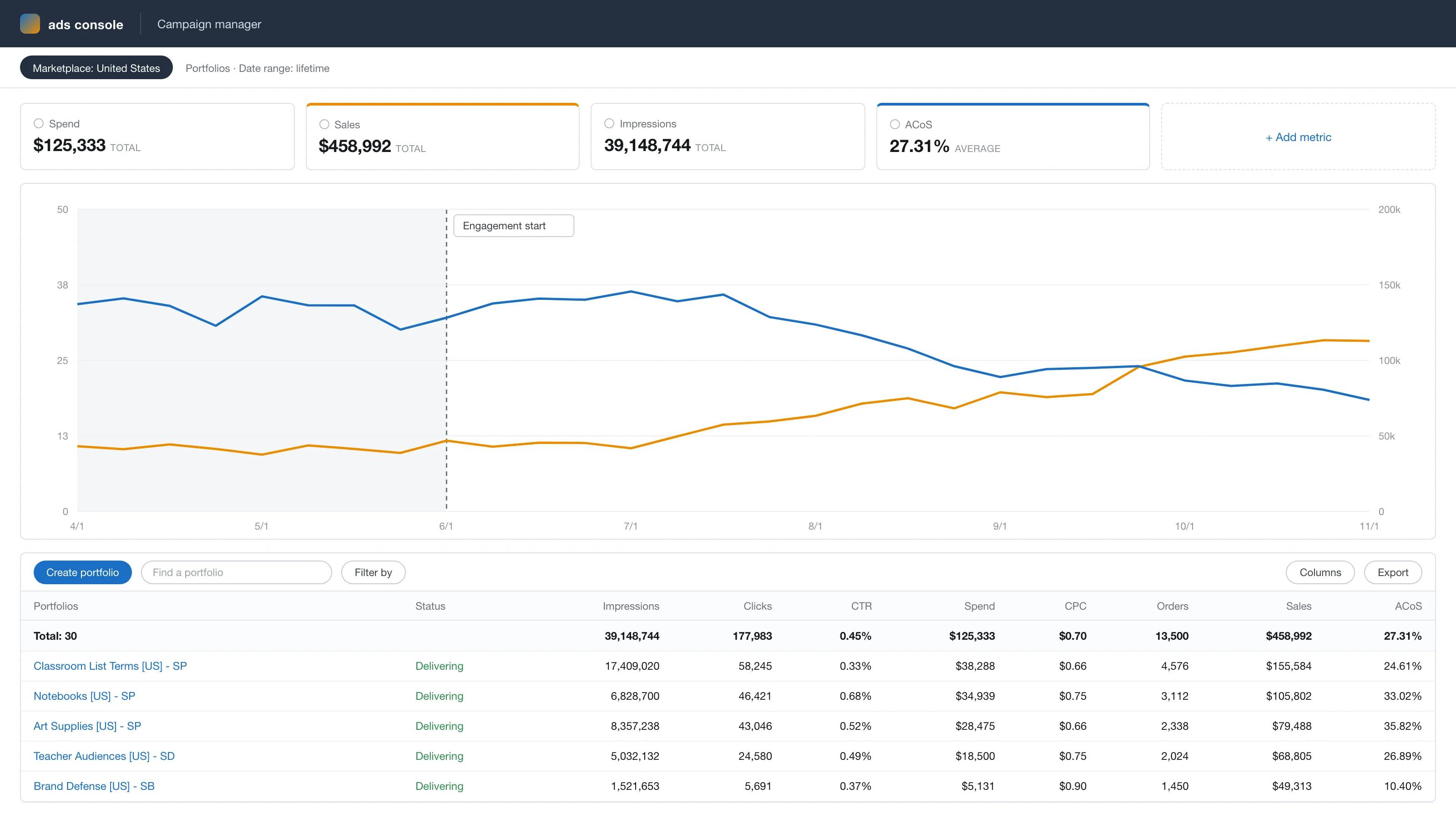
Anonymized account view, rebuilt from the figures reported above: ad sales growing from $43k to $95k a month while ACoS falls from 34% to 21% across the 5-month engagement.
The results
Revenue more than doubled, to $212k a month, on sessions up 75% and conversion up 27%.
Every figure here is measured against the same weeks a year earlier, which matters in a category where August alone can carry a quarter of the year. Blended cost per click fell 42% at the same time, which is the same fact seen from the other side: specification searches are cheap precisely because they are typed by someone who has already decided what they need. No product was altered — the brand simply started describing what it already sold in the words its customers were handed by a teacher.
“We spent our budget on the words we'd use to describe a notebook. The words that mattered were on a sheet of paper in a kid's backpack.”
Services we delivered
Related case studies


Ready to scale your Amazon brand?
Talk to a senior strategist and leave with a growth plan for your store — no obligation.