
Bidding on what a clinic is worth, not on what it orders first
New-to-brand orders +218%
The brand judged every campaign on the profitability of a single order in a category where the first order is a test and the thirtieth is the business. Repricing the click to a clinic's real value let it outbid everyone.

At a glance
- Category
- Professional Medical Supplies
- Marketplaces
- US
- Revenue at start
- $289k / month
- Buying pattern
- Small trial order, then a standing monthly line
- Engagement
- PPC + full account management
- Timeframe
- 8 months
Results
The challenge
The account was being run to a 22% ACoS target, which the team defended as discipline. In a consumable clinical category it was closer to a ceiling on growth. A practice that buys here does not make a purchase, it adopts a supplier: the first order is a small evaluation — one box, one line item — and if the product performs it becomes a standing order repeated for years. Measured over two years the average new account was worth almost two thousand dollars; measured on the click that acquired it, it was worth about forty.
Every bid in the account was set against the forty. Competitors willing to lose money on a first order were taking the keywords that mattered, and the brand was reading its own restraint as efficiency while its share of new accounts shrank quarter after quarter. Nothing in the standard reporting exposed this, because first-order ACoS and lifetime value are simply different numbers and only one of them was on the dashboard.
Our approach
We changed the number the bids are set against.
- Account value modeled from order history — reorder interval, order size and retention, producing a defensible two-year value per new account rather than a guess.
- Targets set per campaign by buyer type — acquisition campaigns allowed a first-order loss, replenishment and branded campaigns held to strict efficiency.
- New-to-brand orders made the reported metric for acquisition, so the team stopped optimizing the one figure that was actively misleading it.
- A payback rule instead of an ACoS rule — spend permitted up to a defined share of modeled account value, with monthly checks that the cohorts were repeating as modeled.
Inside the ad account
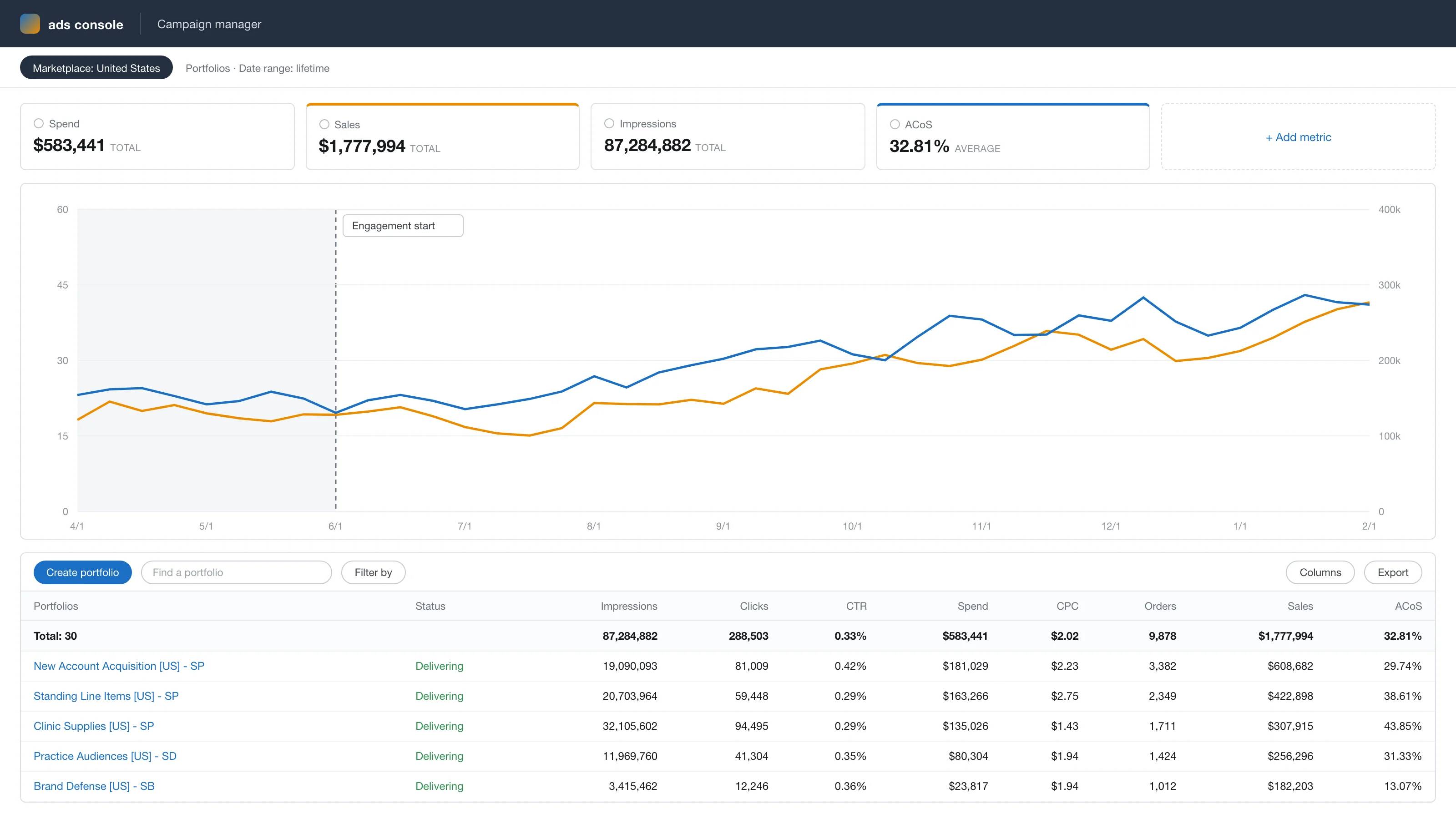
Anonymized account view, rebuilt from the figures reported above: ad sales growing from $130k to $223k a month while ACoS is deliberately lifted from 22% to 41% to buy new accounts.
The results
New-to-brand orders went from 180 to 572 a month, and revenue rose 83% in eight months.
Blended ACoS rose nineteen points, which is the point rather than the price: the account is deliberately buying customers at a first-order loss because each one is worth roughly fifty times that order over two years, and the cohort data confirmed the model as the months accumulated. The modeled two-year value per account also improved 12%, since the accounts arriving through acquisition keywords turned out to be larger practices than the ones arriving on brand terms.
“Our twenty-two percent ACoS target was the proudest number in the business. It was also the reason we had stopped growing.”
Services we delivered
Related case studies




Ready to scale your Amazon brand?
Talk to a senior strategist and leave with a growth plan for your store — no obligation.