
Forty reviews on eleven thousand orders: the professional buyer problem
Reviews 41 → 1,180
Tradespeople do not leave reviews. The brand's listings looked untested beside consumer products with thousands of them, despite selling far more units to far more demanding customers.

At a glance
- Category
- Adhesives, Sealants & Tapes
- Marketplaces
- US, UK
- Revenue at start
- $174k / month
- Gap
- 41 reviews against competitors with 6,000+
- Engagement
- Full account management + creative
- Timeframe
- 11 months
Results
The challenge
Eleven thousand orders had produced forty-one reviews. That is not a bad product — it is a trade customer base. Someone who buys twelve rolls of tape for a job site is not going to open the app that evening to write about it, and the review rate in professional purchasing runs an order of magnitude below consumer categories.
On a search results page that difference is invisible as a cause and devastating as an effect. Beside a consumer brand with six thousand reviews, a professional product with forty-one reads as new, untested or obscure, whichever the shopper assumes. It also compounds: low review counts depress conversion, depressed conversion depresses rank, and the brand had been slipping down the page for two years while its actual sales volume grew.
Our approach
We built a review process suited to a customer who is busy and at work.
- Request timing matched to the job, sent after the point at which the product has actually been used rather than on delivery.
- Every eligible order requested, systematically, using Amazon's own tools — the brand had been doing this manually and sporadically.
- Vine enrolled on the newest SKUs, which is the one legitimate way to seed a base from zero — the box itself asks for nothing, because an insert may not request a review.
- Reviews fed back into the creative, since trade reviews describe applications and failure conditions that the copy had never mentioned.
How we worked
- 1
Measuring the real gap
Review rate calculated per hundred orders and compared with consumer competitors, which established the problem as structural rather than a quality signal.
- 2
Fixing the request process
Review requests automated on every eligible order instead of being sent by hand a few times a month.
- 3
Timing the ask
Request delayed to match the interval between delivery and typical use, measured from reorder data.
- 4
Rebuilding the insert
A compliant packaging card written for a tradesperson, asking about performance on the job.
- 5
Using what came back
Application and condition detail from the new reviews written into bullets and image copy.
Inside the ad account
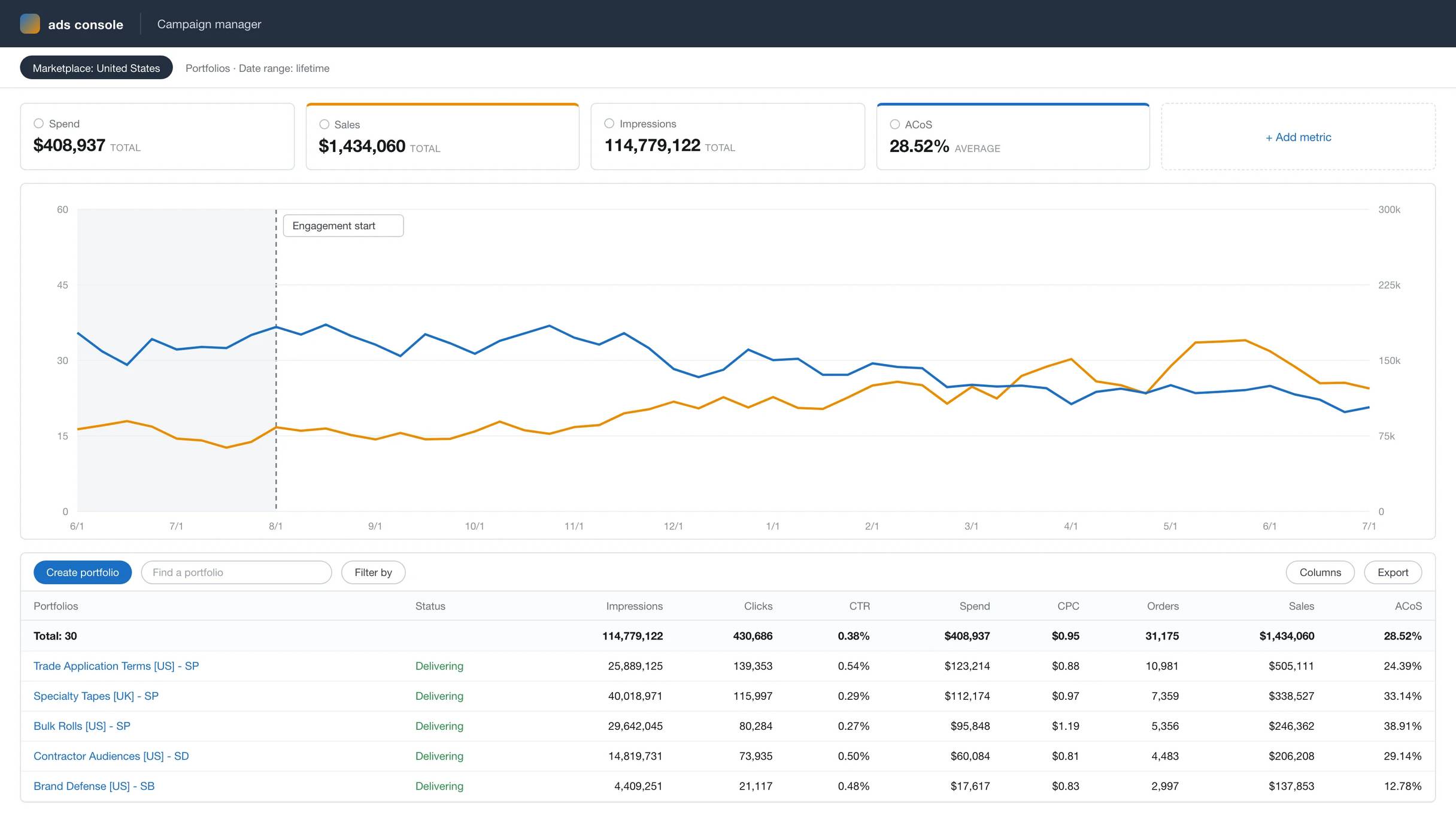
Anonymized account view, rebuilt from the figures reported above: ad sales growing from $78k to $149k a month while ACoS falls from 35% to 22% across the 11-month engagement.
The results
The core catalog went from 41 reviews to 1,180 in eleven months — the product had always earned them, nobody had ever asked.
Conversion rose 63% and the hero term climbed from #19 to #4, which is the compounding running in reverse: credible listings convert, converting listings rank, ranking listings sell. Revenue grew 91% without a product change or an extra dollar of advertising.
“Our customers are on scaffolding, not on their phones. We had to go and ask them, and it turned out they had plenty to say.”
Services we delivered
Related case studies



Ready to scale your Amazon brand?
Talk to a senior strategist and leave with a growth plan for your store — no obligation.