
Selling to a renovation in the order it actually happens
Revenue per household +72%
A home improvement brand sold products used at four different stages of the same project, and advertised all of them to everybody at once. Sequencing the catalog to the build order changed what one customer is worth.

At a glance
- Category
- Tools & Home Improvement
- Marketplaces
- US
- Revenue at start
- $286k / month
- Catalog
- Products spanning demolition, rough-in, surface prep and finishing
- Engagement
- Full account management + DSP
- Timeframe
- 12 months
Results
The challenge
A bathroom remodel is not an event, it is a sequence that runs for six to ten weeks. Somebody demolishes, somebody runs pipe, somebody patches and levels, somebody paints and fits. The brand sold into all four of those weeks, and it treated every customer as if their project had begun and ended on the day they clicked.
So the pry bar buyer and the caulk buyer were the same person eleven weeks apart, and nothing in the account knew it. Advertising reintroduced the brand to that customer at random intervals with whichever product happened to have budget, which is how a catalog with four natural repeat purchases ended up with an 11% repeat rate. The entire back half of every project was being sold by somebody else.
Our approach
We stopped selling a catalog and started selling a schedule.
- Stage map built from order data — every ASIN assigned to the week of a project in which it is actually used, validated against the real intervals between repeat orders.
- Sequenced DSP audiences — a customer who bought a stage-one product enters a stage-two audience on the lag the data says is typical, not on a generic 30-day window.
- Listing copy that names the next step, so the page itself tells the shopper what comes after this purchase and who sells it.
- Budget weighted to stage one — the earliest products in the sequence bid up, because winning the first purchase now buys three more.
Timeline
Map the sequence
- Repeat-order intervals measured per ASIN pair
- Four stages defined and every ASIN assigned
- Baseline six-month household value established
Sequence the media
- DSP audiences built on stage transitions and real lag times
- Stage-one bids raised, late-stage prospecting bids cut
- A+ modules rewritten to name the next stage
Compound it
- Cost per repeat order settled at $7.40
- Repeat households past a third
- Stage-one acquisition allowed to run at breakeven on the first order
Inside the ad account
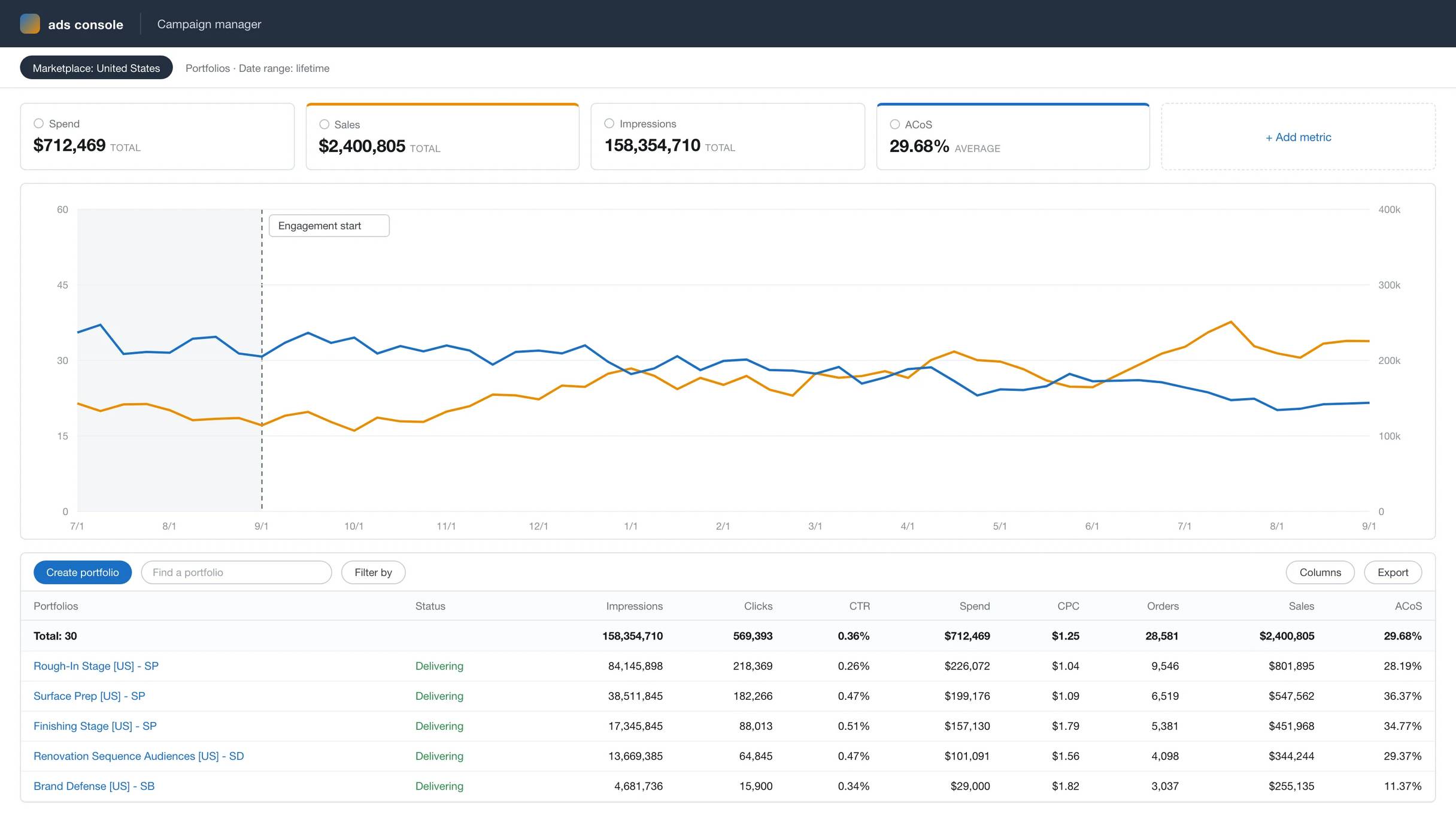
Anonymized account view, rebuilt from the figures reported above: ad sales growing from $129k to $224k a month while ACoS falls from 33% to 22% across the 12-month engagement.
The results
Six-month revenue per household went from $61 to $105, and total revenue grew 66% without adding a single product.
The repeat rate is where the change is visible: 34% of households now buy at least twice, against 11% before. Reaching an existing customer at the moment their project moves to the next stage costs $7.40 an order, which is why stage-one products can now be bid to breakeven — the first sale is no longer the whole relationship.$
“Our customers were never one-time buyers. We were just showing up in week two and then disappearing until they'd already bought the rest from someone else.”
Services we delivered
Related case studies

Ready to scale your Amazon brand?
Talk to a senior strategist and leave with a growth plan for your store — no obligation.