
The machine costs $900 more and one broken service costs $4,000
Conversion 2.1% → 4.4%
A commercial kitchen brand's machines looked identical in photographs to light-duty units at half the price. The difference is what happens at 7pm on a Friday, and no listing had ever put a number on it.
At a glance
- Category
- Food Service Equipment
- Marketplaces
- US
- Revenue at start
- $336k / month
- Position
- $2,400 against visually identical $1,500 light-duty units
- Engagement
- Creative & content + listing SEO
- Timeframe
- 14 months
Results
The challenge
On a search results page a commercial-duty dough sheeter and a light-duty one are two photographs of a stainless box. One is rated for eight hours of continuous operation and a decade of service; the other is built for a few hours a week and will fail inside a year in a working kitchen. The buyer sees $2,400 and $1,500.
The brand's copy answered this the way engineers answer it — motor specification, gauge of steel, bearing type — which reads as detail rather than as consequence. Nobody had ever connected those numbers to the thing that actually decides the purchase: a machine that stops during service costs a night's covers, a scrambled prep schedule and an emergency call-out, and that bill arrives in a single evening. Losing on price to a unit that will not survive the year was being recorded internally as a pricing problem, and two attempts at a discount had made no difference at all.
Our approach
We replaced the specification argument with the arithmetic of a failure.
- Duty cycle stated as operating hours — hours per day and expected service life, in place of motor and material specifications the buyer cannot interpret.
- The cost of one lost service quantified on the page, built from covers, average ticket and an emergency call-out, so the premium is measured against a number the operator recognizes.
- The light-duty distinction made explicit, naming what a unit built for occasional use does under continuous load rather than leaving the shopper to infer it from a spec line.
- Service life evidenced with the brand's own field data on units still running after eight and ten years.
How we worked
- 1
Finding the real objection
Lost-sale conversations and returns coded; almost none were about the product, nearly all were the price gap against a light-duty look-alike.
- 2
Building the arithmetic
A defensible cost-of-failure figure assembled from operator data — covers, ticket average, call-out rates — rather than an invented number.
- 3
Rewriting the argument
Image stack and A+ rebuilt around hours of operation and the cost of a stopped service; the technical specification kept as a fixed panel below.
- 4
Naming the comparison
Duty rating added to the title and to the opening bullet so the distinction is visible before the click.
- 5
Holding the price
No discounting for twelve months, so the positioning had a chance to be tested on its own terms.
Inside the ad account
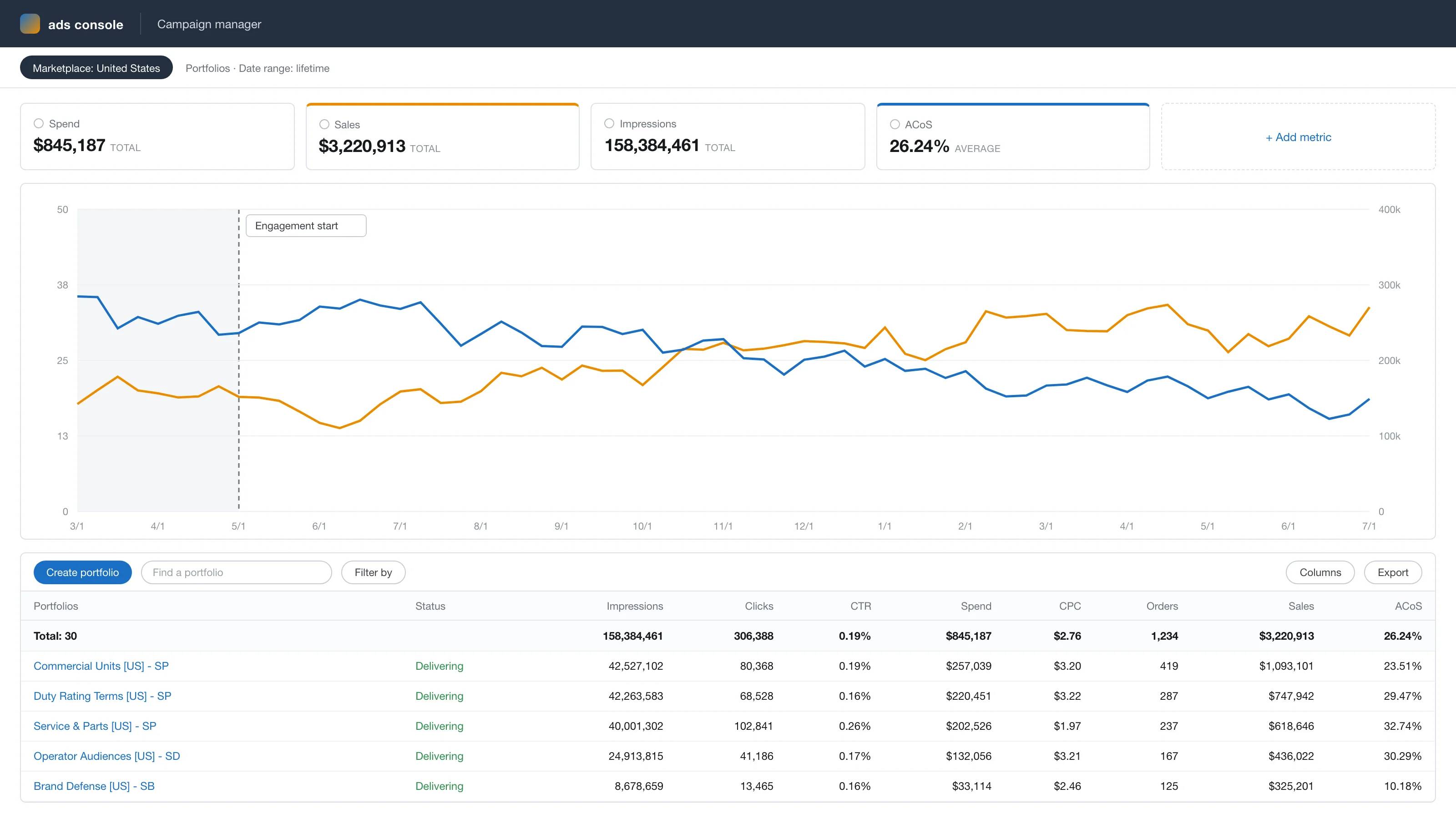
Anonymized account view, rebuilt from the figures reported above: ad sales growing from $151k to $269k a month while ACoS falls from 32% to 18% across the 14-month engagement.
The results
Conversion more than doubled — 2.1% to 4.4% — and revenue grew 78% while the average selling price went up rather than down.
The return rate fell by more than half, which is the same mechanism read from the other side: buyers who previously bought on price and discovered the machine was more than they needed, or who bought the light-duty competitor and came back after it failed, are now making an informed decision at the point of purchase. Two years of discount proposals had never moved the number that a single honest comparison did.
“We kept trying to justify nine hundred dollars. One closed Friday night costs four thousand, and nobody had ever written that on the page.”
Services we delivered
Related case studies



Ready to scale your Amazon brand?
Talk to a senior strategist and leave with a growth plan for your store — no obligation.