
Competing with a supermarket five-pack on fabric, not price
ASP $14 → $29, volume up 47%
A baby basics brand was losing a price war it could never win against mass-market multipacks. It shifted the argument to the one thing a discount five-pack cannot claim.

At a glance
- Category
- Baby Apparel Basics
- Marketplaces
- US
- Revenue at start
- $77k / month
- Position
- $14 five-pack against mass-market $9 five-packs
- Engagement
- Listing SEO + PPC
- Timeframe
- 8 months
Results
The challenge
Bodysuits and sleepsuits are the definition of a commodity: every parent needs a dozen, every retailer sells a multipack, and the search results are a wall of near-identical white cotton at descending prices. The brand had responded the only way that seems available — by pricing barely above the mass-market packs, which meant thin margins and a permanent disadvantage against companies with better freight economics.
What the listings did not say was that the garments were made from certified organic long-staple cotton with a specific weave and dye standard, because the team assumed nobody reads fabric detail on a bodysuit. The parents who search “organic cotton newborn”, “GOTS certified baby” and “no dye sensitive skin” very much do — and they were finding brands with worse products and better copy.
Our approach
We stopped selling a cheaper multipack and started selling a better fabric.
- Material and certification terms indexed across titles, bullets and backend — the specific vocabulary this shopper screens with.
- Fabric shown at macro scale in the image stack, with the weave, the seam construction and the dye standard made visible.
- The washing argument — how the garment holds up over fifty washes, which is the real cost comparison against a pack that greys in a month.
- Price repositioned upward in two steps, with advertising moved off the generic head terms onto the material cluster where cost per click is far lower.
Inside the ad account
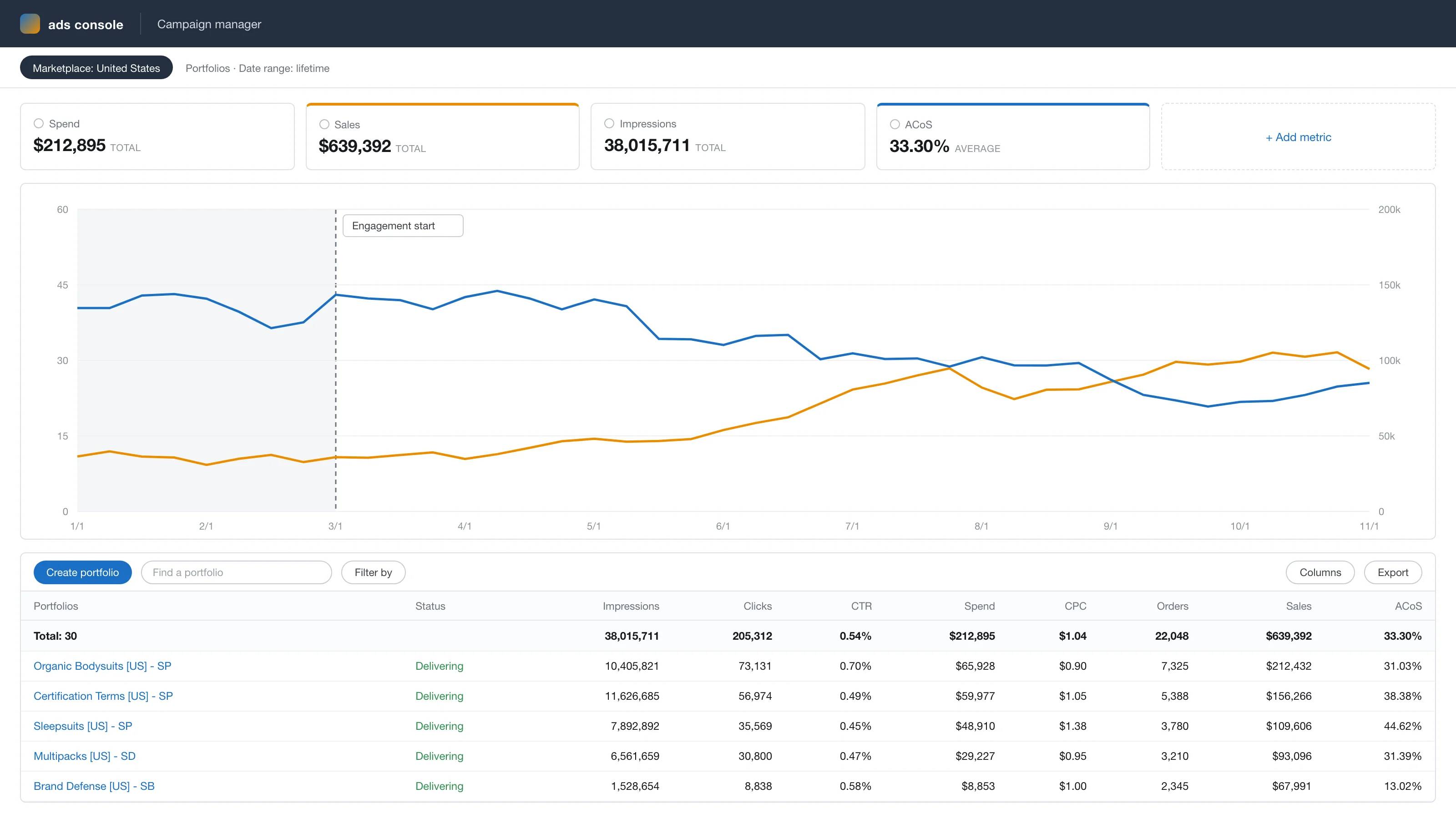
Anonymized account view, rebuilt from the figures reported above: ACoS from 41% to 23% as the average selling price doubled.
The results
Average selling price rose from $14 to $29 while unit volume grew 47% — the combination that makes a repositioning real rather than a margin trick.
Revenue grew 205%, and ACoS fell eighteen points because the material-led searches are contested by a handful of brands instead of by every supermarket in the country. The garments did not change. The brand simply stopped presenting a certified organic product as though it were a cheaper version of a supermarket five-pack.
“We were discounting a better product to sit next to worse ones. The parents who wanted what we actually make couldn't find us.”
Services we delivered
Related case studies




Ready to scale your Amazon brand?
Talk to a senior strategist and leave with a growth plan for your store — no obligation.