
Taking Subscribe & Save from 11% to 34% of a wellness brand's Amazon revenue
Subscriptions: 11% → 34% of revenue
A daily-use wellness brand was acquiring customers efficiently and keeping almost none of them. We rebuilt the offer, the pack sizes and the listing around subscription, and let paid acquisition target the customers worth subscribing.
At a glance
- Category
- Health & Household
- Marketplaces
- US, CA
- Revenue at start
- $142k / month
- Subscription share at start
- 11%
- Engagement
- Full account management + creative
- Timeframe
- 9 months
Results
The challenge
The product was taken every day, which should make it a subscription business. It wasn't: 11% of revenue came through Subscribe & Save, and the rest was one-off purchases from shoppers who mostly never came back.
Three things were working against it. The hero listing was a 30-day supply, so the shopper's natural reorder moment arrived a month after a purchase they had already half forgotten. The subscribe discount sat at the 5% minimum, which is nothing worth committing for. And the listing copy sold the product as a trial — “try it and see” — which is the exact opposite of the message a subscription needs.
Our approach
We rebuilt the offer first and the advertising second.
- Pack architecture — a 90-day size introduced as the hero, with the 30-day kept as an entry point rather than the default.
- Subscription economics — the subscribe discount raised to a level that survives comparison, and the range built so a customer can put five items on one delivery date and reach Amazon's higher subscription tier.
- Creative and A+ rebuilt around the routine — images and copy that show a daily habit and a replenishment cycle, not a one-time experiment.
- Acquisition aimed at subscribers — budget weighted toward the clusters whose switch-back tests moved subscription sign-ups, even where their first-order ACoS looked worse.
How we worked
- 1
Cohort and churn analysis
Subscription revenue per cohort falls away around the third shipment — as close to a cancellation reason as the reports get — and we worked backwards from that to the offer and the pack size.
- 2
Pack and pricing rebuild
A 90-day supply became the hero ASIN, priced so the per-day cost beats both the 30-day size and the main competitor's subscription.
- 3
Creative and A+ rewrite
The image stack now opens on the routine and the supply duration; A+ answers the two questions that stop people subscribing — cancellation and delivery timing.
- 4
Campaign reweighting
Clusters were run on and off against each other and scored on the subscription sign-ups that followed, since no report ties a subscription back to a search term; budget followed that score rather than first-order ACoS.
- 5
Lifecycle reporting
Monthly reporting switched from revenue and ACoS to cohort value, so decisions stopped optimizing the first order at the expense of the fifth.
Inside the ad account
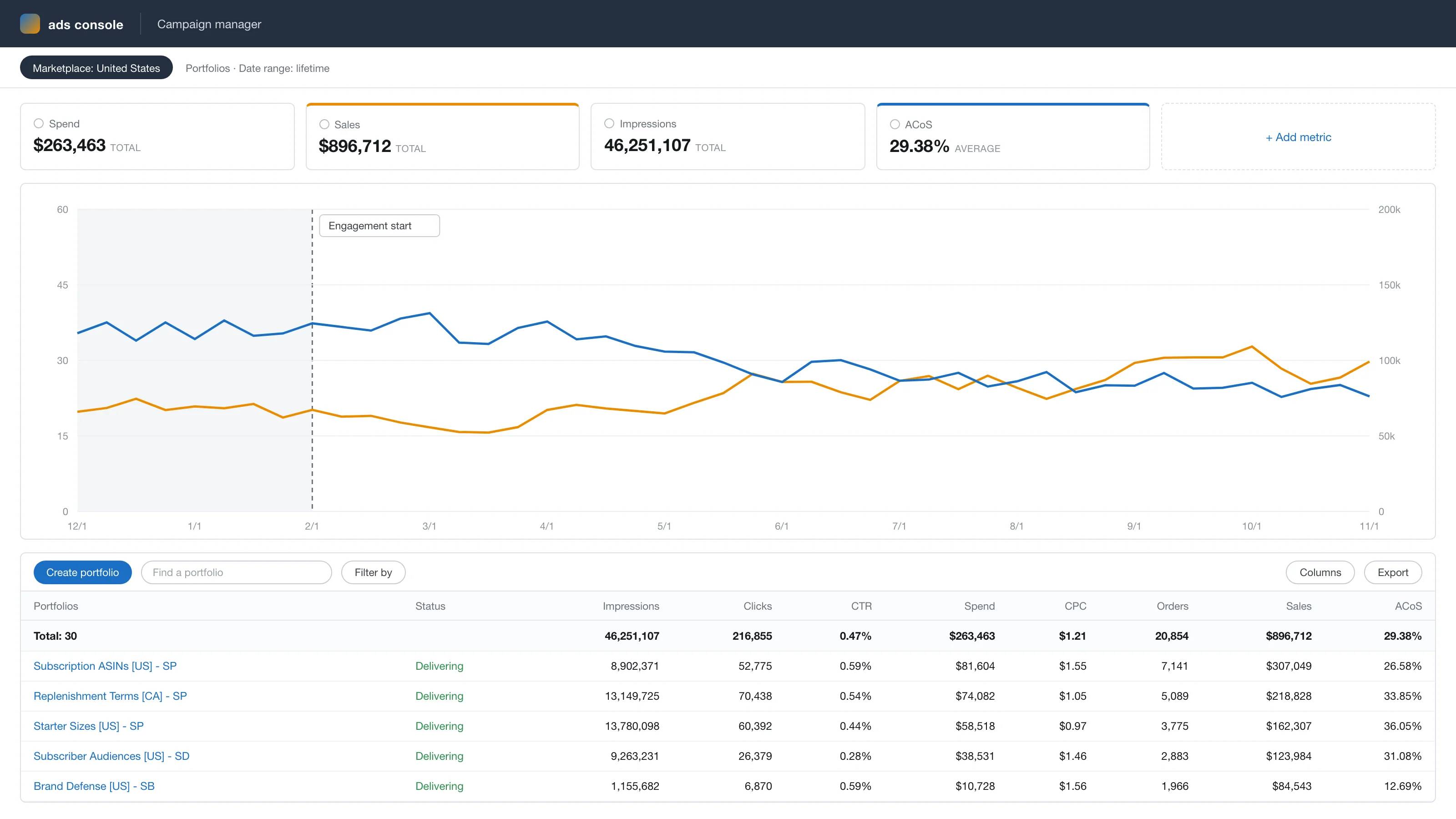
Anonymized account view, rebuilt from the figures reported above: ad sales growing from $64k to $99k a month while ACoS falls from 36% to 23% across the 9-month engagement.
The results
Subscriptions now carry a third of the brand's Amazon revenue — 34%, up from 11% — and total monthly revenue grew from $142k to $219k.
The more important line is lifetime value: $61 to $118 over twelve months, which is what made the acquisition math work. TACoS fell nine points without any campaign being cut, simply because a larger share of revenue no longer needs to be bought twice. The brand now plans inventory against a subscription base it can forecast instead of a promotional calendar it can't.
“We'd been treating subscription as a checkbox on the listing. Turning it into the actual offer changed the whole economics of the account.”
Services we delivered
Related case studies

Ready to scale your Amazon brand?
Talk to a senior strategist and leave with a growth plan for your store — no obligation.