
Cutting a household brand's catalog from 214 ASINs to 96 — and revenue up 82%
+82% revenue on 55% fewer ASINs
A household essentials brand had spent six years adding listings and never removing any. We consolidated 214 ASINs into 96 parent-child families, moved reviews onto the survivors and rebuilt advertising around the products that actually earned margin.

At a glance
- Category
- Health & Household
- Marketplaces
- US
- Revenue at start
- $96k / month
- Catalog at start
- 214 ASINs, 80 of them duplicates
- Engagement
- Full account management + listing SEO
- Timeframe
- 11 months
- Team
- Account lead, catalog specialist, PPC specialist, copywriter
Results
The challenge
Six years of “just list it and see” had left the brand with 214 live ASINs for what was really about ninety products. Scent variations sat as standalone listings, multipacks were disconnected from singles, and three different ASINs competed for the same search term with the same product inside a different box.
The damage was invisible on the P&L but obvious in the data. Reviews were spread thin — the best-selling all-purpose cleaner sat at roughly 480 reviews on each of four duplicate listings instead of one page carrying 1,900. Advertising paid twice for the same shopper, because two of the brand's own ASINs bid against each other on the category term. And every new launch made it worse, since nobody on the team could say which of the existing listings the new size should attach to.
Our approach
We treated the catalog as the root cause and everything else as a symptom.
- Catalog audit before anything else — every ASIN mapped to a physical product, a sales volume and a review count, so merges were decided on evidence rather than on which listing someone liked.
- Duplicates merged, then families rebuilt — true duplicate ASINs merged into the listing that already held the reviews, and the survivors pulled under one parent by scent, size and pack, so a family shares one rating instead of splitting it four ways.
- Listing SEO on the survivors — titles, bullets and backend terms rewritten once per family, not once per duplicate, which is where the previous team's effort had been evaporating.
- Advertising rebuilt after the catalog settled — campaigns keyed to the new families, self-competition removed, and budget concentrated on the ASINs with real contribution margin.
How we worked
- 1
Full catalog inventory
Every live ASIN was matched to a physical SKU, trailing-12-month units and review count. Eighty listings turned out to be duplicates of a listing that already existed, and another thirty-eight had not sold a unit in a year.
- 2
Merge plan and review consolidation
Variation families were designed around the canonical child, then merged in waves so the account never had more than a handful of listings in flux at once. Reviews followed the merges where Amazon allowed it — a merge can be refused or applied only in part, so each wave was verified before the next was submitted.
- 3
Listing SEO for the surviving families
One rewrite per family — title, bullets, A+ and backend keywords built around category and problem-aware search, instead of the brand-name-first copy the listings had carried.
- 4
Retiring the dead tail
The thirty-eight zero-sale ASINs were closed rather than repriced. Storage fees dropped and the internal team stopped forecasting inventory nobody bought.
- 5
Advertising rebuild
Campaigns were reconstructed around the new families with negative targeting between them, so two of the brand's own ASINs could no longer bid on the same shopper.
Inside the ad account
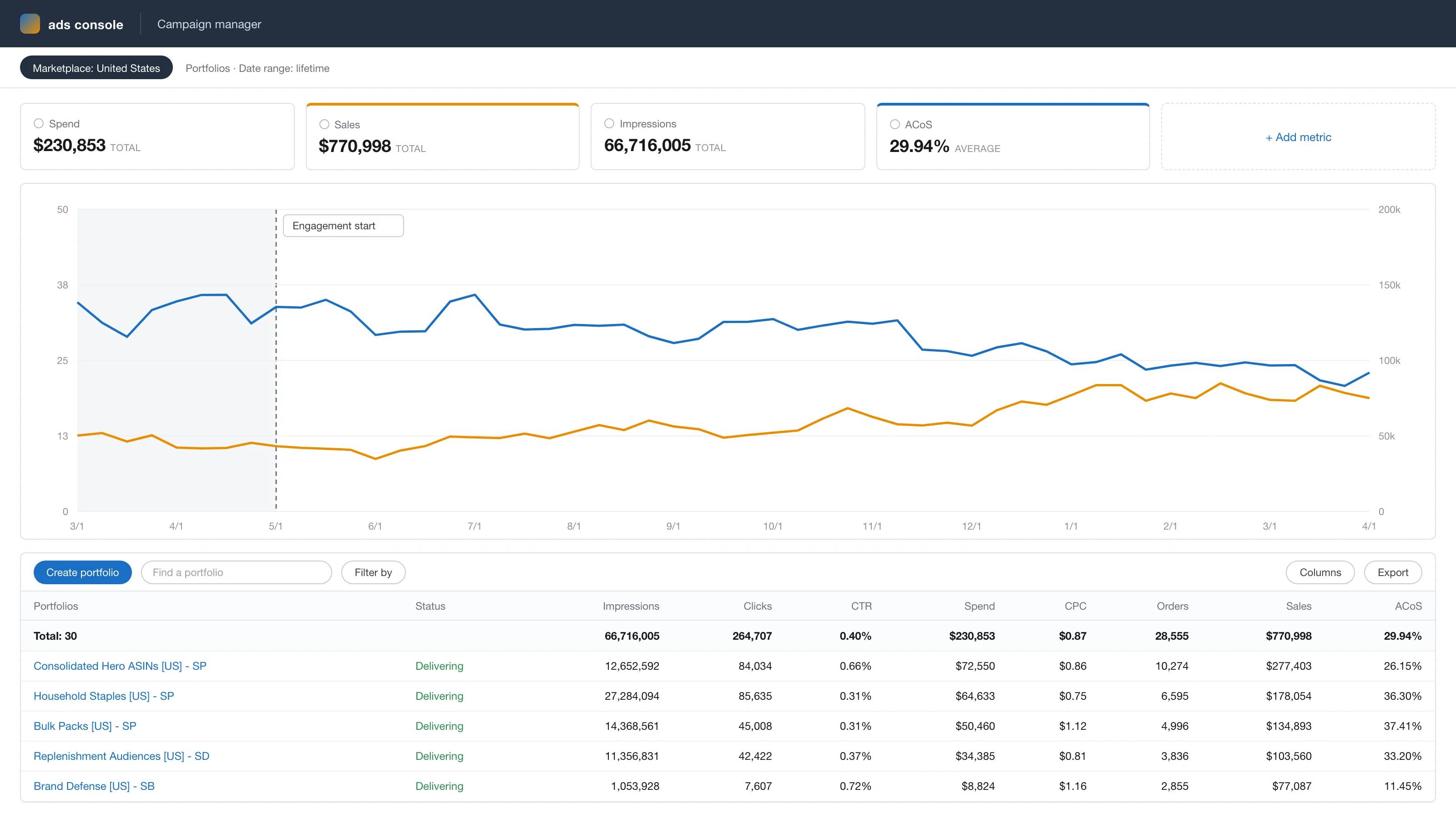
Anonymized account view, rebuilt from the figures reported above: ad sales growing from $43k to $79k a month while ACoS falls from 34% to 22% across the 11-month engagement.
The results
Eleven months in, the brand sells more with half the catalog: monthly revenue grew from $96k to $175k on 96 live ASINs instead of 214.
The consolidated review counts did most of the heavy lifting — the top ten listings went from 3,900 reviews between them to 11,400, which lifted conversion on exactly the pages advertising was paying to reach. TACoS fell five points as a side effect rather than as a target: the account stopped buying the same click twice. The brand also got something harder to put in a table — a catalog its own team can reason about when the next product launches.
“We were terrified of deleting listings. Seeing the reviews land on one page and the sales go up instead of down changed how we think about the catalog.”
Services we delivered
Related case studies




Ready to scale your Amazon brand?
Talk to a senior strategist and leave with a growth plan for your store — no obligation.