
Winning back lapsed buyers with Amazon DSP for 31% incremental revenue
Revenue +31%, repeat rate 38% → 47%
A consumable household brand with strong repeat rates was losing buyers quietly — they simply stopped reordering. We used DSP audiences built on purchase recency to reach them off Amazon, and treated Sponsored ads as the closing step rather than the whole funnel.
At a glance
- Category
- Health & Household
- Marketplaces
- US
- Revenue at start
- $310k / month
- Repeat purchase rate
- 38% — but falling
- Engagement
- Amazon DSP + PPC
- Timeframe
- 8 months
Results
The challenge
On paper the account looked healthy: a consumable product, a 38% repeat rate and Sponsored campaigns running at a comfortable ACoS. The problem only showed up in cohort data — buyers from any given month kept reordering for about two cycles and then disappeared. Nothing was broken; they simply forgot, and a competitor's coupon was easier to find than last year's order.
Sponsored ads could not fix that. They reach shoppers who are already searching, and a lapsed buyer of a household consumable is by definition not searching. Every extra dollar in Sponsored Products bought more of the same in-market traffic at a worse rate, which is what the brand's “we've hit a ceiling” feeling actually was.
Our approach
We split the job between two channels instead of asking one to do both.
- DSP for demand that isn't searching — audiences built on purchase recency in Amazon Marketing Cloud: buyers past their expected reorder window, and shoppers who viewed the product and never converted.
- Creative built for recognition, not discovery — the ads showed the product the shopper already owned, with the reorder as the single action.
- Sponsored ads left to close — PPC budget stayed on high-intent terms rather than chasing the awareness job DSP had taken over.
- Measurement on incrementality — DSP was judged on new-to-brand and reorder lift, not on last-click ROAS, so the two channels were not credited for the same sale.
Timeline
Audience architecture
- Reorder cycle modeled per product size
- Lapsed-buyer, cart-abandon and viewed-not-purchased audiences defined
- Baseline cohort report agreed with the brand
First DSP flights
- Win-back creative tested against generic brand creative
- Frequency capped to avoid burning the small audiences
- Sponsored budget held flat so lift could be read
Scale what worked
- Budget shifted to the lapsed-buyer segment
- Bundle and larger-size creative added for high-value cohorts
- Off-Amazon inventory expanded beyond the initial placements
Steady state
- Always-on win-back flight with rolling audience refresh
- Monthly cohort reporting handed to the brand's team
- PPC retuned around the higher organic baseline
Inside the ad account
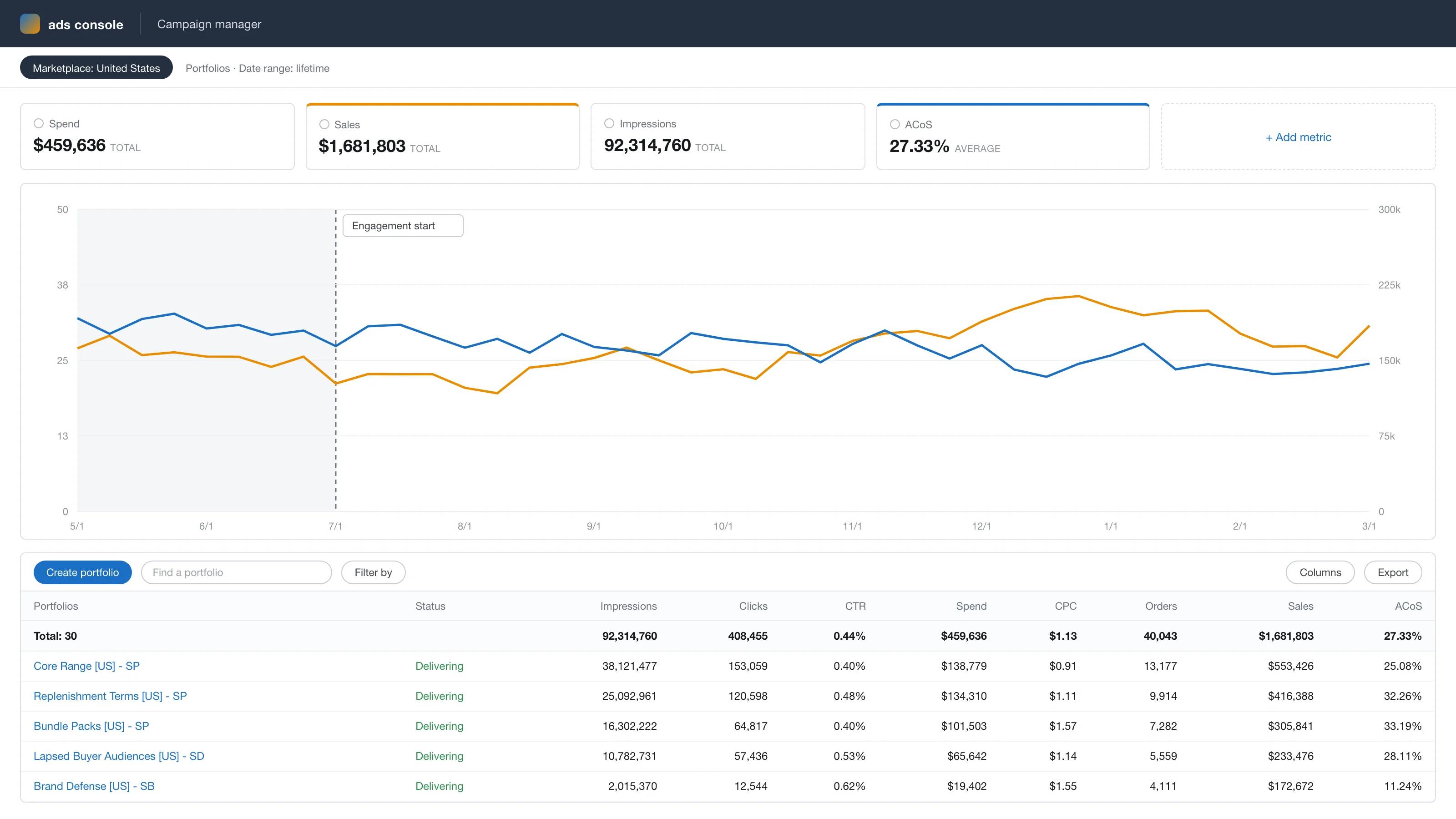
Anonymized account view, rebuilt from the figures reported above: ad sales growing from $140k to $183k a month while ACoS falls from 31% to 24% across the 8-month engagement.
The results
Monthly revenue grew from $310k to $406k — a 31% increase that Sponsored ads alone had not been able to buy — at a DSP ROAS of 4.8x.
The number the brand cares about more is the repeat rate: 38% to 47%, which means the customers it had already paid to acquire are now worth roughly a quarter more each. Blended TACoS moved by a single point, so the growth was not bought by loosening efficiency — it came from a part of the funnel the account had never addressed.
“Those repeat buyers were never loyal. They were convenient — and the moment someone else was more convenient, they were gone. DSP put us back in front of them.”
“The cohort report is the first Amazon reporting our board actually reads.”
Services we delivered
Related case studies

Ready to scale your Amazon brand?
Talk to a senior strategist and leave with a growth plan for your store — no obligation.