
A category with no second purchase needs a different arithmetic
Profit per order +90%
Tool chests are bought once a decade. The account had been run on customer-lifetime logic that this catalog simply does not have, and it was quietly losing money on growth.
At a glance
- Category
- Tool Storage & Organization
- Marketplaces
- US
- Revenue at start
- $241k / month
- Repeat rate
- 3% within 24 months
- Engagement
- PPC + full account management
- Timeframe
- 10 months
Results
The challenge
The previous strategy was built on a sentence that gets repeated in every account review: acquire the customer now, earn on them later. For a tool chest, later never comes. The repeat rate over two full years was 3%, and most of that was a second unit bought in the same week by somebody kitting out a garage.
So an aggressive acquisition ACoS that would be rational for a consumable was, here, simply a permanent subsidy. The account looked healthy — revenue was growing — and a third of advertising spend sat on terms that did not pay back on the order they produced and would never pay back on a second one, because there wasn't going to be a second one.
Our approach
We replaced lifetime logic with a rule the catalog can actually support.
- A first-order payback threshold set per product from real contribution margin, with no term allowed to run below it on the promise of future value.
- Spend audited against that threshold — 37% of it failed, and was cut rather than optimized.
- Freed budget moved to high-intent terms where the shopper is choosing between specific configurations, which converts far above the category browse terms.
- Merchandising for the one order there is — accessories and the drawer-liner attachments surfaced in the same session, since there is no later session to sell them in.
Inside the ad account
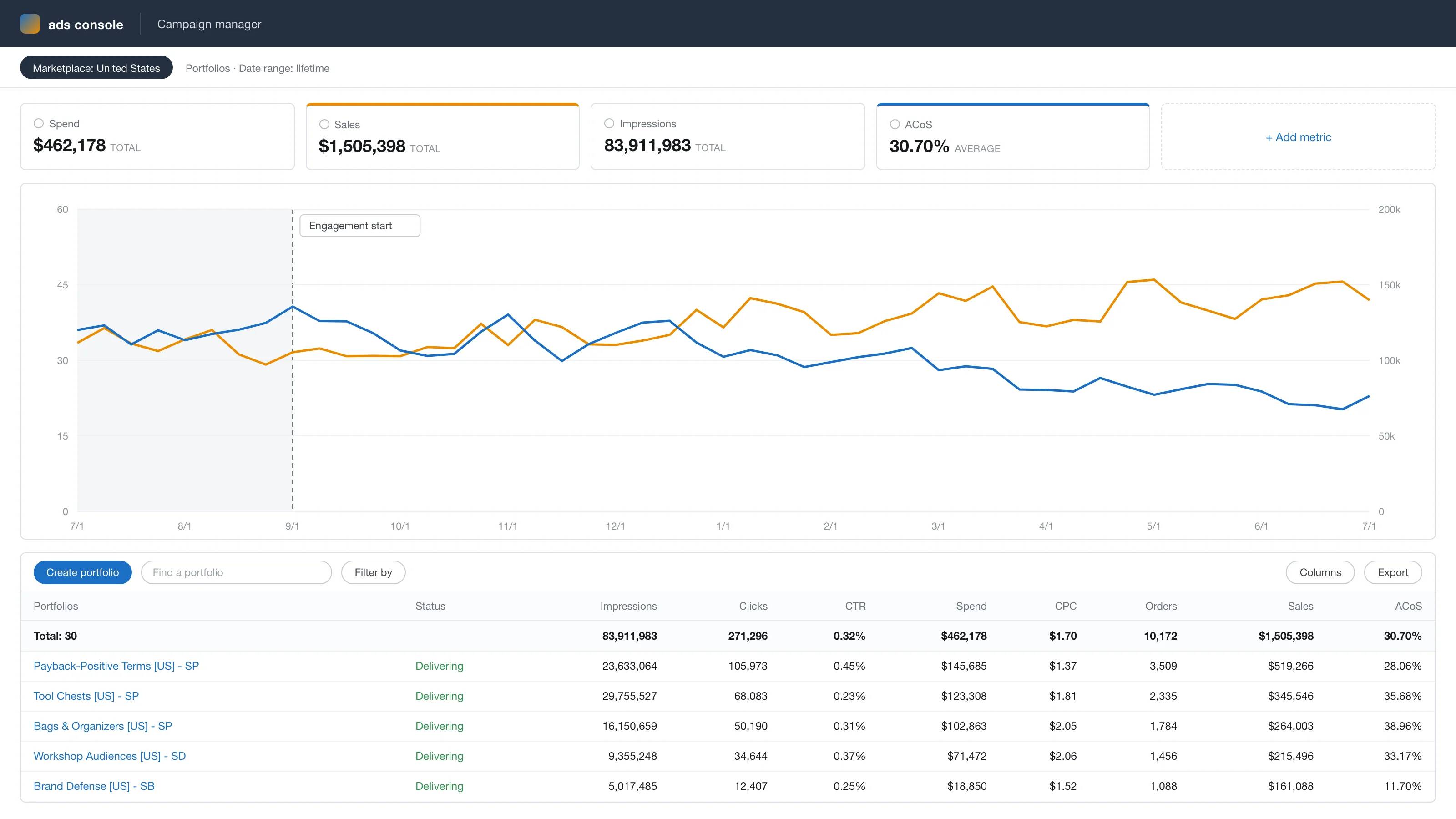
Anonymized account view, rebuilt from the figures reported above: ad sales growing from $108k to $156k a month while ACoS falls from 38% to 22% across the 10-month engagement.
The results
Contribution profit per order rose from $31 to $59 while revenue still grew 44% — the cut spend was not buying growth, it was buying volume at a loss.
TACoS fell seven points and the share of spend on terms that cannot pay for themselves went from 37% to 6%. Nothing here is a clever tactic; it is the consequence of measuring an account against its own repeat behavior instead of against a rule of thumb borrowed from categories people buy twice a month.
“Every agency we'd worked with told us to be patient with acquisition cost. Nobody checked that our customers never come back.”
Services we delivered
Related case studies
Ready to scale your Amazon brand?
Talk to a senior strategist and leave with a growth plan for your store — no obligation.