
Defending the cartridge against forty compatible clones
Genuine cartridge share 29% → 63%
The printers sold well and the ink did not. Every search for a cartridge returned dozens of cheaper compatible versions, and the brand's own page gave shoppers no reason to pay more.
At a glance
- Category
- Printers & Ink
- Marketplaces
- US
- Revenue at start
- $508k / month
- Problem
- 40+ compatible cartridges on the brand's own search terms
- Consumable mix
- Ink at 22% of revenue against a 55% category norm
- Engagement
- Full account management + PPC
- Timeframe
- 14 months
Results
The challenge
A printer business makes its money on the consumable, and this one was losing that money to companies that had never designed anything. Search the cartridge code and four dozen compatible versions appear at half the price, with review counts built on years of accumulated volume. Two thirds of the brand's own customers were buying one of them.
The brand's response had been to say “genuine” louder, which reads as a manufacturer protecting its margin and persuades nobody. Meanwhile the clones were generating a second, hidden cost: a meaningful share of support contacts and one-star printer reviews came from machines that had been fed third-party ink and produced streaked output, banded color or a clogged head. The printer took the blame for the cartridge, so the clones were damaging the hardware listings as well as the ink revenue.
Our approach
We replaced the loyalty appeal with evidence a skeptical shopper can check.
- Cost per printed page as the comparison, since a cheaper cartridge that yields half as much is not cheaper — and the yield gap is measurable and verifiable.
- Print-quality evidence over time in the creative: output at page one and at page four hundred, which is where the difference actually shows up.
- Sponsored Display on the brand's own printer pages and to its owners, because the person who just bought the machine has not yet formed a cartridge habit.
- Support data turned into content — the specific failure modes seen in the field, described factually rather than as a warning.
- A yield-matched high-capacity option added so the shopper wanting the lowest running cost has a genuine cartridge to choose.
Inside the ad account
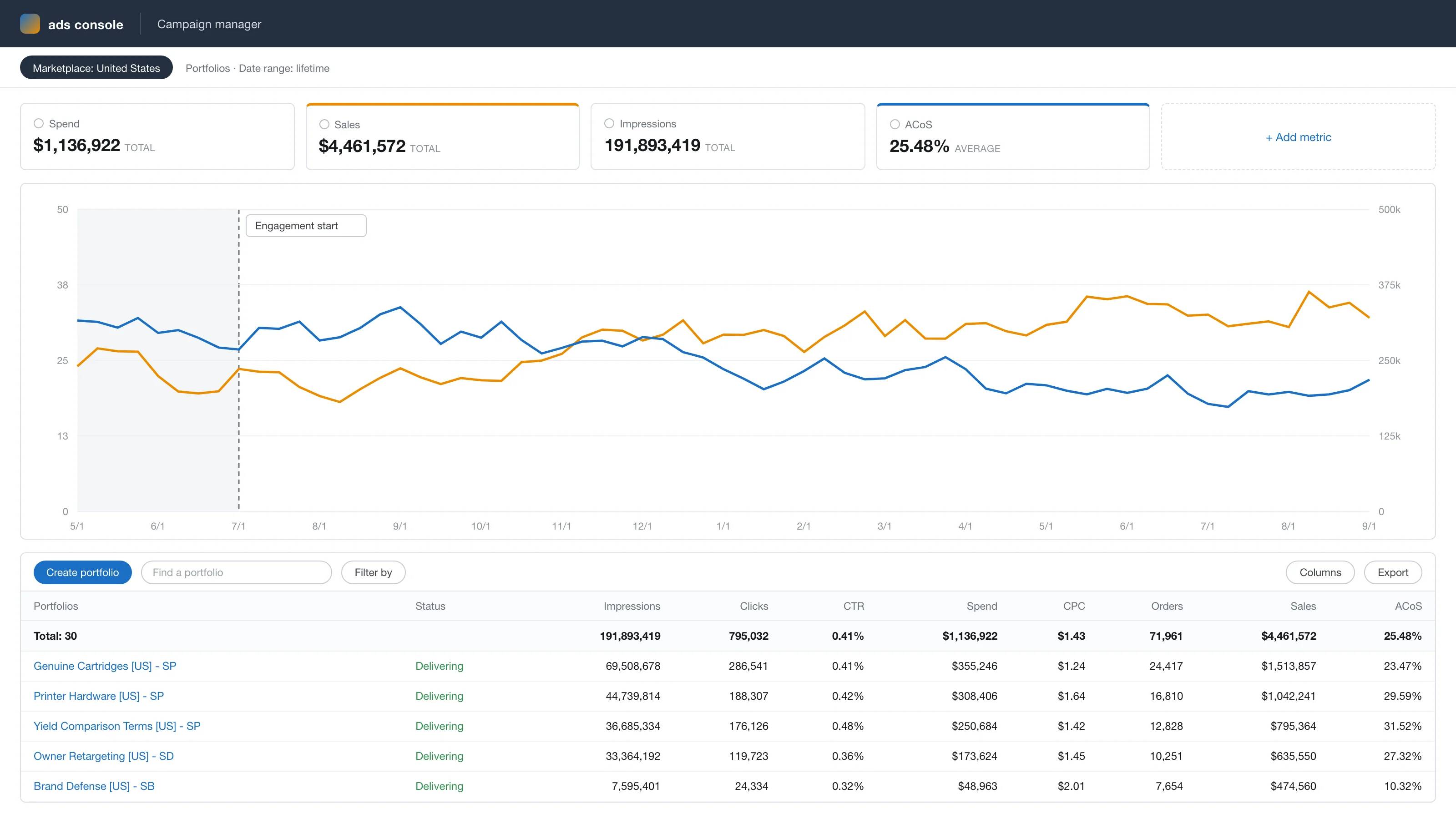
Anonymized account view, rebuilt from the figures reported above: ad sales growing from $229k to $344k a month while ACoS falls from 30% to 19% across the 14-month engagement.
The results
Genuine cartridge share among the brand's own printer owners rose from 29% to 63%, and ink went from 22% of revenue to 41% — a mix shift that is worth far more than the headline growth rate, since the consumable carries the margin.
The unexpected return was on the hardware side: support contacts per hundred printers fell 61%, and with them the review pressure that third-party ink had been putting on the machines. The argument that worked was not ownership or authenticity, but arithmetic the shopper could do themselves — a cartridge that prints two and a half times as many pages for twice the money is the cheaper one.
“Telling people to buy genuine ink sounded exactly like what a printer company would say. Showing them page four hundred did not.”
Services we delivered
Related case studies




Ready to scale your Amazon brand?
Talk to a senior strategist and leave with a growth plan for your store — no obligation.