
When the category's head term is a competitor's brand name
Non-brand organic revenue +264%
Shoppers do not search for painter's tape, they search for a market leader's brand name used as a generic word. Growing without touching that term meant building demand on descriptors instead.

At a glance
- Category
- Paint & Supplies
- Marketplaces
- US
- Revenue at start
- $67k / month
- Context
- Category head term is a rival's trademark
- Engagement
- Listing SEO + PPC
- Timeframe
- 9 months
Results
The challenge
In this subcategory the word people type is not a product description, it is a company. Decades of advertising have turned one brand into the generic term, and the search volume is distributed accordingly: an enormous head term that belongs to somebody else, then a long, thin tail of actual descriptions.
The brand had built its entire keyword strategy around the head term anyway, ranking nowhere and paying dearly for the few clicks it won — clicks from shoppers who had typed a competitor's name and were, reasonably, looking for that competitor. Everything left after the head term was written off internally as “too small to bother with”, which was a judgment made about individual terms rather than about their sum.
Our approach
We built the demand the head term does not capture.
- The descriptor space mapped exhaustively — surface, edge quality, days of clean removal, indoor and outdoor use, width — each small, each specific, together substantial.
- A listing architecture per descriptor cluster, so each product answers one description precisely rather than every product claiming all of them.
- Budget withdrawn from the head term entirely for six months, which freed roughly a third of the spend for terms the brand could actually win.
- Review language fed back into copy — the phrases customers use for a clean edge turned out to be the descriptor vocabulary, verbatim.
Timeline
Quantify the tail
- Every descriptor term sized and clustered
- Head-term spend and its true conversion rate isolated
- Baseline non-brand organic revenue measured
Rebuild and defund
- Listings restructured one cluster per product
- Head-term bids withdrawn, budget moved to descriptors
- Descriptor ranking keywords past 600
Compound
- Organic descriptor revenue overtakes paid
- ACoS settles at 24%
- Head term re-entered at a small defensive budget only
Inside the ad account
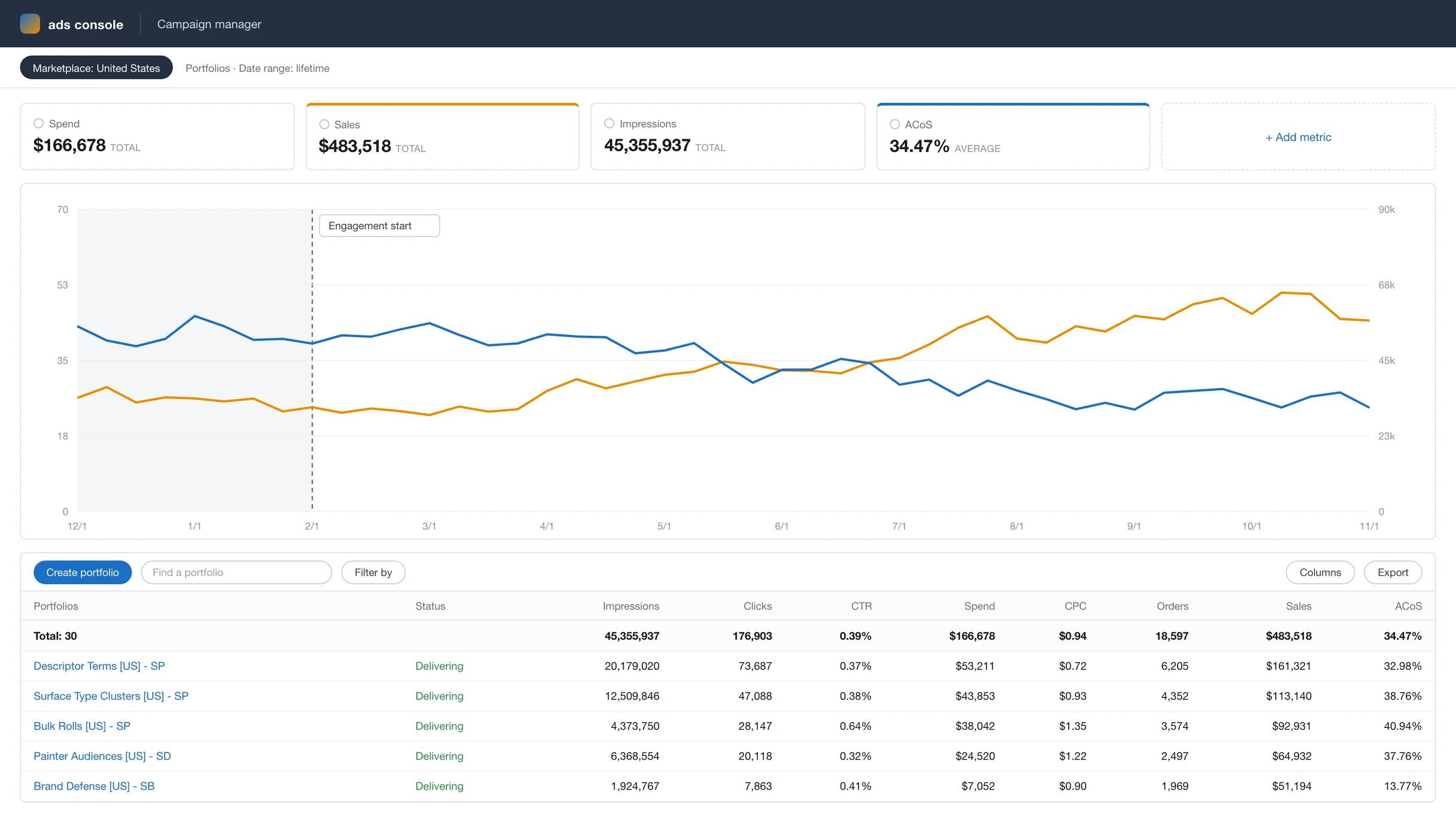
Anonymized account view, rebuilt from the figures reported above: ad sales growing from $30k to $62k a month while ACoS falls from 41% to 24% across the 9-month engagement.
The results
Non-brand organic revenue grew from $14k to $51k a month and total revenue doubled, without ever ranking for the term that dominates the category — which is a competitor's brand name, and therefore a word this brand could not have put in its listing anyway.
The descriptor footprint went from 180 ranking terms to 990. Individually none of them matter; collectively they now produce more revenue than the head term ever did, at an ACoS seventeen points lower — because a shopper searching for a competitor by name was never going to be a cheap conversion.
“We spent years trying to rank for a word that is legally somebody else's. The customers who describe what they want were sitting there uncontested.”
Services we delivered
Related case studies




Ready to scale your Amazon brand?
Talk to a senior strategist and leave with a growth plan for your store — no obligation.