
Competing with a distributor catalog instead of with other sellers
New-to-brand orders +294%
The brand's real competition was never the seller on the next search result. It was a quote request, a purchase order and a two-week wait — and nothing on its listings said so.
At a glance
- Category
- Lab & Scientific
- Marketplaces
- US
- Revenue at start
- $188k / month
- Real competitor
- Traditional distributor catalogs, not other Amazon sellers
- Engagement
- Listing SEO + DSP
- Timeframe
- 12 months
Results
The challenge
The brand had spent two years optimizing against the four other sellers of similar glassware and reagents on Amazon, and had won that fight without the revenue moving much. The reason is that those four sellers were not where the category's money was. A working lab buys from a scientific distributor: an account, a catalog number, a quote for anything unusual, a purchase order, an account minimum and a lead time measured in weeks.
That is an enormous amount of friction, and it is invisible to anyone benchmarking against Amazon competitors. The brand's listings read as a slightly cheaper alternative to the seller above it, when the argument that would actually move a lab manager — that the same item arrives in two days with no account, no quote and no minimum order — was never made anywhere on the page.
Our approach
We changed the thing the page compares itself to.
- The friction named explicitly — no account, no quote, no minimum order, in the image stack and the first bullet.
- Equivalence published where it belongs — the cross-reference table lives in the brand's own store and its off-Amazon pages, because another company's catalog numbers do not go on a detail page; the listing states grade, purity and volume precisely enough to match a line item.
- Grade, purity and volume stated the way a requisition states them, since that is the form the buyer arrives with.
- DSP aimed at research and institutional audiences off Amazon, where the brand was previously absent entirely and the friction argument lands hardest.
How we worked
- 1
Mapping the real alternative
Interviews and order notes used to reconstruct what a lab actually does when it needs this item, start to finish.
- 2
Publishing the equivalences
Grade, purity, volume and catalog equivalences added across 140 SKUs so a distributor line item can be matched on sight.
- 3
Rewriting the argument
Listings rebuilt around the purchasing process rather than the product spec, which was already accurate.
- 4
Opening the off-Amazon channel
DSP audiences built around research and institutional intent, driving first-time buyers to the catalog.
- 5
Measuring first-time buyers
New-to-brand tracked as the primary metric, since the entire thesis was about buyers not previously on Amazon at all.
Inside the ad account
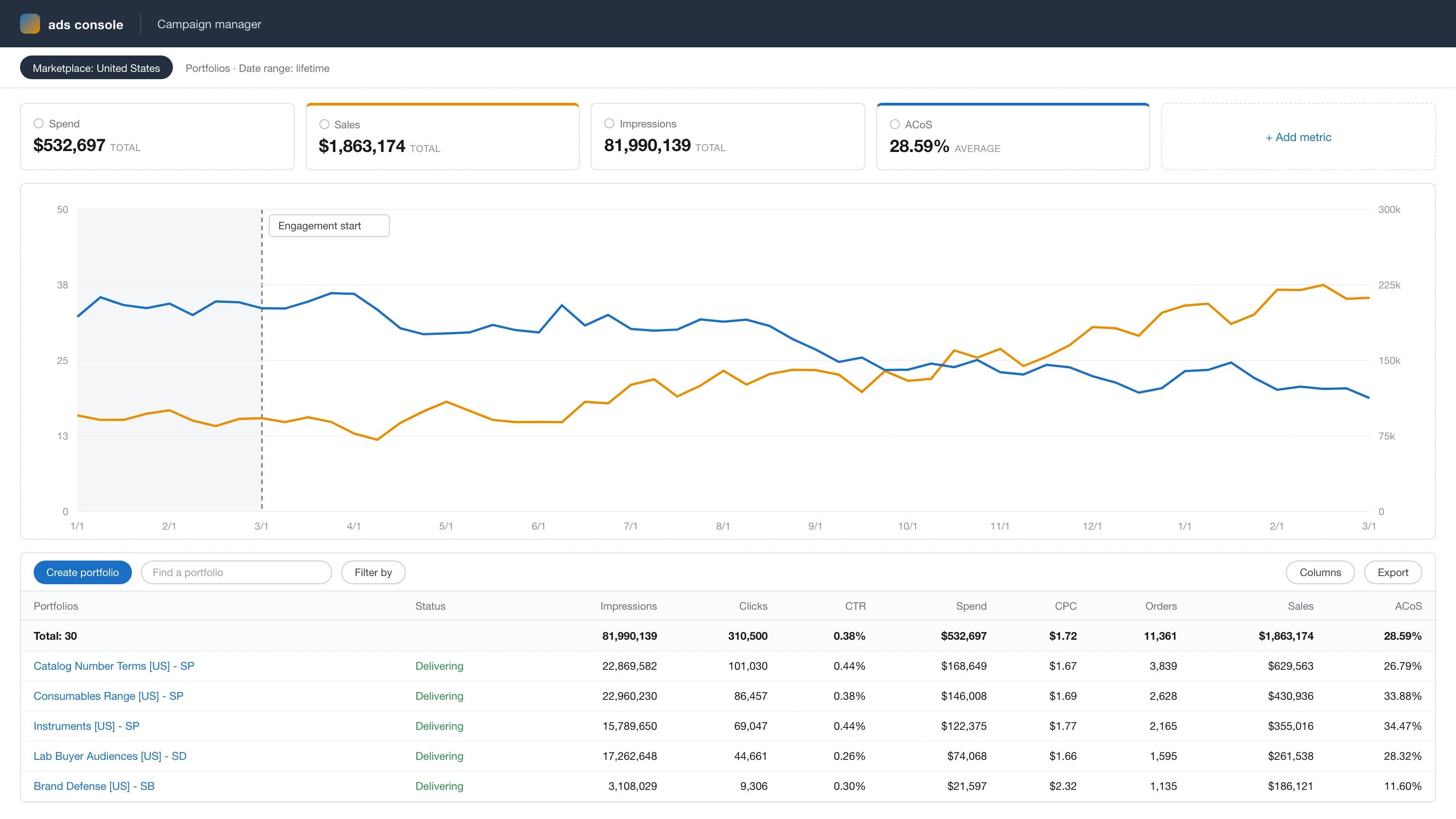
Anonymized account view, rebuilt from the figures reported above: ad sales growing from $85k to $192k a month while ACoS falls from 34% to 22% across the 12-month engagement.
The results
New-to-brand orders almost quadrupled — 310 to 1,220 a month — and revenue more than doubled to $427k.
Average order value rose 69%, because a lab that discovers it can order here without a purchase order does not order one flask; it orders the week's list. The competitive set that had absorbed two years of effort turned out to be almost irrelevant: the growth came entirely from buyers who had never bought this category on Amazon before.
“We were winning a fight against four other sellers. Our customers were not choosing between us and them, they were choosing between us and a purchase order.”
Services we delivered
Related case studies
Ready to scale your Amazon brand?
Talk to a senior strategist and leave with a growth plan for your store — no obligation.