
Growth capped by a restock limit nobody was watching
In-stock rate 62% → 96%
A fitness equipment brand kept selling out of its best products while the warehouse was full. The constraint was not demand or supply — it was how many units Amazon would let it store.

At a glance
- Category
- Exercise & Fitness
- Marketplaces
- US
- Revenue at start
- $286k / month
- Constraint
- Restock limit below 5 weeks of cover on hero ASINs
- Engagement
- Full account management + PPC
- Timeframe
- 10 months
Results
The challenge
The brand's three best sellers were out of stock roughly four months out of every ten, and every conversation about it ended with the warehouse manager pointing at a full pallet rack. The stock existed; Amazon simply would not accept it.
A low Inventory Performance Index had pushed the account onto a tight restock limit, and the limit was being consumed by slow-moving SKUs that had been shipped in optimistically two years earlier. So the account was storing eighteen months of cover on items that sold four a week, and five weeks of cover on items that sold four hundred. Each stockout then cost rank, which cost sales, which lowered sell-through further — the limit tightened as a direct consequence of the problem it was causing.
Our approach
We freed the allowance before adding a single unit.
- Dead stock cleared first — the slowest 30% of ASINs liquidated or removed, which is what raises sell-through and with it the restock allowance.
- Allowance allocated by velocity, so the hero ASINs receive cover proportional to what they actually sell rather than a flat split.
- Advertising paced to inventory — spend cut automatically as cover falls below three weeks, so budget is never spent driving traffic to a listing about to go dark.
- Split shipments and multi-node placement to reduce the receiving delays that had been eating a week of cover on every restock.
How we worked
- 1
Audit the allowance
Restock limit consumption mapped per ASIN: 64% of the allowance was held by SKUs producing 9% of revenue.
- 2
Liquidate the tail
The slowest 30% removed over six weeks through price-down and removal orders, deliberately taking a one-off loss.
- 3
Rebuild IPI
Sell-through, excess inventory and stranded listings addressed as the three inputs the score actually measures.
- 4
Reallocate to heroes
Freed allowance directed to the three ASINs carrying most of the revenue, taking cover from 4.8 to 9.5 weeks.
- 5
Protect rank
Ad spend linked to cover, and reorder points set on Amazon-side availability rather than warehouse stock.
Inside the ad account
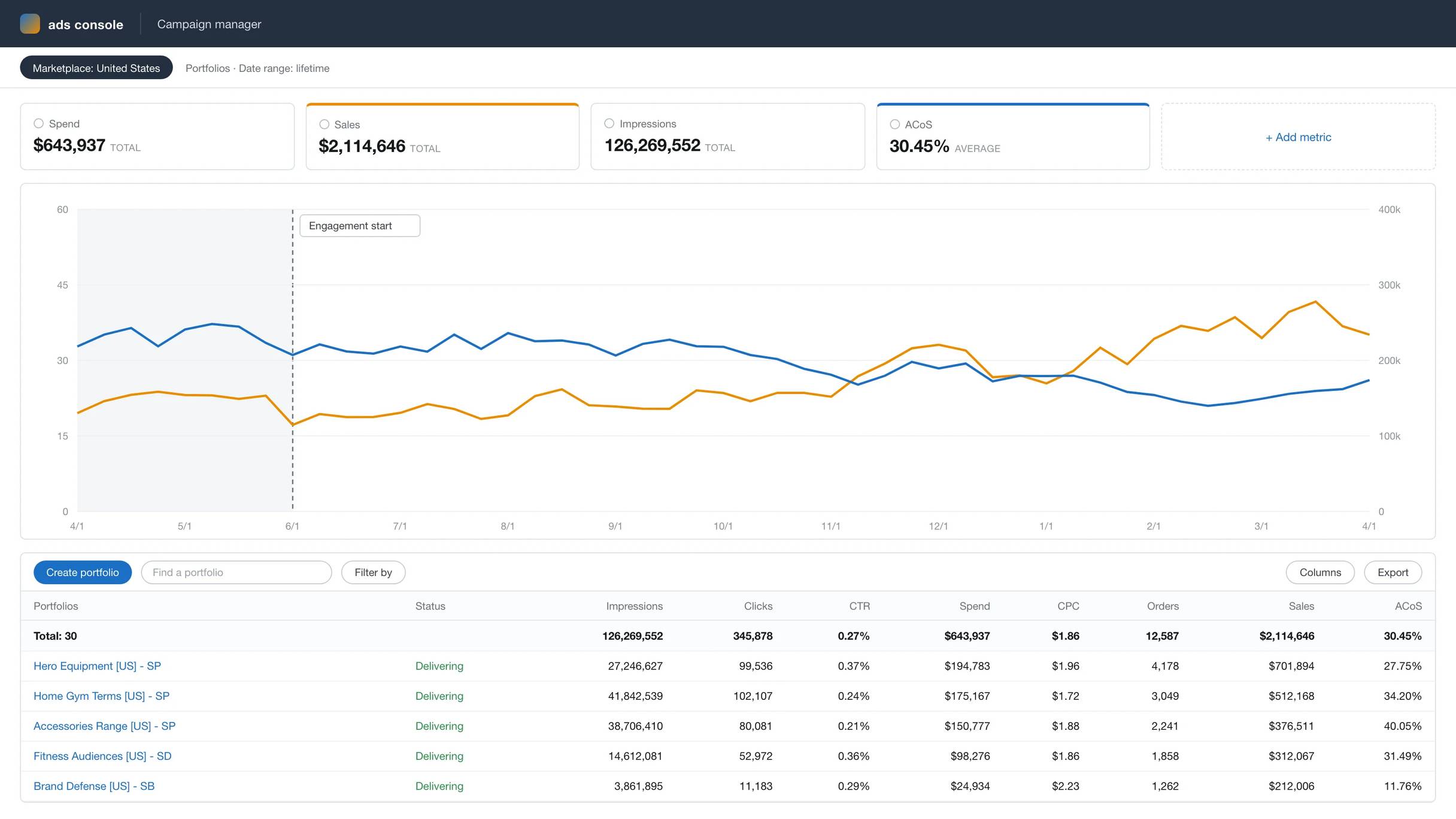
Anonymized account view, rebuilt from the figures reported above: ad sales growing from $129k to $224k a month while ACoS falls from 34% to 23% across the 10-month engagement.
The results
In-stock rate on the hero ASINs rose from 62% to 96%, and revenue grew 74% with no new products and no increase in manufacturing.
The loop that had been running against the brand now runs for it: consistent availability raises sell-through, higher sell-through raises the allowance, and a larger allowance makes the next stockout less likely. Clearing the dead stock cost real money in one quarter and unlocked more than that in the next.
“We were arguing about demand forecasts while the actual ceiling was a number in a dashboard nobody opened.”
Services we delivered
Related case studies




Ready to scale your Amazon brand?
Talk to a senior strategist and leave with a growth plan for your store — no obligation.