
Selling licensed merchandise without collecting IP complaints
IP complaints 14 → 0
A fan merchandise seller listed products across dozens of teams, some licensed and some not, and lost listings to rights complaints every month. Aligning the catalog with actual licenses ended the churn and grew the licensed half.

At a glance
- Category
- Fan Shop
- Marketplaces
- US
- Revenue at start
- $212k / month
- Problem
- 14 open IP complaints, account health at risk
- Engagement
- Full account management + listing SEO
- Timeframe
- 10 months
Results
The challenge
The catalog had grown the way fan merchandise catalogs do: a license for two leagues, an assumption that team names in a title were fine, and a long tail of products referencing clubs the seller had no agreement with. Every month something came down, and roughly once a quarter a complaint escalated far enough to threaten the account itself.
The cost was not only the removals. Constant enforcement risk made the seller nervous about investing in any listing, so the properly licensed products — the profitable half of the business — were as thin and neglected as the ones that were about to be taken down. The account was being run defensively across a catalog where half the problem was self-inflicted.
Our approach
We reconciled the catalog with the paperwork and then invested in what was left.
- License audit against the catalog — every listing matched to a specific agreement, territory and product category, which revealed how much of the tail was unlicensed.
- Unlicensed references removed from titles, images and keywords, including the oblique ones, rather than waiting for a complaint to find them.
- Retractions pursued properly — each open complaint resolved with the rights holder directly, with evidence of the corrective action.
- Licensed lines rebuilt — team and competition vocabulary, sizing, seasonal timing and imagery treated as a real catalog for the first time.
Inside the ad account
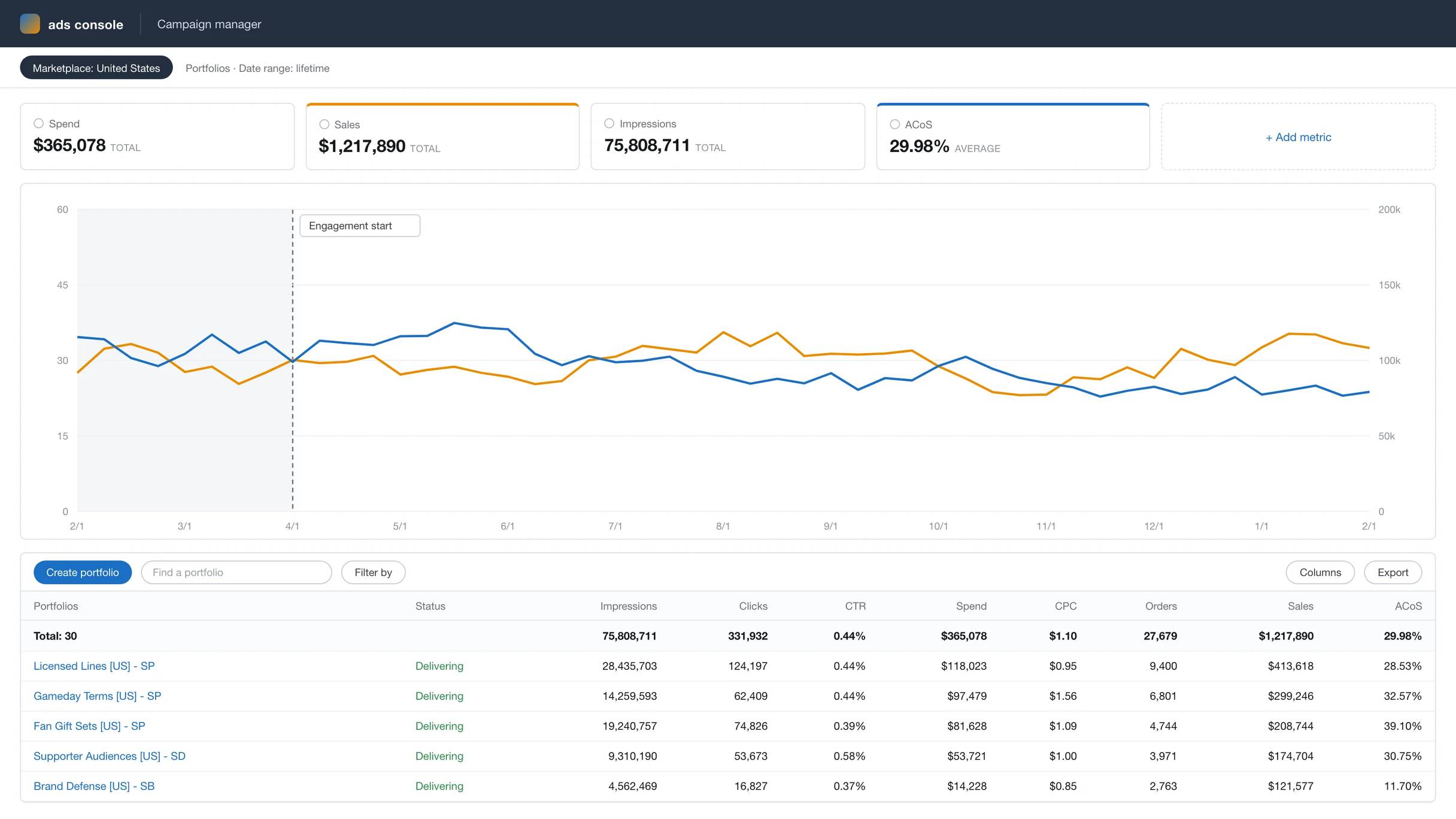
Anonymized account view, rebuilt from the figures reported above: ad sales growing from $95k to $112k a month while ACoS falls from 34% to 24% across the 10-month engagement.
The results
All fourteen complaints cleared and no listing has been removed by a rights holder since, taking the account off the risk register.
Revenue from properly licensed lines doubled, which more than replaced the unlicensed tail that was deleted — total revenue still rose 6% while a third of the catalog disappeared, and the $28k a month that sits outside the licensed lines is plain unbranded merchandise that never needed a license. That is the whole trade: the removed products were producing a little revenue and all of the existential risk, and the licensed ones had never received any attention because nobody wanted to invest in a catalog that might vanish.$
“We were afraid to improve anything, because we never knew which listings would still be there next month.”
Services we delivered
Related case studies



Ready to scale your Amazon brand?
Talk to a senior strategist and leave with a growth plan for your store — no obligation.