
The stock was in the warehouse; the listings were never created
+$38k / month from existing inventory
A golf brand manufactured left-handed and women's-flex versions of its best sellers for its pro-shop channel and had never listed a single one on Amazon.

At a glance
- Category
- Golf
- Marketplaces
- US
- Revenue at start
- $148k / month
- Finding
- 23 manufactured variants absent from the marketplace catalog
- Engagement
- Account management + listing SEO
- Timeframe
- 7 months
Results
The challenge
The brand had grown up selling through pro shops, where a fitter pulls whatever specification the golfer needs from a back room. When it came to Amazon, someone listed the best sellers — which meant right-handed, regular flex, men's — and the rest of the range stayed in the warehouse.
Left-handed golfers are roughly a tenth of the market and are served by a fraction of the listings, which makes their searches unusually cheap and unusually convertible. Women's flex is a similar story. The brand was manufacturing both, storing both, and competing for neither.
Our approach
This was an inventory-to-catalog gap, not a marketing problem.
- Reconciliation of everything manufactured against everything listed, which is how twenty-three absent variants surfaced.
- Own listings rather than variation children for the underserved specs, so the title, the images and the indexed terms all say “left-handed” instead of sitting under a parent written for the right-handed version.
- Copy written for that golfer — the left-handed listing leads with it, because that is the first thing the shopper is scanning for.
- Small dedicated campaigns per specification, cheap to run because barely anyone bids on a left-handed query.
Timeline
Reconciliation
- Every manufactured SKU matched against the marketplace catalog
- Twenty-three absent variants identified
- Demand and competition sized per absent spec
Listing build
- Own listings created for the underserved specs
- Copy led with handedness and flex rather than the model name
- Photography reshot for the left-handed versions
Scale
- Small exact-match campaigns opened per variant
- Bids raised where competition stayed thin
- Inventory planning switched to the full spec range
Inside the ad account
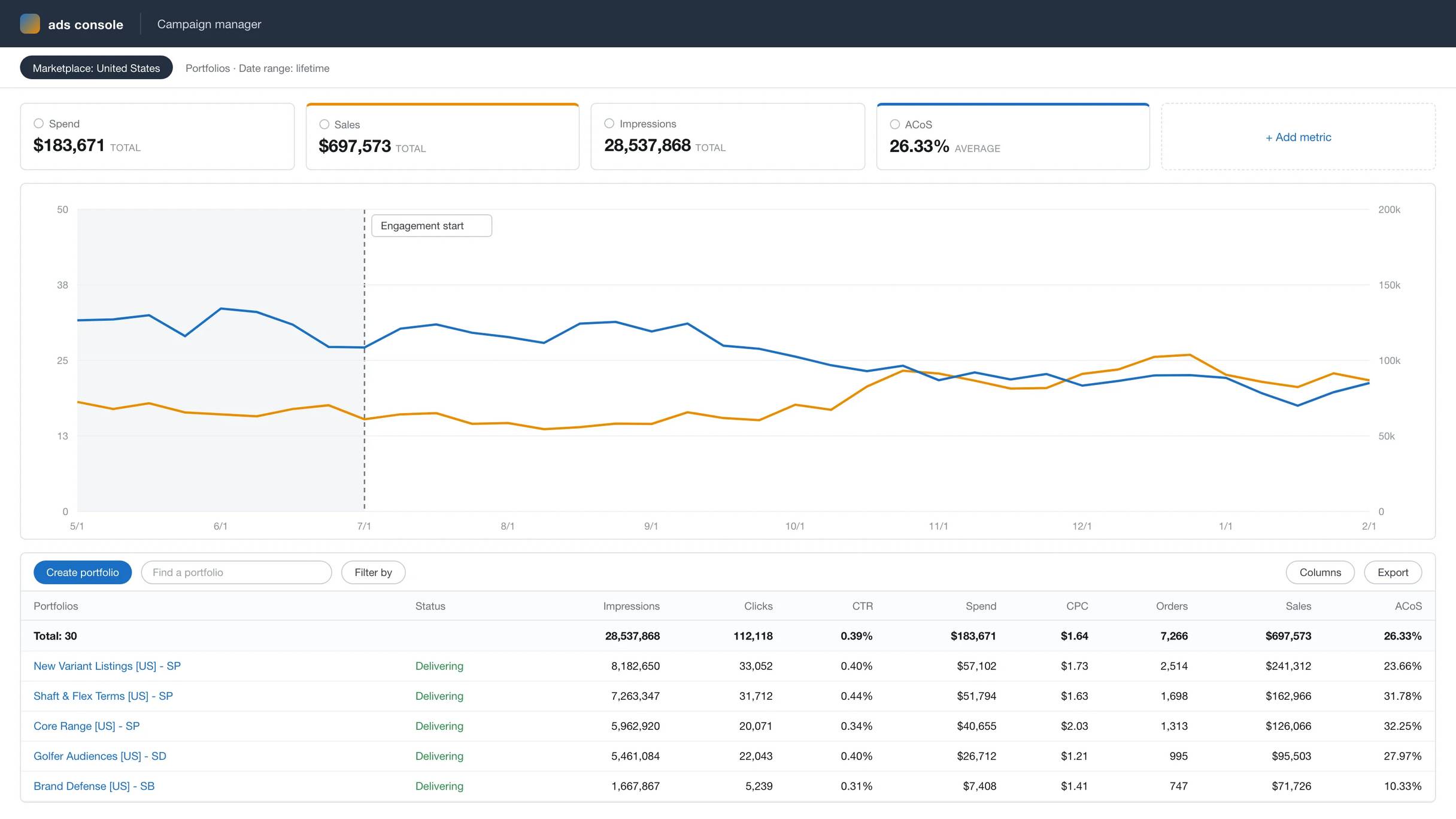
Anonymized account view, rebuilt from the figures reported above: ad sales growing from $67k to $99k a month while ACoS falls from 31% to 20% across the 7-month engagement.
The results
The newly listed variants produce $38k a month from stock the brand was already holding, lifting total revenue 33%.
Their ACoS is 18% against an account average in the high twenties, because an uncontested search is cheap. No product was designed, no inventory was ordered and no price changed — the work was reconciling a warehouse against a catalog, which nobody had done since the account was opened.
“We'd been asking how to grow on Amazon while a third of what we make wasn't on it.”
Services we delivered
Related case studies




Ready to scale your Amazon brand?
Talk to a senior strategist and leave with a growth plan for your store — no obligation.