
Spending a craft trend's peak on demand that would outlive it
Revenue held at 2.4x after the trend collapsed
A craft brand rode a viral trend to a record quarter and expected the fall. We treated the peak as a funded window to buy rankings on terms that would still exist a year later.

At a glance
- Category
- Arts, Crafts & Sewing
- Marketplaces
- US, CA
- Revenue before the trend
- $104k / month
- Peak
- $611k in the trend's best month
- Engagement
- Full account management + PPC
- Timeframe
- 14 months
Results
The challenge
A technique went viral and the brand's core material was what it required. Revenue went from $104k to $611k a month in eleven weeks, and everyone involved knew how that story ends: craft trends of this kind burn for two or three quarters and then fall almost as fast as they rose.
The two obvious failure modes were both in play. One is to treat the peak as the new normal, buy inventory against it and be left holding a warehouse of a dead trend. The other is to enjoy it passively, do nothing structural, and land back at $104k when it passes — having gained nothing but one good quarter. The brand had done the second thing during a smaller trend two years earlier.$
Our approach
We spent the peak buying things that do not expire.
- Adjacent evergreen keyword map — every material, technique and finished-object term that a trend participant also searches, most of which predate the trend and will outlast it.
- Deliberate over-investment in ranking while conversion rates were inflated, because rank bought during a demand spike is cheap and persists.
- Purchase orders capped against a decay curve, not against last month, with the reorder plan assuming the trend halves every quarter after peak.
- A second listing set built for the evergreen use cases, launched at the peak so it would inherit traffic on the way down.
Timeline
Ride and instrument
- Trend terms tracked separately from everything else
- Evergreen adjacency map built from trend buyers' other searches
- Inventory plan rebuilt around a decay assumption
Buy the future
- Advertising pushed hard on evergreen terms while conversion was high
- Second listing set launched into inherited traffic
- Trend revenue falling steadily from month 4, on the modeled curve
Land softly
- Trend terms fell 90% from peak, as modeled
- Evergreen revenue grew past the falling trend line in month 11
- Ending run rate 2.4x the pre-trend baseline
Inside the ad account
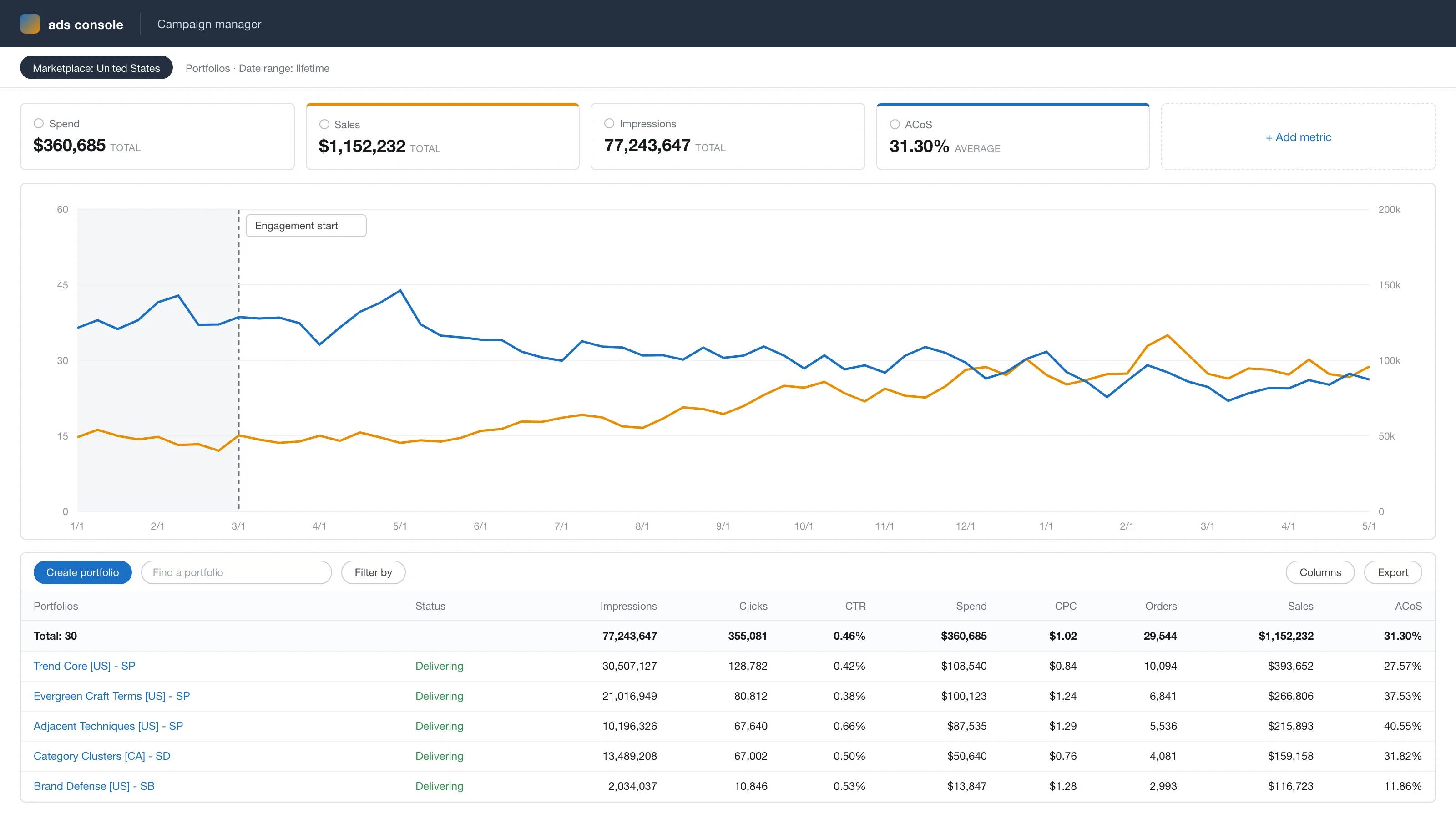
Anonymized account view, rebuilt from the figures reported above: ad sales growing from $47k to $112k a month while ACoS falls from 38% to 25% across the 14-month engagement.
The results
The trend did exactly what everyone expected: its search terms fell 90% from peak. The account did not. Revenue settled at $249k a month — 2.4x the pre-trend baseline — with only 21% of it coming from the trend that started the whole thing.
The mechanism was timing rather than cleverness. During a spike, conversion rates rise and organic rank is easier to buy; those rankings then cost nothing to hold. Inventory discipline did the rest: $18k written off on a $340k buy-in is an acceptable price for a boom nobody could size in advance.
“The last trend gave us a great quarter and nothing else. This one paid for a catalog that still ranks.”
Services we delivered
Related case studies




Ready to scale your Amazon brand?
Talk to a senior strategist and leave with a growth plan for your store — no obligation.