
Invisible in the grocery aisle of the same marketplace
31% of orders from a second surface
A breakfast brand sold well in Amazon search and not at all to the shoppers who fill a weekly grocery basket — a separate storefront, a separate catalog, and a set of attributes the brand had never filled in.

At a glance
- Category
- Breakfast Foods
- Marketplaces
- US
- Revenue at start
- $221k / month
- Purchase pattern
- Weekly household replenishment
- Engagement
- Full account management + PPC
- Timeframe
- 10 months
Results
The challenge
Breakfast is bought weekly, in a basket, alongside milk and fruit — and inside Amazon that behavior happens in a grocery storefront with its own catalog, its own search and its own eligibility rules. The brand had built a good business in the main marketplace and was completely absent from that storefront, which meant it never appeared to the shopper whose buying pattern its product is designed around.
Getting in is an approval rather than a form — but the brand had never applied, and the catalog it would have been assessed on was half-empty: net weight, unit count, unit price and dietary flags were all blank, and the case pack was a twelve-unit format built for a warehouse order rather than for a household filling a basket. None of it was dramatic; together it was a closed door.
Our approach
We treated eligibility as a data and format problem, which is what it was.
- Enrollment applied for and approved, then the missing product data filled in — weight, count, unit price and dietary fields — so each offer clears its eligibility check.
- Basket-sized formats introduced alongside the existing case packs, priced for a weekly shop rather than a stock-up.
- Offers created and maintained for the second storefront, with stock allocated to it deliberately rather than left to compete with the main channel.
- Advertising extended to the placements inside that storefront, where the shopper is already assembling an order rather than evaluating a single product.
Inside the ad account
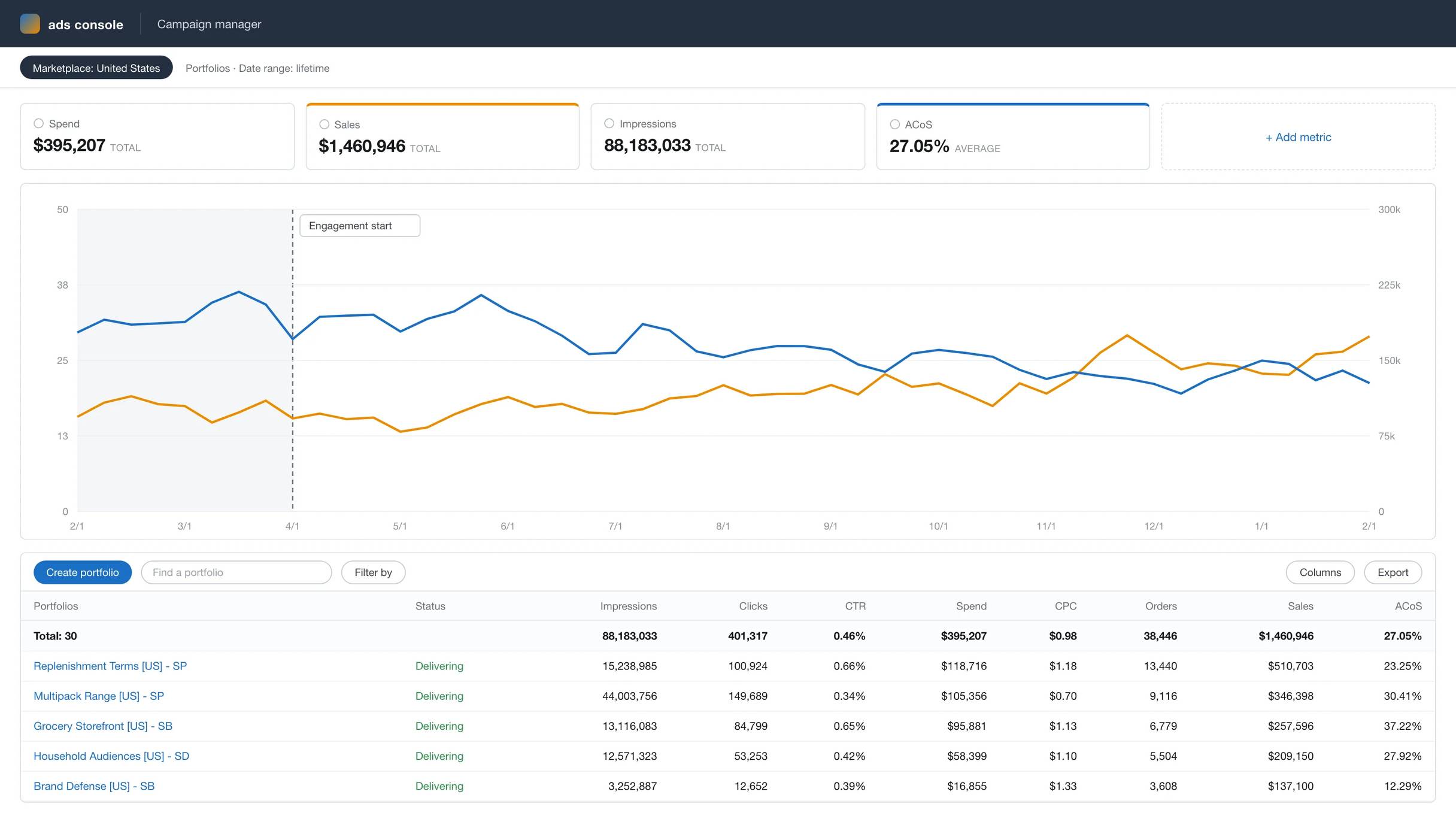
Anonymized account view, rebuilt from the figures reported above: ad sales growing from $99k to $156k a month while ACoS falls from 32% to 22% across the 10-month engagement.
The results
Within ten months, 31% of orders come through the grocery storefront — a channel that was producing nothing because nobody had filled in the fields that open it.
The second-order effects matter more than the first. Units per order rose by a third, because a shopper adding to a cart behaves differently from one buying a single product, and the repeat rate rose fifteen points for the same reason: a weekly shop comes back weekly. Revenue grew 57% while spend on the main marketplace stayed flat.
“A weekly-shop product, sold for two years in the one channel where people buy a single item at a time.”
Services we delivered
Related case studies

Ready to scale your Amazon brand?
Talk to a senior strategist and leave with a growth plan for your store — no obligation.