
Growing a laundry brand's organic sales 142% with listing SEO
+142% organic sales
A laundry care brand ranked for its own name and almost nothing else. We rewrote the catalog around how people actually describe laundry problems — stains, fabrics, sensitivities — and let advertising follow the rankings instead of substituting for them.

At a glance
- Category
- Household Supplies
- Marketplaces
- US
- Revenue at start
- $64k / month
- Organic share at start
- 29%
- Engagement
- Listing SEO + creative
- Timeframe
- 10 months
Results
The challenge
The listings read like the back of the bottle. Titles opened with the brand name and a product line nobody searches for, bullets described the formula, and the backend keyword fields had been filled once at launch and never revisited. The catalog ranked well for the brand name and for almost nothing else — 310 keywords in the top three pages across nineteen ASINs.
Meanwhile the demand was obvious in the search data and written in a completely different language: people search for the problem — a stain, a fabric, a smell, a skin sensitivity — not for a product line. Advertising had been quietly compensating for the gap for two years, which is why 71% of revenue arrived through a paid click.
Our approach
We rewrote the catalog in the shopper's words, one family at a time.
- Problem-led keyword research — the term set built from stains, fabrics, sensitivities and use occasions, then mapped to the ASIN that genuinely solves each one.
- One rewrite per variation family — titles, bullets, A+ and backend terms redone together so the whole family indexes consistently.
- Creative carrying the same claim — the image stack answers the problem in the first two frames, because a listing that ranks and doesn't convert loses the rank back.
- Staged rollout with measurement — families released in waves, so ranking movement could be attributed rather than guessed at.
How we worked
- 1
Demand mapping
Search volume grouped into problem clusters — stain types, fabric care, fragrance-free and sensitive-skin — and each cluster assigned an owner ASIN.
- 2
Family-by-family rewrite
Nineteen ASINs rewritten as six variation families: title, five bullets, A+ modules and backend terms in one pass per family.
- 3
Image stack rebuild
Frame one shows the problem solved, frame two the fabric or sensitivity claim — the two questions the copy now ranks for.
- 4
Staged release
Two families per wave with a four-week gap, so indexation and ranking movement could be read against a stable baseline.
- 5
Advertising retuned to the new rankings
Once a cluster ranked organically, paid bids on it came down deliberately and the budget moved to clusters that had not ranked yet — which is why paid revenue kept growing while its share of the total fell.
Inside the ad account
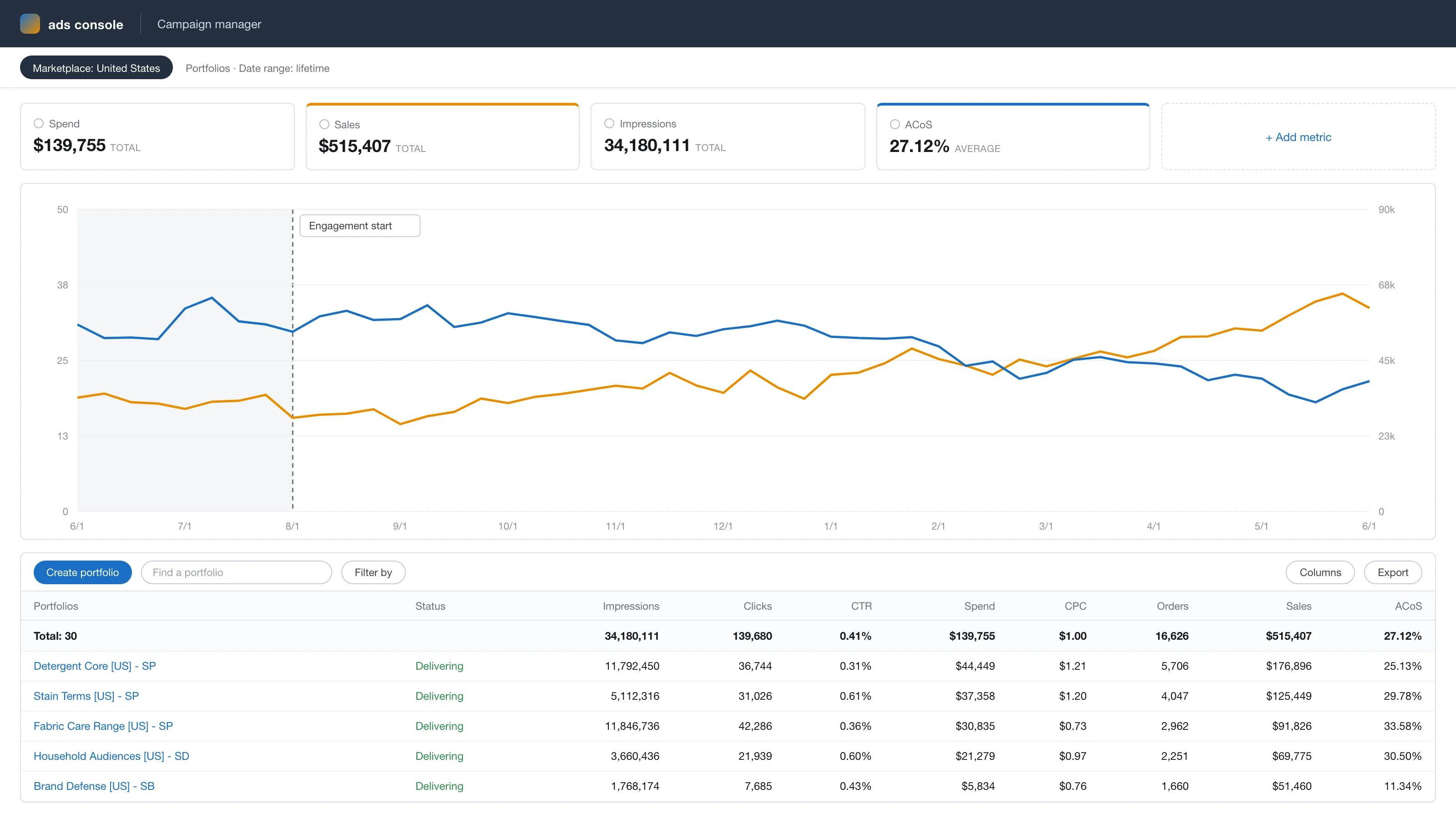
Anonymized account view, rebuilt from the figures reported above: ad sales growing from $29k to $53k a month while ACoS falls from 33% to 22% across the 10-month engagement.
The results
Organic sales went from $19k to $46k a month — +142% — and total revenue from $64k to $118k.
Indexed keywords in the top three pages grew from 310 to 1,180, and conversion rate rose 3.7 points because the listings now answer the question the shopper arrived with. The brand's dependence on paid traffic started to invert: 71% of revenue arrived through an ad click at the start and 61% does now, with organic the faster-growing half for the first time.
“Our copy was written for us, not for the person with a grass stain. Reading the rewritten listings was slightly embarrassing and then very profitable.”
Services we delivered
Related case studies




Ready to scale your Amazon brand?
Talk to a senior strategist and leave with a growth plan for your store — no obligation.