
The whole set came back because four pieces were missing
Return rate 11% → 4%
A building toy brand was taking back entire sets over a handful of absent bricks. Giving buyers a way to get the missing pieces instead of a refund changed the rating, the margin and the review page.

At a glance
- Category
- Building Toys
- Marketplaces
- US
- Revenue at start
- $176k / month
- Problem
- 11% returns; 7 in 10 cited missing or damaged pieces
- Engagement
- Full account management + creative
- Timeframe
- 8 months
Results
The challenge
A 480-piece set arrives four bricks short and the customer returns all 480. That is rational behavior — the alternative on offer was a half-built model — but it is a catastrophic outcome for the seller: the set cannot be resold as new, the refund is full price, and the customer usually leaves a one-star review on the way out.
Seven in ten returns named missing or broken pieces, and the review page repeated the complaint loudly enough that new shoppers were reading it before buying. Nothing on the listing, in the insert or in the brand's messaging offered any route other than “return it”, so every shortfall of four bricks cost the brand a full set and a point of rating.
Our approach
We built the alternative to a return and put it where the customer looks.
- A replacement-parts request route, printed on the insert and repeated in the listing, promising the missing pieces within days at no cost.
- Spare-piece packs listed as their own ASINs, so a buyer who simply lost a brick has somewhere to go instead of the return button.
- Count verification at the packing line for the four sets that generated most complaints, plus a small surplus of the most-lost pieces in each box.
- Expectation set in the image stack — the exact piece count and the replacement promise shown as a frame, not buried in the A+.
How we worked
- 1
Return-reason coding
Six months of returns read individually: 71% were missing or broken pieces, concentrated in four sets with small connector parts.
- 2
Supplier count audit
Two of the four sets traced to a bagging step that split counts across two bags; the reconciliation step was missing.
- 3
Replacement route launched
An insert card and a listing frame offering free replacement pieces, fulfilled within three business days.
- 4
Surplus packing
The five most frequently missing parts over-packed by two units each — cheaper than one return in every scenario.
- 5
Answering the complaint on the page
The replacement promise added to the image stack, so new shoppers see the answer to the complaint they just read.
Inside the ad account
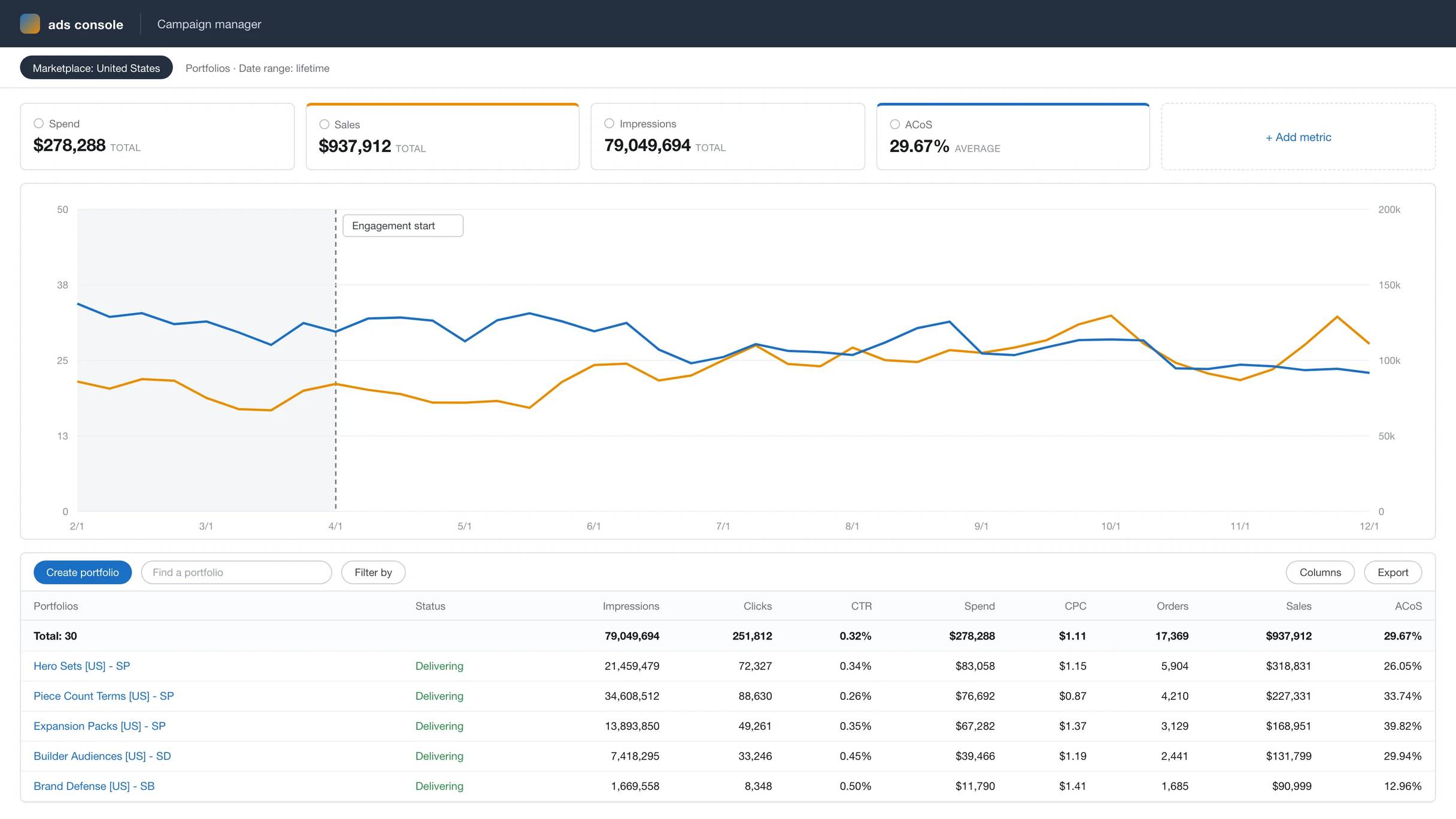
Anonymized account view, rebuilt from the figures reported above: ad sales growing from $79k to $118k a month while ACoS falls from 32% to 23% across the 8-month engagement.
The results
Returns fell from 11% to 4%, and net revenue rose 49% on modest order growth — about a sixth of that is product that no longer comes back unsellable, and the rest is what a 4.1 rating does to conversion.
The rating moved 3.7 → 4.1 because the customer whose set was short now gets replacement bricks in the mail instead of a refund, and that customer does not write the review the old process guaranteed. Over-packing five small parts costs pennies per set; a single return cost the full retail price plus the review it came with.
“We were refunding forty-dollar sets over four bricks that cost us nine cents. Once someone put those two numbers on the same slide it took about a minute to decide.”
Services we delivered
Related case studies




Ready to scale your Amazon brand?
Talk to a senior strategist and leave with a growth plan for your store — no obligation.