
Finding buyers in the category next door
+79% revenue from adjacent demand
A tablet keyboard brand was fighting for accessory searches worth a fraction of the demand sitting one category over, where people were shopping for a cheap laptop and would have been better served by its product.

At a glance
- Category
- eReaders & Tablets Accessories
- Marketplaces
- US
- Revenue at start
- $83k / month
- Contested pool
- Accessory searches, 6 direct competitors
- Adjacent pool
- Budget laptop searches, ~8x the volume
- Engagement
- Listing SEO + PPC
- Timeframe
- 8 months
Results
The challenge
The brand made a keyboard case that turns a tablet into something a student can write an essay on. Its entire marketing existed inside the accessory aisle, competing with six near-identical products for a search pool that had stopped growing, at prices that fell every quarter.
One category over, a much larger group of people were searching for an inexpensive laptop for study or travel — many of them already owning a perfectly capable tablet. For a meaningful share of them, a sixty-dollar keyboard was a better answer than a four-hundred-dollar budget laptop, and nobody was making that argument. The barrier was not demand or product fit; it was that the brand thought of itself as an accessory and so did every word on its listings.
Our approach
We went to where the demand and the money were.
- Substitution messaging — the product framed against what the shopper is currently considering, with the comparison made honestly including what a tablet cannot do.
- Listing rewritten around the job — writing, study, travel — rather than around the hardware it attaches to.
- Sponsored Display and Sponsored Products aimed at the adjacent category, where a low-priced product converts unusually well against a four-figure consideration set.
- A compatibility answer at the top of the page, since the adjacent shopper's first question is whether it fits the tablet they already own.
How we worked
- 1
Demand sizing
Adjacent search pool measured at roughly eight times the accessory pool, with far lower advertiser density at the long end.
- 2
Message testing
Two framings run against each other for six weeks; the honest comparison outperformed the aspirational one.
- 3
Listing rebuild
Copy and imagery restructured around study and travel use rather than around the accessory category.
- 4
Campaign expansion
Adjacent targeting scaled in stages, with the accessory campaigns held flat as the control.
- 5
Compatibility handling
A device-matching answer placed above the fold to absorb the adjacent shopper's main objection.
Inside the ad account
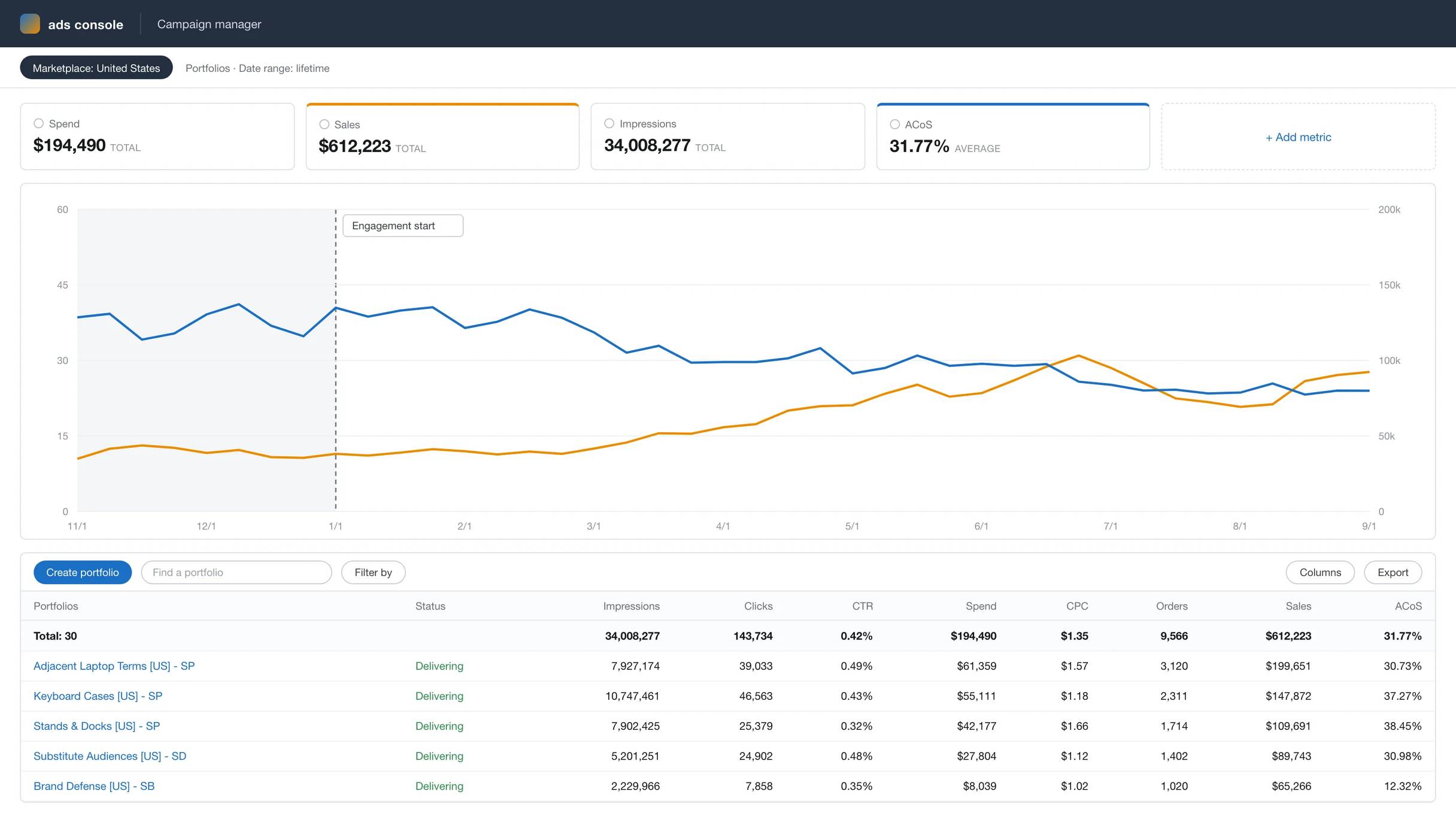
Anonymized account view, rebuilt from the figures reported above: ad sales growing from $37k to $98k a month while ACoS falls from 38% to 22% across the 8-month engagement.
The results
Revenue grew 79% to $149k a month, with 44% of orders now coming from searches the brand previously did not appear in at all.
Cost per order fell 35%, which is the counterintuitive part — bidding into a category of far more expensive products is cheap, because the advertisers there are optimizing against a four-hundred-dollar average order and a sixty-dollar alternative simply does not register as competition. The accessory business did not shrink; it just stopped being the whole business.
“We'd been fighting six people for the same shrinking pool. The buyers we needed were in a different aisle entirely, and they weren't even being sold to.”
Services we delivered
Related case studies

Ready to scale your Amazon brand?
Talk to a senior strategist and leave with a growth plan for your store — no obligation.