
Ranking better by deleting two thirds of the keywords
Sessions +10% after pruning
Four years of “add it, it can't hurt” had stuffed every backend field and title with terms the products had nothing to do with. Relevance is a ratio, and theirs had collapsed.

At a glance
- Category
- Electronics
- Marketplaces
- US
- Revenue at start
- $402k / month
- Finding
- Average listing indexed for 1,900 terms, two thirds irrelevant
- Engagement
- Listing SEO + PPC
- Timeframe
- 6 months
Results
The challenge
Every quarter someone had added keywords. Competitor brand names, adjacent product types, misspellings of things the brand doesn't sell, seasonal terms from a promotion two years ago — all of it accumulating in backend fields, titles and bullets because removing a keyword feels like removing an opportunity.
It isn't. A listing that appears in searches it cannot satisfy collects impressions without clicks and clicks without orders, and both of those tell the ranking algorithm that this listing is a poor answer. The catalog was slowly teaching Amazon to distrust it, and the visible symptom — falling sessions while the ad account looked fine — read to the team as a competitive problem.
Our approach
We measured each term's contribution and deleted the ones that were costing relevance.
- Per-term audit — impressions, click-through and conversion for every indexed term, per ASIN, over twelve months.
- Deletion criteria agreed in advance, because the argument “but what if someone searches it” has to be settled by data rather than by seniority.
- Titles and bullets rewritten around what remained, which also made them readable for the first time in years.
- Advertising negatives aligned with the pruned set, so paid traffic stopped reinforcing the same irrelevance.
How we worked
- 1
Term-level export
Twelve months of search-term and query-performance data pulled per ASIN, so every indexed term had impressions, click-through and conversion against it.
- 2
Deletion criteria
Thresholds agreed before anyone looked at a specific keyword, so the cut was a rule rather than an argument about someone's favorite term.
- 3
Backend and title rewrite
Surviving terms rebuilt into readable titles and bullets; the backend fields kept only what the product genuinely answers.
- 4
Negative alignment
Paid campaigns negated the removed terms, so advertising stopped feeding the same irrelevance back into the listing.
- 5
Eight-week watch
Rank and sessions tracked per pruned ASIN before the next wave, so a wrong deletion would surface on a handful of listings rather than the whole catalog.
Inside the ad account
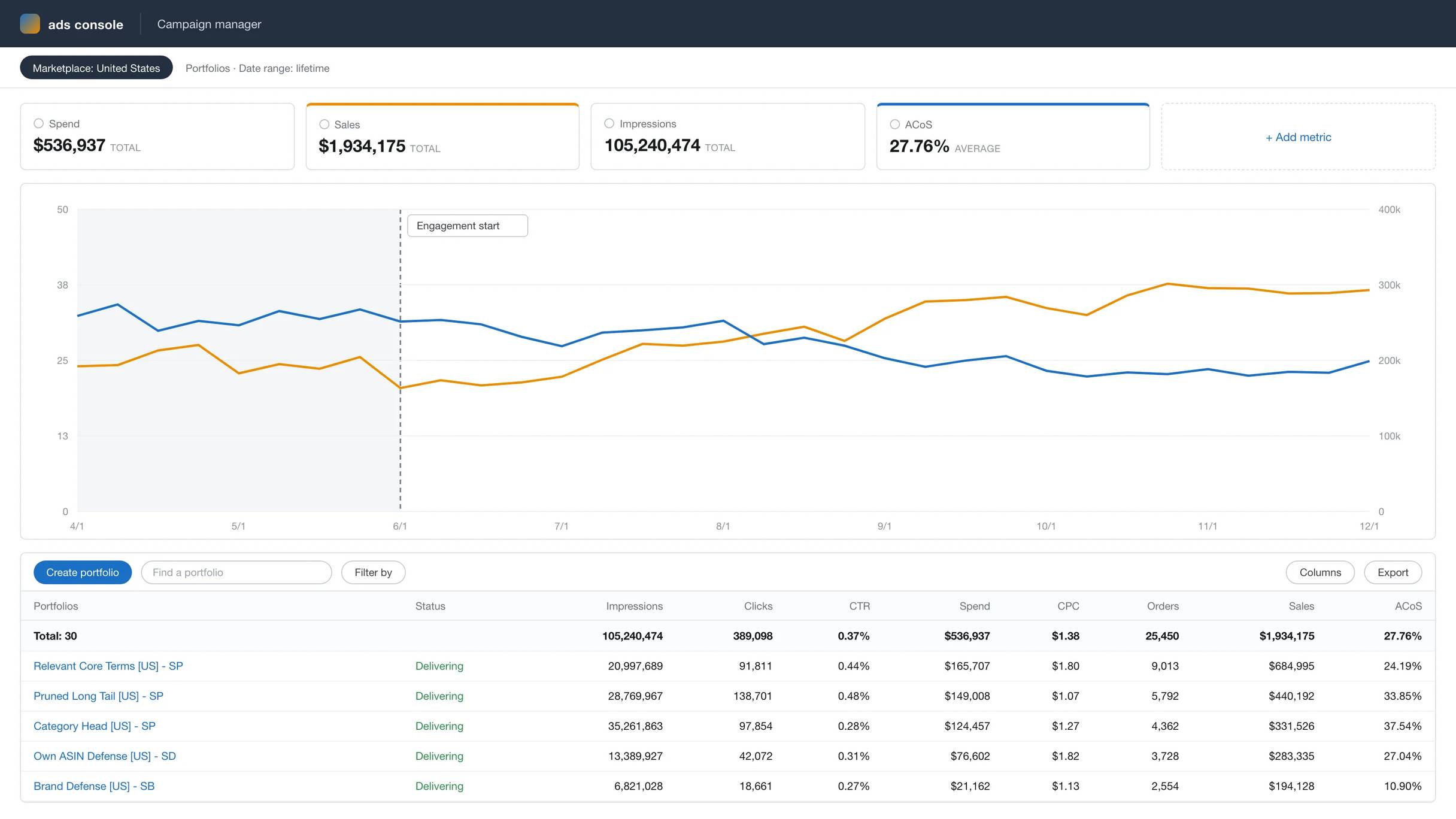
Anonymized account view, rebuilt from the figures reported above: ad sales growing from $181k to $275k a month while ACoS falls from 32% to 22% across the 6-month engagement.
The results
Cutting indexed terms from 1,900 to 620 per listing raised sessions 10% — far fewer searches entered, and a much larger share of them won.
Conversion rose 38% for the same reason: the traffic arriving now matches what the products are. Revenue grew 52% in six months with no new products, no price changes and a slightly smaller advertising budget. The counter-intuitive part is the whole lesson — in a relevance-ranked marketplace, appearing in a search you lose is not free.
“Every keyword in there had been added by someone reasonable. Together they were telling Amazon we were nothing in particular.”
Services we delivered
Related case studies




Ready to scale your Amazon brand?
Talk to a senior strategist and leave with a growth plan for your store — no obligation.