
Publishing the capacity customers actually get
Rating 3.8 → 4.2
Every power bank in the category advertises a cell capacity nobody ever receives, and every review section is full of people who feel cheated. The brand won by printing the honest number.

At a glance
- Category
- Power Banks
- Marketplaces
- US, DE
- Revenue at start
- $208k / month
- Problem
- 38% of negative reviews about capacity
- Engagement
- Creative & content + account management
- Timeframe
- 9 months
Results
The challenge
A 20,000 mAh power bank cannot deliver 20,000 mAh to a phone — conversion losses and voltage step-up take roughly a third of it. The whole category prints the cell number anyway, so shoppers buy expecting five charges, receive three, and write the review accordingly.
The brand's rating had settled at 3.8 with 38% of its negative reviews describing exactly this gap. The team's instinct was to defend: the number was technically accurate, every competitor used the same one, and printing a smaller figure would lose the comparison on the search page. Meanwhile the reviews were doing more damage to conversion than any spec sheet was doing good.
Our approach
We stopped selling a number the customer would never see.
- Deliverable output stated on the page — the real usable figure, alongside the cell capacity, with the difference explained in one line.
- Charges-per-device framing — how many times it fills the common device sizes, which is the unit the buyer is actually interested in.
- Imagery carrying the honest figure in the second frame, so it is seen before the purchase rather than discovered after it.
- The same figure carried into the Q&A and buyer-message replies, so the answer a shopper is given matches the number the page prints.
How we worked
- 1
Measuring it properly
Every SKU bench-tested for real delivered output across three common device sizes, producing figures the brand could stand behind.
- 2
Review evidence
Eighteen months of negative reviews coded; capacity disappointment was 38% of them and the largest single cause.
- 3
Rewriting the claim
Cell capacity kept for comparability, deliverable output added as the headline figure with a plain-language explanation.
- 4
Watching the search page
Four weeks of monitoring to confirm the smaller headline number was not losing clicks — click-through fell 3%, conversion rose 44%.
- 5
Closing the loop
New reviews monitored per SKU; capacity complaints fell to under 6% of negatives by month seven.
Inside the ad account
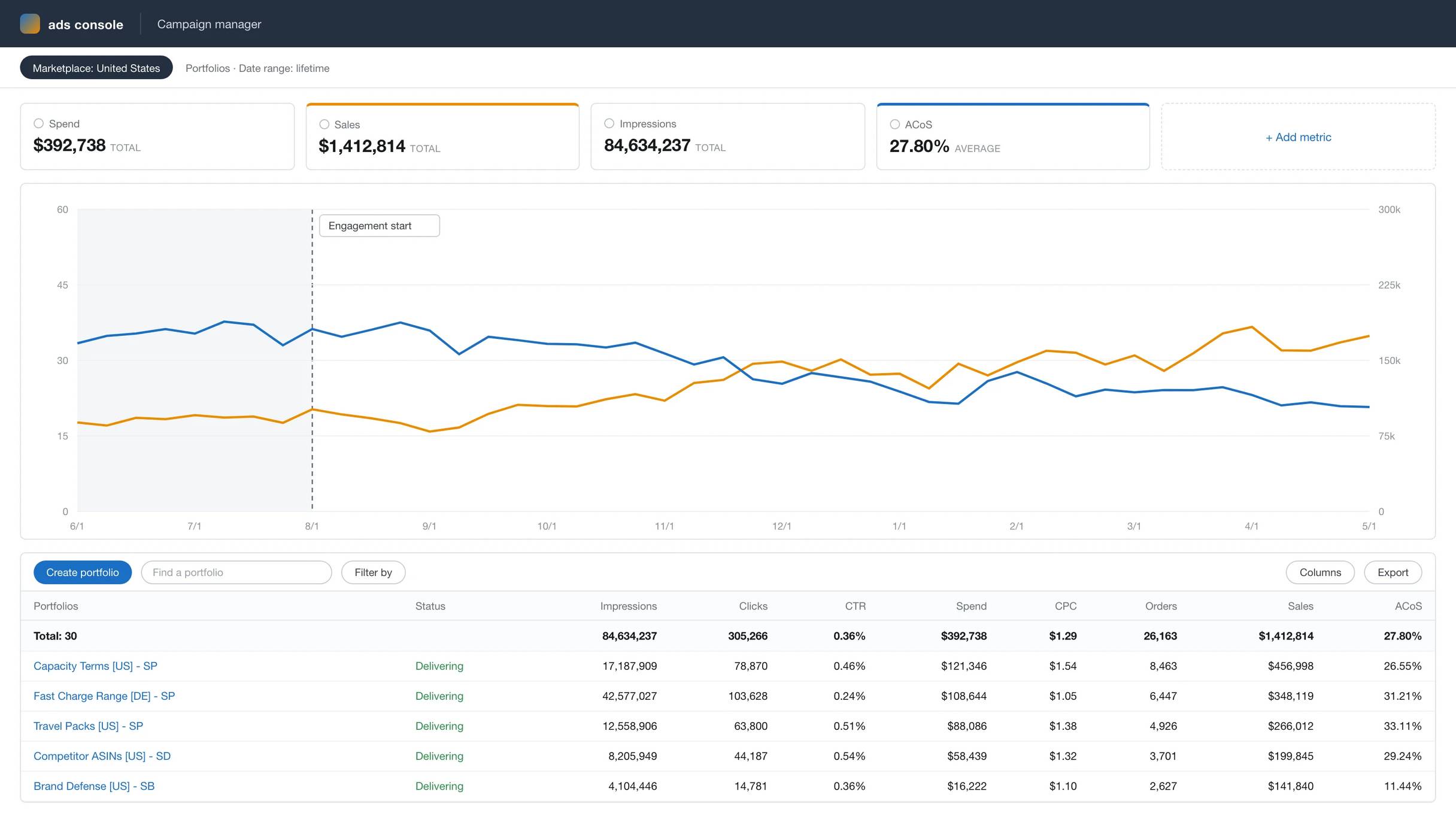
Anonymized account view, rebuilt from the figures reported above: ad sales growing from $94k to $160k a month while ACoS falls from 34% to 22% across the 9-month engagement.
The results
The rating climbed from 3.8 to 4.2 and returns fell from 11% to 4%, because the product now does what the page said it would.
Conversion rose 44% despite advertising a smaller number than every competitor — the honest figure reads as confidence, and the review section stopped arguing with the listing. Revenue grew 71%. The one cost was a 3% drop in click-through from the search page, which the conversion gain repaid many times over.
“We were technically right and losing a star a year for it. The smaller number sells better than the big one did.”
Services we delivered
Related case studies




Ready to scale your Amazon brand?
Talk to a senior strategist and leave with a growth plan for your store — no obligation.