
The season starts in February in Arizona and in May in Minnesota
ACoS 31% → 20% on the same budget
An outdoor living brand ran one national campaign calendar for a category whose season moves north across the map for fourteen weeks. Splitting the budget by region changed the economics without changing its size.

At a glance
- Category
- Patio, Lawn & Garden
- Marketplaces
- US
- Revenue at start
- $412k / month
- Problem
- One on/off budget switch for a 14-week rolling season
- Engagement
- Full account management + PPC
- Timeframe
- 11 months
Results
The challenge
The brand turned its advertising on in late March and off in early August, because that is when the category is busy in aggregate. Aggregates are misleading here: patio season opens in the southern states in February and does not reach the upper Midwest until mid-May, so a single national calendar is late for a third of the country and early for another third.
The cost showed up twice. In February and March the southern demand was served by competitors while the brand was still dark, and the ranking those competitors built held through the rest of the season. Then in June the brand was still bidding hard in states where shoppers had already furnished their yards. Everything was compressed into a short national peak the warehouse could not keep up with, which is why sell-through ended at 71% and the leftovers were discounted in September.
Our approach
We stopped treating the United States as one season.
- A regional season map built from three years of the account's own order data — the week each state's orders begin to climb, not a national average.
- A rolling budget calendar rebuilt week by week against that curve — live in February when the southern states start buying, stepping up as the season moves north, instead of one national switch in late March.
- Inventory inbounded to match, with the season's stock sent into the network in January rather than April.
- A weekly read of the state-level order curve, because the calendar the data implies in March is not the one it implies in June.
- Creative that follows the weather — the early-season message is about getting ready, the late-season one about the summer already underway.
Timeline
Map the season
- Three years of order data broken down by state and week
- Fourteen-week spread between the earliest and latest regions confirmed
- Region groups defined by season start, not by geography
Split the calendar
- Campaign calendar rebuilt around the rolling demand curve
- Budget live in February for the first time — six weeks earlier
- Season inventory inbounded in January instead of April
Tune and hold
- Bids stepped down week by week as the order curve rolled north
- Late-season budget concentrated on the terms still converting
- Discounting on end-of-season leftovers largely unnecessary
Inside the ad account
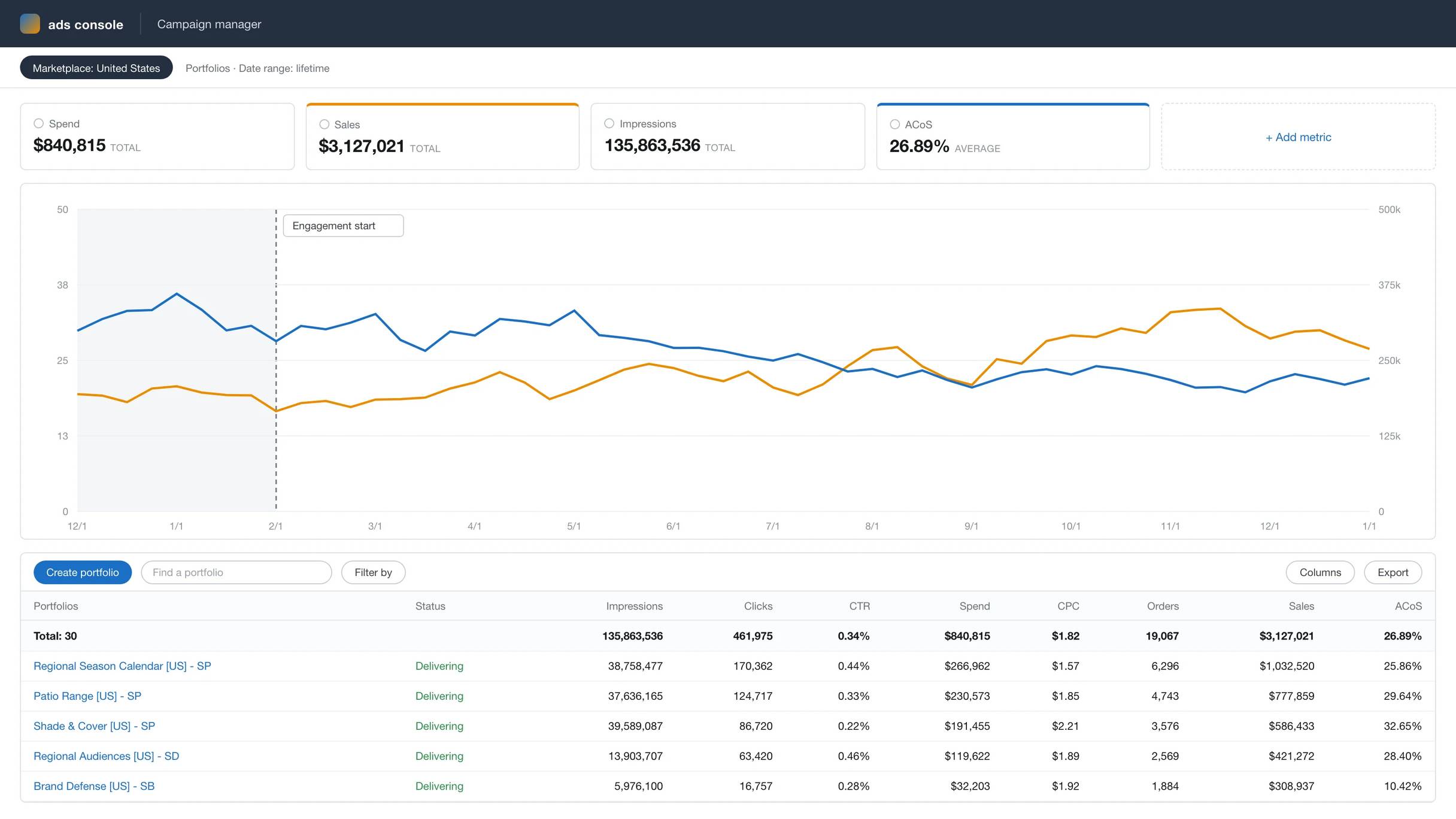
Anonymized account view, rebuilt from the figures reported above: ad sales growing from $184k to $285k a month while ACoS falls from 31% to 20% across the 11-month engagement.
The results
ACoS fell from 31% to 20% on a budget of the same size, and the season's revenue grew 55%.
The interesting number is the flattening: the peak week used to carry 38% of the year and now carries 24%, because the brand sells across fourteen weeks of rolling regional demand instead of fighting everyone in the same four. That flattening is what took sell-through to 94% — the warehouse is no longer trying to ship a year's volume in one month, and September no longer starts with a clearance decision.
“We switched everything on in late March. That was six weeks late for Arizona and six weeks early for Minnesota, and the national report averaged both away.”
Services we delivered
Related case studies




Ready to scale your Amazon brand?
Talk to a senior strategist and leave with a growth plan for your store — no obligation.