
Untangling two house brands that had been bidding against each other for two years
+32% combined revenue, spend flat
A home goods company ran two of its own brands from one account and one ad budget. They shared keywords, shoppers and placements, and the cheaper one was quietly eating the premium one's margin.

At a glance
- Category
- Home & Kitchen
- Marketplaces
- US
- Revenue at start
- $264k / month across two brands
- Structure
- One account, one ad budget, shared keywords
- Engagement
- Full account management + PPC
- Timeframe
- 12 months
Results
The challenge
The company had bought a second brand two years earlier and merged it into the existing Seller Central account because it was easier. Both sold storage and organization products, both targeted the same twenty keywords, and both ran out of a single advertising budget managed by one person optimizing for account-level ACoS.
That single number hid the damage. The budget always flowed to whichever brand converted cheaper — the value line — so the premium brand slowly lost impression share on the terms that justified its price. Worse, the two brands frequently appeared on the same search page, where the shopper simply picked the cheaper one. The company was paying to move its own customers down to a lower margin.
Our approach
The fix was strategic separation, not a bigger budget.
- Two positions, written down — the value brand plays on price-per-unit and multipacks; the premium brand plays on materials, warranty and design. Every listing decision now tests against one of those.
- Budget split and ring-fenced — each brand got its own budget, its own targets and its own reporting; neither can borrow from the other mid-month.
- Keyword separation where it mattered — the head terms both need stayed shared, but modifier sets were divided so the brands stop meeting on the same query.
- Margin, not ACoS, as the account metric — targets set per brand against contribution margin, which is what made the premium brand's higher ACoS acceptable.
How we worked
- 1
Overlap audit
Search-term and placement data cross-referenced between the brands. On 31 of the top 50 terms both brands were serving, and on 12 of them they were the top two organic results.
- 2
Positioning split
Each brand's listings rewritten to a single position — value-per-unit or materials and design — so the pages stop reading as substitutes.
- 3
Budget and target separation
Two budgets, two ACoS targets derived from each brand's contribution margin, and separate weekly reporting.
- 4
Modifier-level keyword split
Long-tail modifiers assigned to one brand or the other and negated on the opposite side; shared head terms kept for both but capped.
- 5
Premium relaunch
The premium line got new A+ and image stacks aimed at the shopper who was already comparing on quality, not on price.
Inside the ad account
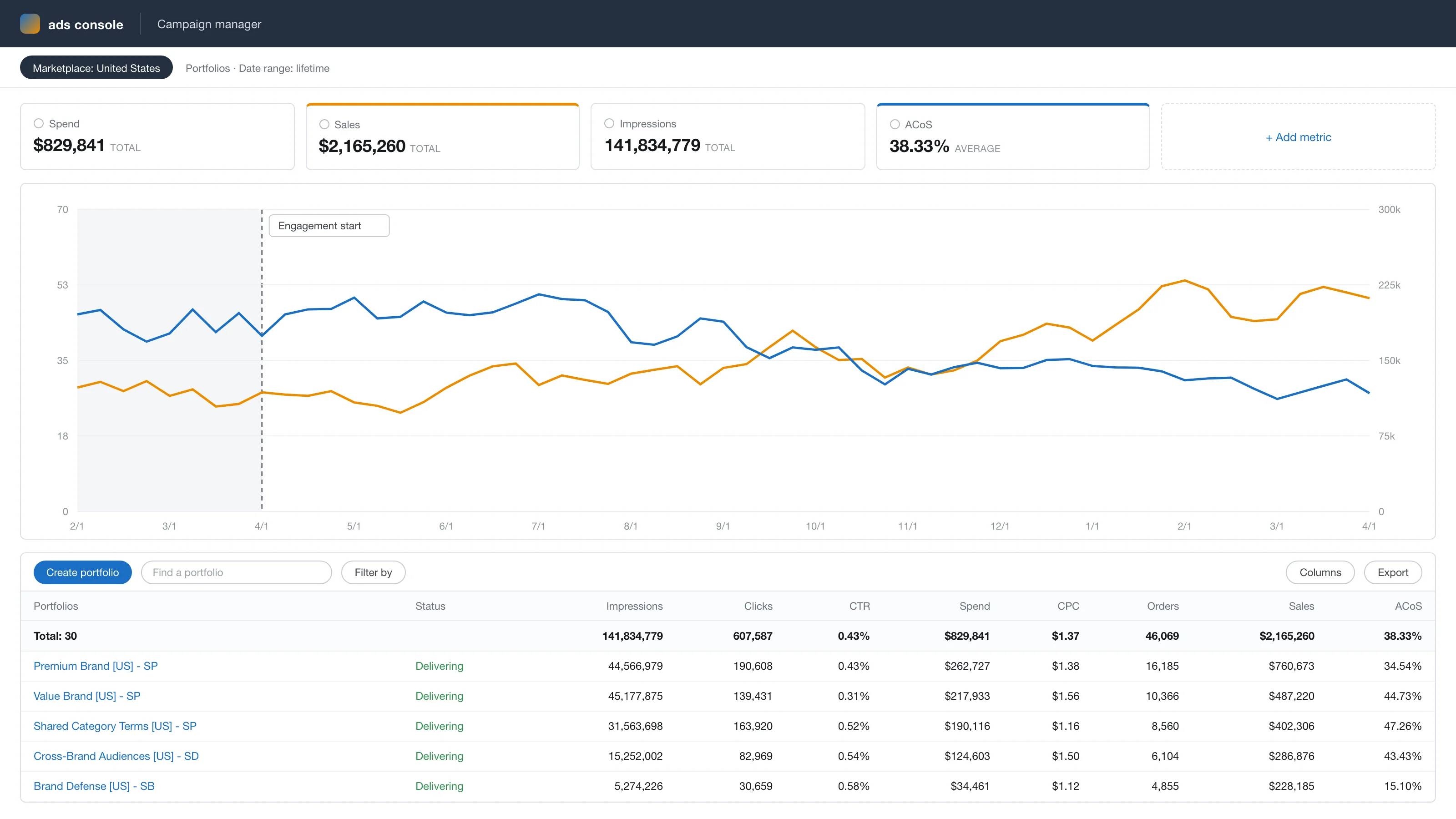
Anonymized account view, rebuilt from the figures reported above: ad sales growing from $119k to $195k a month while ACoS falls from 46% to 29% across the 12-month engagement.
The results
Combined revenue grew from $264k to $348k a month — +32% on flat advertising spend — and the mix changed: the premium brand went from 29% to 51% of revenue.
That mix shift is where the money is. Blended gross margin rose eight points, so the same top line is worth considerably more than it was. No product changed; the account simply stopped funding the cheaper brand's growth with the expensive brand's demand.
“Running both brands from one account looked efficient. It was efficient at cannibalizing ourselves.”
Services we delivered
Related case studies




Ready to scale your Amazon brand?
Talk to a senior strategist and leave with a growth plan for your store — no obligation.