Amazon PPC Explained: The Complete Guide for Brands
The auction mechanics, ad formats, targeting and reports behind Amazon PPC, written for brand owners who already spend real money on ads.


Amazon PPC is the pay-per-click advertising system inside Amazon's marketplace, where brands bid for placement in shopping results and on product detail pages and pay only when a shopper clicks. It is an auction, not a media buy: what you type into the bid field is a ceiling, not a price, and the ad that wins is rarely the one with the highest number attached to it. For a brand already doing meaningful volume, the interesting part is not "how do I launch a campaign" but how the auction decides, what the reports are actually measuring, and where the money quietly goes.
What Amazon PPC is, and what it isn't
Amazon pay per click covers the self-service sponsored ad formats you run from Campaign Manager: Sponsored Products, Sponsored Brands, Sponsored Display and Sponsored TV. Amazon DSP sits next to them as the programmatic option that reaches audiences on and off Amazon, and it is bought differently — usually on a CPM basis, often through a managed service or an agency seat.
Three things separate PPC in Amazon from search advertising elsewhere:
- The click lands on a transaction, not a landing page you control. Your listing does the selling, so ad performance is capped by a conversion rate that lives outside the ads console.
- The advertiser and the retailer are the same company. Amazon sees the sale, the return, the review and the repeat purchase, and uses that data in the auction. You see a filtered slice of it.
- Paid and organic share one ranking surface. Ad-driven sales feed the same sales-velocity signal that moves organic position, so ads and SEO are not two separate budgets.
That last point is why campaign work that ignores the listing tends to plateau. If your detail page converts at half the category norm, no bidding strategy fixes the math.
How the Amazon ad auction actually works
Your bid is a ceiling, not a price
Amazon runs a second-price style auction. You do not pay what you bid; you pay roughly what it took to beat the next-ranked competitor, plus a cent. Bid $2.00 against a next-best effective bid of $1.50 and you pay something close to $1.51, not $2.00.
This trips up a lot of accounts. Because the price is set by the competitor beneath you, shading every bid downward "to be safe" does not save money per click — it removes you from auctions entirely. You lose impressions long before you lose cost. A bid is a statement of maximum willingness to pay, set from unit economics rather than nerves.
Amazon does not publish the exact computation, and no one outside the company sees competitors' bids or relevance scores. Treat any precise formula you read, including the model below, as a working approximation.
Relevance is the other half of the equation
Highest bid does not win. Amazon ranks ads on a combination of bid and expected performance — how likely the ad is to be clicked and to convert for that specific query, inferred from your listing content and your sales history. A well-matched product with a strong conversion record can outrank a higher bid from a weaker listing, and pay less for the privilege.
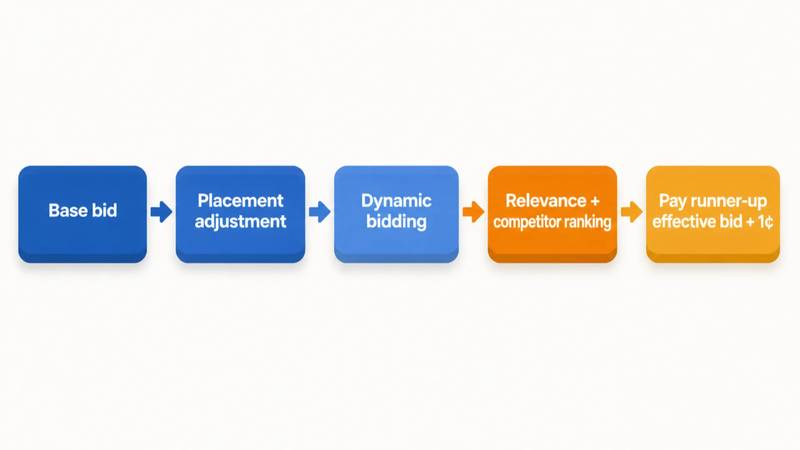
So the effective bid that enters the auction is your typed bid modified several times over:
| Layer | What it does | Who controls it |
|---|---|---|
| Base bid | Your maximum for that keyword or target | You |
| Placement adjustment | Multiplies the bid for top of search, rest of search or product pages | You (campaign level) |
| Dynamic bidding | Raises or lowers the bid per auction based on conversion likelihood | You choose the mode, Amazon applies it |
| Relevance / expected performance | Weights the ranked bid up or down | Amazon |
Amazon documents the mechanics of the two middle layers. Placement adjustments are set per campaign and apply to every target inside it; increases of up to 900% are possible. Dynamic bidding has three modes: down only (lowers the bid when a conversion looks unlikely, never raises it), up and down (raises up to 100% for top-of-search placements and up to 50% elsewhere, and lowers on weak auctions) and fixed (your bid as typed, with manual placement multipliers still applied on top).
Order matters: the placement adjustment is applied to the base bid first, then dynamic bidding works on top of the adjusted number. A $1.00 bid with a 50% top-of-search adjustment on "up and down" can reach $3.00 in a single auction. That stacking is a common source of a CPC that looks nothing like the bid in the spreadsheet — the rules for handling it are a topic of their own, in Amazon bidding strategies and budgets.
Why an ad gets zero impressions
Three ordinary explanations, in the order worth checking: the bid sits below the floor for that query; the product is not considered relevant enough to enter the auction at all; or the campaign has run out of budget for the day and is simply not competing after mid-morning. A high bid does not rescue an irrelevant match — Amazon has no incentive to show a shopper something it expects them to ignore.
The ad types and the job each one does
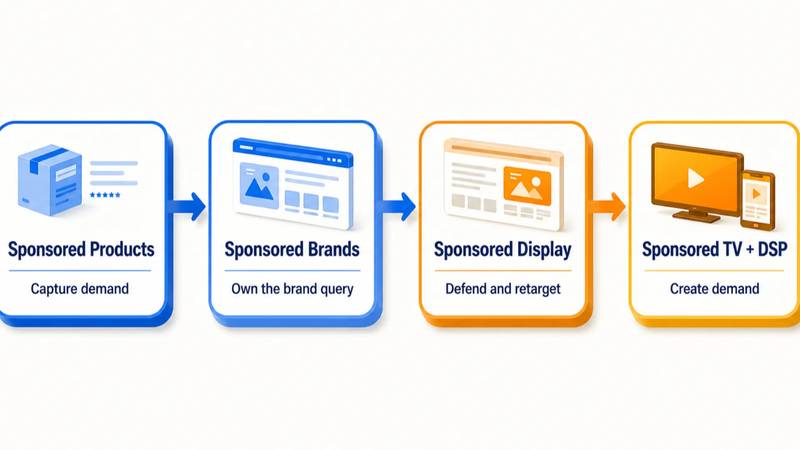
The formats are not interchangeable, and they are not a funnel you climb in order. Each does a different job.
| Format | Pricing | Where it shows | The job it does |
|---|---|---|---|
| Sponsored Products | CPC | Shopping results, product detail pages | Capture existing demand; the workhorse of most accounts |
| Sponsored Brands | CPC | Top of search, as headline, collection, Store spotlight or video | Own the branded query, present a range, send traffic to a Store |
| Sponsored Display | CPC or vCPM | Detail pages, on and off Amazon | Defend your own pages, target competitors, retarget viewers |
| Sponsored TV | CPM | Ad-supported streaming inventory | Upper-funnel reach for brands with demand to create |
| Amazon DSP | Mostly CPM | Amazon-owned and third-party inventory | Programmatic reach, suppression and frequency control at scale |
Sponsored Products is where the majority of spend and nearly all of the diagnostic value sits, because it is the only format that reports the raw shopper query. Sponsored Brands and Sponsored Display earn their budget once you have something to defend — a branded search volume worth owning, or competitor pages worth being on. The split between the three is a real decision with real trade-offs, covered in Sponsored Products vs Sponsored Brands vs Sponsored Display.
Sponsored TV and DSP belong to a later stage. If your Sponsored Products account still holds unharvested converting terms, upper-funnel media is buying reach you have not yet learned to convert.
Targeting: how you tell Amazon who to show the ad to
Automatic targeting
Amazon matches your product to queries and pages using your listing content and sales data, across four named groups: close match and loose match (query-side — what the shopper typed) and substitutes and complements (page-side — what the shopper is browsing). Set a separate bid per group. They behave nothing alike, and averaging them hides both the winners and the waste.
Auto campaigns are not a beginner setting you graduate from. In a mature account they stay on permanently as a discovery instrument — provided the terms you already scaled elsewhere are negated inside them.
Manual keyword targeting
Three match types, from loosest to tightest:
- Broad — the words can appear in any order, with plurals, variations and synonyms. Amazon has widened broad match semantically in recent years, so it now serves on related queries where your exact phrase never appears. Without a negative layer it behaves like a second discovery campaign, not a controlled one.
- Phrase — all the components, in order, with words allowed around them.
- Exact — matched word for word, in the same order.
The workflow that follows from this is unglamorous and durable: discover in auto and broad, refine in phrase, scale proven converters in exact, and negate each harvested term in the campaign it came from so the two never bid against each other. How to arrange that without campaigns colliding as the account grows is the subject of Amazon PPC campaign structure.
Product targeting
You can target individual ASINs, whole categories, or categories filtered by attributes such as brand, price range, star rating or Prime eligibility. This is the most under-used control in the accounts we audit: a category target with a price-and-rating refinement puts you in front of shoppers looking at products your item genuinely beats, which is a better use of a click than a generic head term.
Negatives
Negative keywords and negative product targets are the cheapest optimization available. They do two jobs: stop spend on queries that were never going to convert, and stop your own campaigns competing with each other. The caution is symmetrical — negating on three clicks is guessing, and a high-ACoS term is not automatically a bad one if it holds a rank position you rely on.
What the console reports actually mean
Four numbers do most of the work, and each has a caveat worth knowing.
| Metric | Definition | The caveat |
|---|---|---|
| CPC | Ad spend ÷ clicks | An outcome of the auction, not a setting; it moves with competitors, not just with your bid |
| CTR | Clicks ÷ impressions | Reads the main image, price and rating far more than the ad settings |
| Conversion rate | Orders ÷ clicks | Belongs to the listing; ads can only send better-matched traffic |
| ACoS | Ad spend ÷ ad sales | Measures the ad, not the business; break-even ACoS is set by your margin |
ACoS is the most misread number in the console, because a "good" figure only exists relative to your contribution margin and your goal for that product. The full treatment — formula, break-even, and where the benchmarks mislead — is in what ACoS on Amazon really is.
Two reports matter more than the campaign dashboard. The Search Term Report, downloaded from Campaign Manager, is the only place Amazon tells you which actual shopper queries consumed your budget and which produced sales. Search Query Performance, in Brand Analytics under Search Analytics for Brand Registry accounts, shows paid and organic together for a query: impression share, click share, cart-add share and purchase share. Read side by side they separate two problems. Fifteen percent impression share with five percent purchase share is a conversion problem; fifteen and fifteen is a visibility problem. The fixes are unrelated.
Attribution windows also differ by format: Sponsored Products in a Seller Central account attributes clicks over seven days, Sponsored Brands and Sponsored Display over fourteen. Amazon additionally revised its attribution modeling at the start of 2026, tightening view-through windows — if reported view-attributed conversions dropped that year, that is a measurement change, not a performance one.
Where the budget actually leaks
In accounts we take over, waste is rarely a bidding error. It is structural, and it hides in predictable places.
- Campaigns bidding against each other. The same term live in auto, broad and exact with no negatives. You win your own auction and pay a competitive price for it.
- Placement multipliers stacked on aggressive dynamic bidding. Costs rise faster than anyone modeled, because the two layers multiply.
- Budget-capped campaigns. A campaign that exhausts its daily budget by 11am is not "efficient" — it is absent for the afternoon, and its ACoS reflects only the cheapest hours.
- Ads running on out-of-stock or suppressed listings. Spend continues, conversions do not.
- Branded terms with no ceiling. Some branded defense is rational; unlimited branded spend mostly buys sales you would have made anyway and flatters ACoS while doing it.
- Averaged auto-campaign bids. One bid across close match, loose match, substitutes and complements funds the weakest group at the price of the strongest.
- Ad spend on products with broken unit economics. No ACoS target rescues a unit that loses money after fees.
None of these are exotic. They are what an account drifts into after a year of changes made by different people with different goals. Working through them is what the first month of Amazon PPC management mostly consists of, and it is also something you can do yourself with the Search Term Report, the placement report and a stock check — or with an Amazon growth plan for a second pair of eyes.
How paid and organic interact
Ad-driven sales count toward the sales velocity that influences organic rank. That is the mechanism behind the standard launch play: buy the query, convert it, earn organic position, then reduce paid dependence on it. It works, with two honest qualifications.
First, the effect is downstream of conversion: clicks that do not convert build cost, not rank. Second, the direction runs both ways — as organic rank improves, ads on that term start cannibalizing sales you would now win for free, which is why ACoS alone stops steering well at scale and total ad cost of sales becomes the better view.
The AI layer changes the surface but not the logic. Amazon's shopping assistant — launched as Rufus and folded into Alexa for Shopping in May 2026 — assembles answers from listing copy, A+ content, Q&A and reviews, and Amazon has begun charging on a cost-per-click basis for sponsored placements inside those AI prompts. Same trade as always: better listing data earns cheaper attention.
For a brand at scale, this is the argument for treating ads and listing work as one program rather than two vendors. When we rebuilt the account for an outdoor brand, ACoS moved from 44% to 21% while the business grew 68% — structure, negatives and listing conversion moving together, not a bid script running harder.
What "good" looks like, and why you should be careful with benchmarks
Published benchmarks are useful for orientation and dangerous as targets. The 2026 vendor datasets — Ad Badger, Autron and Trellis among them — cluster marketplace-wide average CPC around $1.10 to $1.25 and blended average ACoS in the low thirties. The category spread is more informative than the average: those same datasets put median CPC roughly between $0.40 in Books and $1.45 or more in Electronics, with beauty and supplements at the expensive end.
Two cautions. These figures come from tool and agency panels, not from Amazon, so methodologies differ and the numbers move year to year — your category's median is a better reference than the blended average. And no benchmark can tell you what your ACoS should be, because only your margin can. For the money side worked through properly, how much Amazon PPC costs covers CPC ranges, minimum viable budgets and how to derive your own threshold.
FAQ
Do I pay my full bid on Amazon PPC?
No. Amazon uses a second-price style auction, so you pay approximately what was needed to beat the next-ranked advertiser, plus a cent, not the amount you typed. Your bid is a maximum. This is why bidding defensively low usually costs impressions rather than saving money on each click.
Is a 30% ACoS good on Amazon?
It depends entirely on your contribution margin. If your product clears 40% after cost of goods and fees, a 30% ACoS is profitable; if it clears 25%, the same campaign loses money on every order. Calculate break-even ACoS from your own margin first, then decide whether you are buying profit or rank.
Does Amazon PPC help organic ranking?
Indirectly, yes. Ad-driven sales contribute to the sales velocity signal that influences organic position for a query, which is why launch campaigns target rank rather than efficiency. The effect depends on conversions, not clicks: traffic that lands and leaves builds cost, not rank.
Why do my Amazon ads get impressions but no clicks?
Almost always the listing, not the campaign. Shoppers judge the main image, price, star rating, review count and Prime badge before anything else in the ad. If click-through is far below your category norm while impressions are healthy, fix the creative and price position before touching bids or match types.
How long should I wait before judging an Amazon PPC campaign?
At least one full attribution window plus a data buffer. Sponsored Products in a Seller Central account attributes clicks over seven days, and Sponsored Brands and Sponsored Display over fourteen, so decisions made on three days of data are reading incomplete sales. Wait for volume, not just for time.
Should I run automatic or manual campaigns?
Both, permanently. Automatic campaigns discover queries and competitor products that keyword tools miss; manual campaigns scale what has already proven it converts. The connection between them is negation — every term you harvest into a manual campaign should be negated in the auto campaign that found it, or the two bid against each other.
Where to start
If you inherited an account and want a defensible first week, do these three things in order rather than rebuilding anything:
- Pull sixty days of the Search Term Report and split spend into converting terms, non-converting terms and terms already scaled elsewhere. That single table usually explains most of the ACoS.
- Check every campaign for a daily budget that runs out before the afternoon, and check every advertised ASIN for stock and listing suppression. Both are silent and both are trivial to fix.
- Write down the break-even ACoS for your top ten ASINs from actual margin. Until that number exists, every bid decision in the account is a guess dressed up as optimization.