
The cart button disappeared and the ads kept running
Featured offer uptime 43% → 99%
A toy brand's own website promotions were cheaper than its Amazon price, so Amazon quietly removed the buy button from its best listings — while the advertising carried on paying to send shoppers there.

At a glance
- Category
- Toys & Games
- Marketplaces
- US
- Revenue at start
- $352k / month
- Problem
- featured offer suppressed on 11 of 14 hero ASINs
- Engagement
- Full account management
- Timeframe
- 8 months
Results
The challenge
For most of a year the brand's best listings had no “Add to cart” button. In its place sat “See all buying options” — the quiet signal that Amazon has suppressed the featured offer because it has found the same item cheaper somewhere else.
The cheaper somewhere else was the brand itself. Its direct site ran a standing 25% welcome discount, stacked promotions on top of it several times a quarter, and one wholesale partner had been listing below the agreed floor for months. Nobody connected the two: internally the missing buy button was filed as “an Amazon glitch”, and meanwhile the team kept advertising into pages where a shopper who clicked was shown a list of offers instead of a purchase. Sponsored Products stops serving while the featured offer is gone, but Sponsored Brands and Display do not — so roughly $27k a month was still delivering shoppers to a page they could not easily buy from, and the Sponsored Products budget quietly re-pooled onto weaker ASINs.$
Our approach
We fixed the cause off Amazon before touching anything on it.
- Reference-price audit — every place the products were listed publicly, including the brand's own promotions and two marketplaces nobody was monitoring.
- A parity rule with teeth — the landed price on the direct site, after discount codes and shipping, never below the Amazon price; the welcome discount converted into a loyalty credit that does not change the displayed price.
- Wholesale floor enforced with the one partner selling below it, and the agreement rewritten to say so.
- Advertising paused per ASIN while suppressed, so no budget is ever spent on a listing without a buy button again.
How we worked
- 1
Diagnosis
The suppression traced, ASIN by ASIN, to a specific lower public price — in nine cases the brand's own checkout after a discount code.
- 2
Direct-site restructure
The 25% welcome code replaced with post-purchase store credit, which changes the customer's economics without changing the advertised price.
- 3
Wholesale correction
The partner selling below the floor brought back into line; two marketplace listings they had created were removed.
- 4
Featured offer recovery
Offers reinstated within days of each price correction; the last hero ASIN recovered in week seven.
- 5
Standing monitor
A weekly check of the featured-offer status across the catalog, with advertising automatically paused on any ASIN that loses it.
Inside the ad account
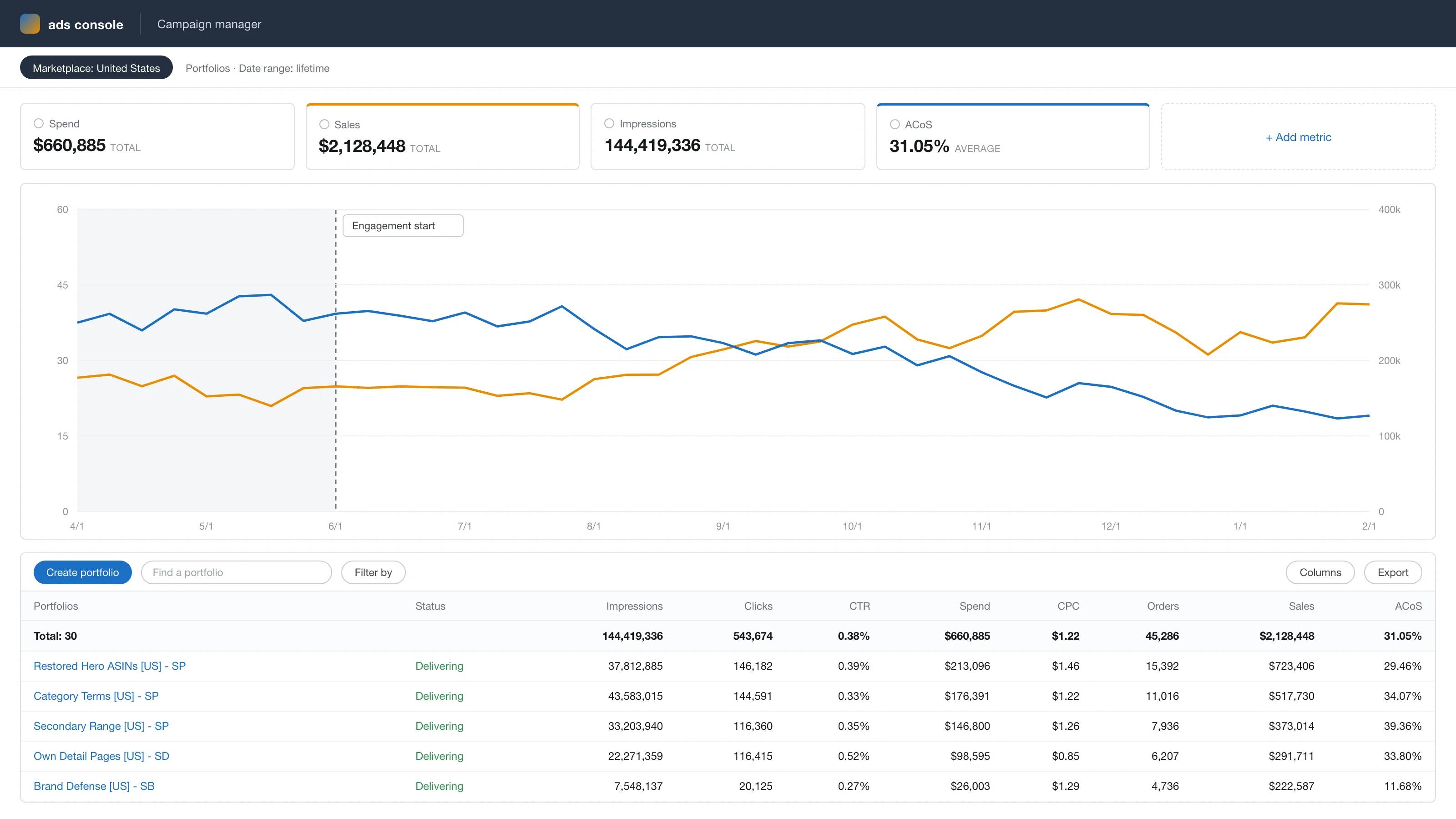
Anonymized account view, rebuilt from the figures reported above: ad sales growing from $158k to $269k a month while ACoS falls from 40% to 21% across the 8-month engagement.
The results
The featured offer went from present 43% of the time to 99%, and revenue grew 70% in eight months on the same traffic.
Conversion rose 71% for a reason that has nothing to do with persuasion: a listing without a buy button loses most shoppers at the moment they decide to buy, and no copy, image or bid can compensate. The advertising saving was immediate — $27k a month had been flowing into pages that could not complete a sale — but the larger gain is that the account stopped competing against its own discount codes.$
“Nine months of blaming Amazon for hiding our buy button. It was our own welcome discount, every single time.”
Related case studies




Ready to scale your Amazon brand?
Talk to a senior strategist and leave with a growth plan for your store — no obligation.